Yesterday
p. 97 · Read in the full issue
“Is Norfolk Island for New Zealand?” was one of the headlines in PIM 20 years ago. The Auckland Chamber of Commerce had requested the Associated Chambers at Welling ton to approach the NZ Government about the possibility of transferring sovereignty of Norfolk Island from Australia to NZ. PIM concurred, and said the transfer “might open a new economic era for Norfolk Island ” and give the island a good reliable market for its produce.
OTHER items in PIM, for July, 1947, included: DOUBLE Royal wedding cele brations in Nukualofa pre sented a marvellous chance for Tonga’s infamous escapee, Mahe, to escape from prison for the sixth time. By June 25 searchers hadn’t found a trace of him in all Tongatapu.
In one of his previous escapes, Mahe had stolen a boat in Nukua lofa, had wrecked it on a reef and had finally reached the Lau Group of Fiji in a dug-out canoe.
GOLD was starting to come out of New Guinea again. Bulolo Gold Dredging Ltd., had restarted dredging and had found gold worth $U5469,153. However, six other dredges were still out of action because of equipment delays from America.
COPIES of Eric Feldt’s book The Coast Watchers were advertised for 17/6. (The book is now a collector’s item and fetches about $2O on the secondhand market—NOT $20,000, as was inadvertently stated in PIM in May).
A Businessman, Mr. Tom
Flower, had started a sawmill 10 miles outside Port Moresby and had shipped 200,000 feet of Ilimo timber to Sydney. Another mill was under construction. Mr.
Flower hoped to begin shipping the much more valuable walnut timber to Australia.
Mr. Pierre Maestracci
had been appointed Gov ernor of French Oceania (now French Polynesia) to succeed Colonel Georges Orselli.
THERE was a plague of giant snails at Hansa Bay, New Guinea. Mr. E. J. Wauchope, of Madang, wrote: “They are dying here by the million—but for every one that passes out, hundreds more appear the reproduction rate appears to be enormous. The only consoling feature that I can see is that there is no housing problem in Hansa Bay for the kuka (land-crab). Snail-shells now provide him with countless ready-made houses”.
ORGANISED trade unions were on the way for Tahiti. Each profession had set up a separate
“syndicate” and the wharfies were divided under two leaders. PlM’s correspondent said there were no May Day parades by the new trade unions.
ABOUT 1,100 former residents of Niuafo’ou (Tonga’s “Tin Can” Island) were to be re settled on Eua, about 30 miles south-east of Tongatapu.
Niuafo’ou was almost devastated by a volcanic eruption in Sep tember, 1946, and most of the inhabitants had later been evacua ted to Tongatapu where they lived on Queen Salute’s estate in a temporary village called Mataliku.
LARGE numbers of natives from Malaita, BSIP, armed with spears and blow-pipes, were reported to have landed on Guadalcanal and threatened about 200 British settlers. The report said the natives were maddened because they had had to live on fish and coconuts for six months because supplies of flour and rice ran out. American airmen had brought the news to Townsville.
PLANS to spend £73,000 on a new hydro-electric scheme and £97,000 on new roads were to be put before the Western Samoan Legislative Council.
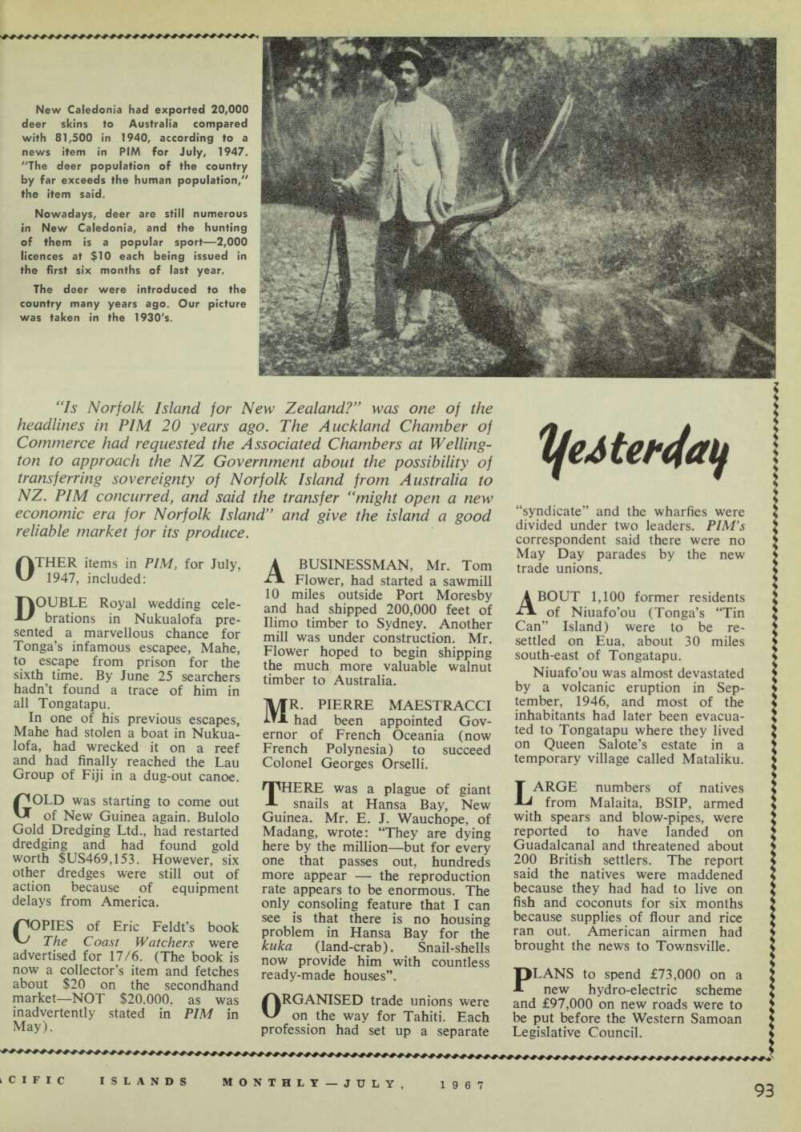
New Caledonia had exported 20,000 deer skins to Australia compared with 81,500 in 1940, according to a news item in PIM for July, 1947.
"The deer population of the country by far exceeds the human population," the item said.
Nowadays, deer are still numerous in New Caledonia, and the hunting of them is a popular sport —2,000 licences at $lO each being issued in the first six months of last year.
The deer were introduced to the country many years ago. Our picture was taken in the 1930's.