Rarotonga Floods
p. 79 · Read in the full issue
Food shortage may follow
Play Havoc With
Food Crops
From W. H. Percival
on Rarotonga Rarotonga may face a serious food shortage in a few months’ time because of serious losses of subsistence crops in two floods during May, the second of which came in the wake of a gale on the night of May 24.
THE gale, which also struck the southern islands of the Cook Group, came as a climax to months of unusually heavy rain.
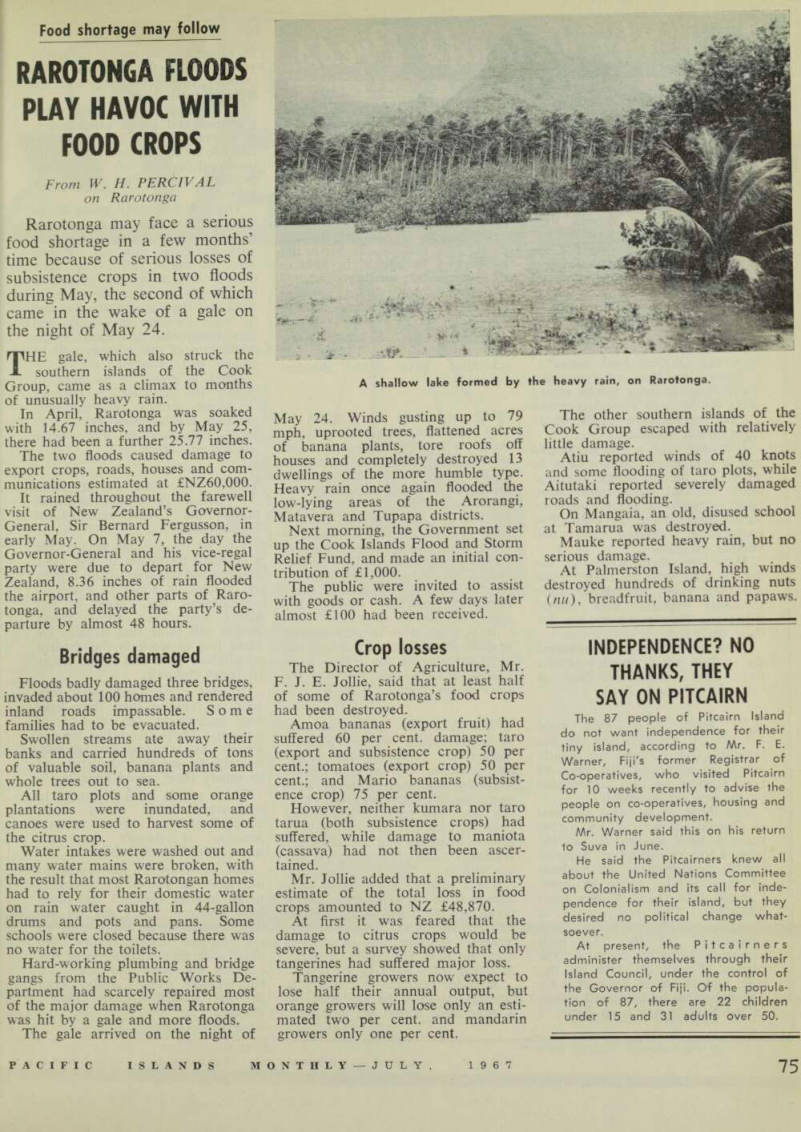
In April, Rarotonga was soaked with 14.67 inches, and by May 25, there had been a further 25.77 inches.
The two floods caused damage to export crops, roads, houses and com munications estimated at £NZ6O,OOO.
It rained throughout the farewell visit of New Zealand’s Governor- General, Sir Bernard Fergusson, in early May. On May 7, the day the Governor-General and his vice-regal party were due to depart for New Zealand, 8.36 inches of rain flooded the airport, and other parts of Raro tonga, and delayed the party’s de parture by almost 48 hours.
Bridges damaged
Floods badly damaged three bridges, invaded about 100 homes and rendered inland roads impassable. Some families had to be evacuated.
Swollen streams ate away their banks and carried hundreds of tons of valuable soil, banana plants and whole trees out to sea.
All taro plots and some orange plantations were inundated, and canoes were used to harvest some of the citrus crop.
Water intakes were washed out and many water mains were broken, with the result that most Rarotongan homes had to rely for their domestic water on rain water caught in 44-gallon drums and pots and pans. Some schools were closed because there was no water for the toilets.
Hard-working plumbing and bridge gangs from the Public Works De partment had scarcely repaired most of the major damage when Rarotonga was hit by a gale and more floods.
The gale arrived on the night of
May 24. Winds gusting up to 79 mph, uprooted trees, flattened acres of banana plants, tore roofs off houses and completely destroyed 13 dwellings of the more humble type.
Heavy rain once again flooded the low-lying areas of the Arorangi, Matavera and Tupapa districts.
Next morning, the Government set up the Cook Islands Flood and Storm Relief Fund, and made an initial con tribution of £l,OOO.
The public were invited to assist with goods or cash. A few days later almost £lOO had been received.
Crop losses
The Director of Agriculture, Mr.
F. J. E. Jollie, said that at least half of some of Rarotonga’s food crops had been destroyed.
Amoa bananas (export fruit) had suffered 60 per cent, damage; taro (export and subsistence crop) 50 per cent.; tomatoes (export crop) 50 per cent.; and Mario bananas (subsist ence crop) 75 per cent.
However, neither kumara nor taro tarua (both subsistence crops) had suffered, while damage to maniota (cassava) had not then been ascer tained.
Mr. Jollie added that a preliminary estimate of the total loss in food crops amounted to NZ £48,870.
At first it was feared that the damage to citrus crops would be severe, but a survey showed that only tangerines had suffered major loss.
Tangerine growers now expect to lose half their annual output, but orange growers will lose only an esti mated two per cent, and mandarin growers only one per cent.
The other southern islands of the Cook Group escaped with relatively little damage.
Atiu reported winds of 40 knots and some flooding of taro plots, while Aitutaki reported severely damaged roads and flooding.
On Mangaia, an old, disused school at Tamarua was destroyed.
Mauke reported heavy rain, but no serious damage.
At Palmerston Island, high winds destroyed hundreds of drinking nuts ( mi ), breadfruit, banana and papaws.
A shallow lake formed by the heavy rain, on Rarotonga.