Magic of Prince's Landing
p. 77 · Read in the full issue
By LEM A LOW, author of “Family in Fiji”
The handsome old Suva Post Office, which stood in the shade of a lovely flamboyant tree, has vanished into the leisured past. The big, shabby Suva Town Hall, with its wrought iron filigree lace trimmings and its ancient associations with early Suva, is doomed to extinction. The Central Buildings are but a vague memory.
EVEN the little shops in the back streets are being face-lifted beyond recognition, as slab-sided, efficient, modern buildings are rapidly taking the place of the wooden struc tures of earlier years, so reminiscent of pukka sahibs, beachcombers, Somerset Maugham plots and true tropical atmosphere.
With Suva’s present fever for demolition and rebuilding, it will soon be hard to find some genuine tropical atmosphere. Perhaps even a coconut palm may become a rarity, only to be found in the Botanical Gardens.
Yet for those who would like to recapture the old South Seas magic, there is still Prince’s Landing to stir the imagination with thoughts of the islands which lie on the misty horizon.
Old friends
Although the wharf has been re built, and there are rumours that more will be done to it, the authentic South Seas atmosphere remains.
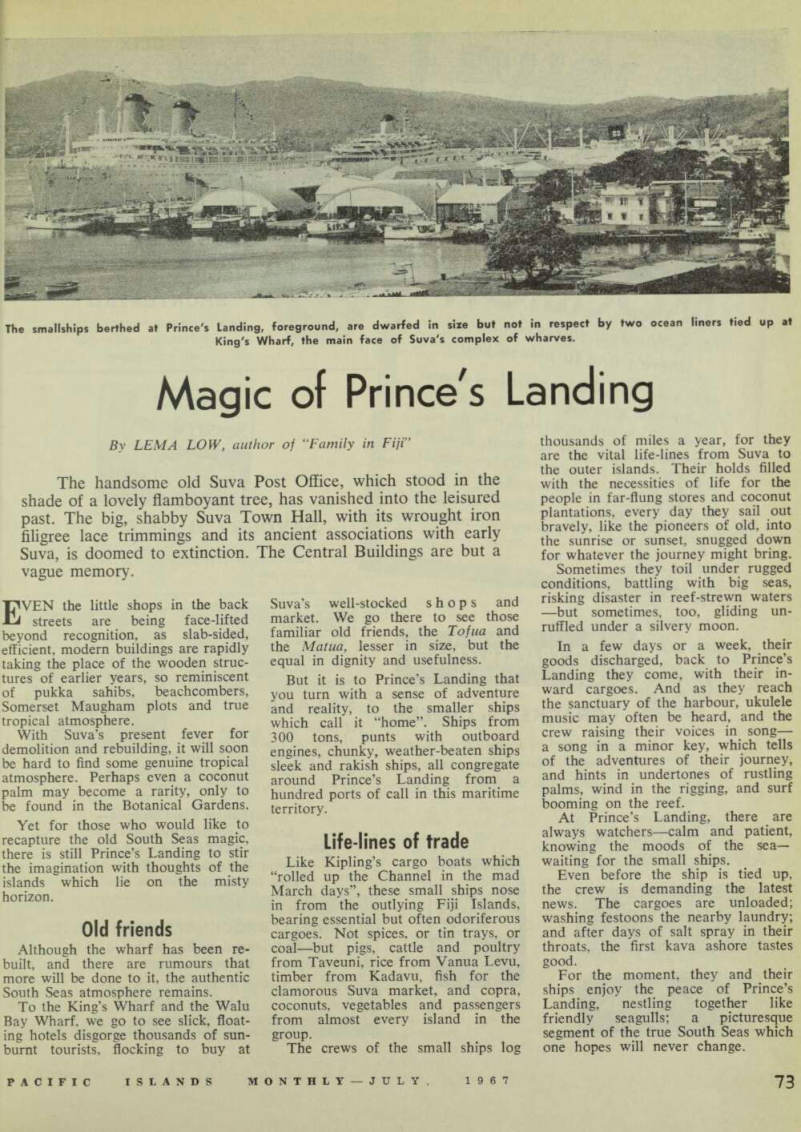
To the King’s Wharf and the Walu Bay Wharf, we go to see slick, float ing hotels disgorge thousands of sun burnt tourists, flocking to buy at
Suva’s well-stocked shops and market. We go there to see those familiar old friends, the Tofua and the Matua, lesser in size, but the equal in dignity and usefulness.
But it is to Prince’s Landing that you turn with a sense of adventure and reality, to the smaller ships which call it “home”. Ships from 300 tons, punts with outboard engines, chunky, weather-beaten ships sleek and rakish ships, all congregate around Prince’s Landing from a hundred ports of call in this maritime territory.
Life-lines of trade
Like Kipling’s cargo boats which “rolled up the Channel in the mad March days”, these small ships nose in from the outlying Fiji Islands, bearing essential but often odoriferous cargoes. Not spices, or tin trays, or coal—but pigs, cattle and poultry from Taveuni, rice from Vanua Levu, timber from Kadavu, fish for the clamorous Suva market, and copra, coconuts, vegetables and passengers from almost every island in the group.
The crews of the small ships log
thousands of miles a year, for they are the vital life-lines from Suva to the outer islands. Their holds filled with the necessities of life for the people in far-flung stores and coconut plantations, every day they sail out bravely, like the pioneers of old, into the sunrise or sunset, snugged down for whatever the journey might bring.
Sometimes they toil under rugged conditions, battling with big seas, risking disaster in reef-strewn waters —but sometimes, too, gliding un ruffled under a silvery moon.
In a few days or a week, their goods discharged, back to Prince’s Landing they come, with their in ward cargoes. And as they reach the sanctuary of the harbour, ukulele music may often be heard, and the crew raising their voices in song— a song in a minor key, which tells of the adventures of their journey, and hints in undertones of rustling palms, wind in the rigging, and surf booming on the reef.
At Prince’s Landing, there are always watchers —calm and patient, knowing the moods of the sea waiting for the small ships.
Even before the ship is tied up, the crew is demanding the latest news. The cargoes are unloaded; washing festoons the nearby laundry; and after days of salt spray in their throats, the first kava ashore tastes good.
For the moment, they and their ships enjoy the peace of Prince’s Landing, nestling together like friendly seagulls; a picturesque segment of the true South Seas which one hopes will never change.
The smallships berthed at Prince's Landing, foreground, are dwarfed in size but not in respect by two ocean liners tied up at King's Wharf, the main face of Suva's complex of wharves.