lessons for Fiji, New Guinea
pp. 28-29 · Read in the full issue
When ill-equipped minds shouldered the white man's burden . . . lessons for Fiji, New Guinea in story of emerging Samoa
Reviewed by STUART INDER In an emerging territory one of the great difficulties be setting its colonial rulers is to know when internal agitation for political progress is a genuine reflection of local thinking, and when merely the mouthings of minor dissentients.
THE local administration, which most certainly will be dominated by expatriates, needs an efficient and sympathetic intelligence system, and sensitive and sincere public servants able to make proper use of what they find. Even the most immaculate of colonial policies will misfire if the expatriates who are administering it on the spot, and the public servants back in the centre of metropolitan government, have not the intellectual capacity to really understand what is happening.
In his book on the emergence of the independent state of Western Samoa, Samoa mo Samoa (“Samoa for the Samoans”), Professor J. W.
Davidson, Professor of Pacific History at the Australian National University, shows how badly Samoa suffered at the hands of brash and uncouth New Zealand officials oyer a great many years, and how mis handling by a succession of local administrators and expatriate public servants delayed Samoan indepen dence and caused ill-feeling which may still be found in Samoa.
Professor Davidson’s consciousness of the poor quality of expatriate officers does in fact dominate his 500-page history of Western Samoa; but what he has to say is a timely lesson, relevant to present-day de velopments in Pacific territories, par ticularly New Guinea and Fiji.
Modern colonialism
As a first-rate study of the prob lems of modern colonialism in the Pacific, Samoa mo Samoa is a valu able book for anyone working or living in the South Seas. But for Samoa in particular Professor David son, already celebrated as a main architect of the Samoan constitution, has done that country a further erudite service for which the Samoans will have cause to be grateful while history books are still read there; for this is a record of the impact of the
West on Samoa, from 1830 to inde pendence in 1962. A big portion of the book is a detailed account of the behind-the-scenes moves since 1946, in which Davidson himself was closely involved.
This is not to say that his interpre tation of events, especially in that critical period from the end of World War I to the beginning of World War 11, will be accepted in its entirety. His documentation is prodigious and exhaustive, but he himself points out that his position on Samoa has often been that of “a passionate partisan”, and that the “after-glow of past political involve ment has no doubt affected my pre sentation of events”.
Mau troubles
As a true historian he merely im plies that he has done as well as he could (and that is very well indeed) and that others should write their interpretation of the years, because a definitive history “can only be written through the process of pro gressive approximation”.
For me, there is some approxima tion to be found in Professor David son’s interpretation of the official mind during the Mau troubles in the 19205. (The word Mau means testi mony, and used in the sense of a Samoan political movement it means opposition party.) The aspirations of the Mau came to a crisis on “Black Saturday”, December 28, 1929, when a Mau procession in Apia was fired on by the police, and 11 Samoans, nearly all holding important matai titles, were killed or died later from in juries. The Mau was soon afterwards declared a seditious organisation and its members took to the bush.
By 1929 the Mau represented a reassertion of Samoan traditionalism, and by then, Professor Davidson says, it was the dominant factor in the country. The expatriate officers
had believed that the growing agr tion was merely a storm in a teaci whipped up by “agitators” like Nels and Smyth. Professor Davidson is course critical of this attitude, and certainly proves his contention, frc documentary files; that the N< Zealanders in charge were inept a insensitive.
But although he is aware of th< I doubt if he always gives enou weight to the difficulties faced officials at this, and later tim Allowing for the inadequacies of 1 New Zealand public servants, Samo desires and attitudes surely were i always as clear as Professor Dav son’s account implies.
Stimulating
While it is unfair to accuse 1 author of taking advantage of hu sight—he is too experienced an 1: torian for that—his obvious sy pathies for the Samoans perh; carry him further than they shou and thus we are given the impress] that after 1900, the Samoans wi continuously being sinned against completely insensitive idiots a bullies as they struggled for reci nition in a difficult world.
He does, as he himself says, Samoan society in a clear light a not in false colours; his difficu may be that because of this he is ] able to see the colonialists quite sympathetically. There was, after ; a cultural clash too.
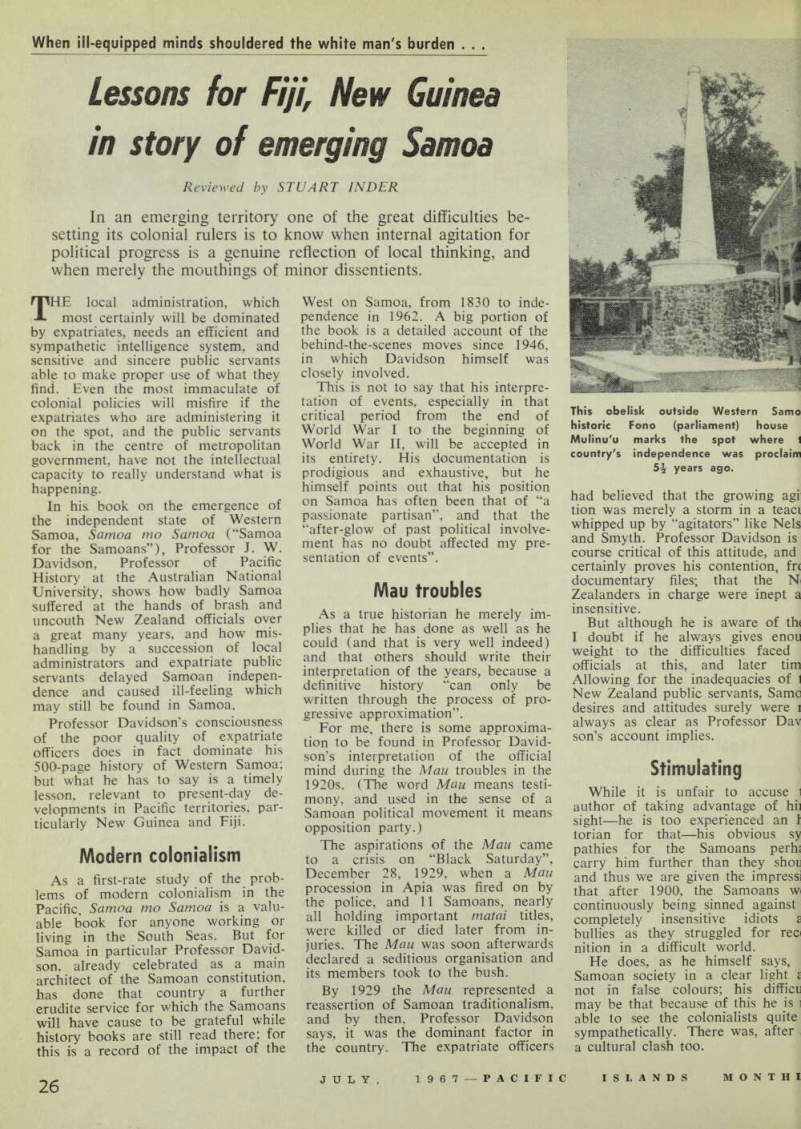
This obelisk outside Western Samoa
historic Fono (parliament) house [?]
Mulinu'u marks the spot where t[?]
country's independence was proclaim
5½ years ago.
But one must be careful not to verstress what is merely my own iterpretation of Professor Davidson’s iterpretation. He gives us facts lough to form different opinions we want them, and here is a book ill of stimulating thought.
He explains how constitutional re >rms in dependencies always lack jrmanency; their success being icasured only by whether they pro de a workable sytsem of govern icnt for the time being, and also ave the way open for a further ivance towards independence, in rnal self-government or incorpora on in some larger political unit, ny reforms will quickly be exposed ► criticism, because by providing iportunities for more political ex ;rience they stimulate demands for irther reforms.
He adds, pointedly: “Indeed, :quiescence in the status quo is in self a sign of failure—and of future mger. It most frequently indicates -for example, in colonies (such as iji) where internal divisions have ;en constitutionally recognised and icouraged—that a solution to jlitical problems may eventually be tught through non - constitutional lannels.”
Public Service dangers
Samoa’s experience gives fair arning of how local officers any bere may be expected to react to ediocre expatriates, brought in on •od salaries with fringe benefits such inexpensive government housing, any Samoan junior officials, in the ne Davidson was working in the rvernment, believed that the conded officers would stick together :cause of what they had in common, imoan officers who feared they ight have to shoulder the blame r the errors of their senior expat ite officers gave up rather than ;ht.
The book stresses the dangers of a blic service, such as that consti ted in Samoa in 1949, staffed by ople with wide powers and bureau atic minds. Because of it, Samoa is forced to go forth to indepen nce with an inadequately trained rps of local officers, and there are ecial lessons in this for New ainea.
How familiar, for instance, is his scription of the post-war Public rvice in Samoa. “It was,” he says, n the whole, ill-qualified for the >ks it had to undertake. Before the ir an attempt had been made to :ruit a few university graduates for ministrative service in Samoa; but ose who were actually appointed d found little scope for their talents a service dominated by men of
different background, and resigned.
Samoa had continued to be dependent for its administrative staff on men seconded from the ordinary ranks of the New Zealand Public Service.
“A few of these, indeed, had re sponded to their opportunities and served Samoa with intelligence and sensitivity: they had found their re ward in the respect of the local people, if not always in official approval. But many had lived in Samoa for years without learning anything of importance about the country or the people, having few contacts beyond expatriate circles, and looking forward to the time when they would return to New Zealand suburbs that they looked on as home.
“Many had found a basis for self esteem in the expression of contempt for all Samoans. A few—even more conscious of their worth—had seen themselves as martyrs rendering self less service to an ungrateful people.
Official weaknesses
“One or two had set themselves up as experts in things Samoa, like guests correcting their hosts from a manual of etiquette. None of these men had served in positions of real administrative responsibility outside the New Zealand island territories; few knew—or seemed much to care —about the solution of problems similar to Samoa’s in other parts of the world; their notions of policy and of administration were largely limited to what they had picked up in their own small realm, a construct of red tape and their own illusions.”
Other expatriates will be interested too in Davidson’s summing up of the difficulties of official members in a colonial legislature. Such men are in a difficult position, he says, be cause at best they are seen by the elected members as advocates of a cause that is not their own, and at worst as marionettes who merely rise to vote at their master’s call.
One of their special weaknesses is that because they are not politicians by training or inclination, they tend
to present facts baldly, and avoid relating them to the broad issues of policy which interest elected mem bers.
The personal picture that emerges of Professor Davidson on the job as an official member in Samoa is at times fascinating. Because, he says, he spoke to the Samoans in the Assembly with sympathy, not with condescension, and spoke of co operation and not of the white man’s burden, his own position began to diverge from that of his official colleagues.
He tells how on one occasion he referred, in the Assembly, to the nominal rents charged expatriates for housing as “constituting a concealed increment” to their salaries; and for a long time afterwards, in all sorts of out-of-the-way places, he was regarded by the Samoans with new respect. Since German times the Samoans had been critical of the privileges enjoyed by expatriate officials, and now here was an ex patriate talking about it.
Professor Davidson makes many exceptions in his general criticism of the quality of expatriates—and in particular Sir Guy Powles and Mr.
J. B. Wright. Of Wright, Davidson says that although his background was little broader than that of many others who came from New Zealand, he was a man “with an unusually keen and critical mind; one who was never content to consider only the superficial symptoms of a deep-seated disorder, but sought for its basic cause”.
Samoa mo Samoa makes it clear just how many men of this type are needed in the South Pacific, and how few of them have been available under the Australian and New Zealand system of expecting ill equipped minds to shoulder the white man’s burden—to the despair and anger of the black and brown man.
As one educated Samoan said, “We didn’t meet people like these back in Auckland”. (SAMOA MO SAMOA. Oxford University Press. $9.75.)
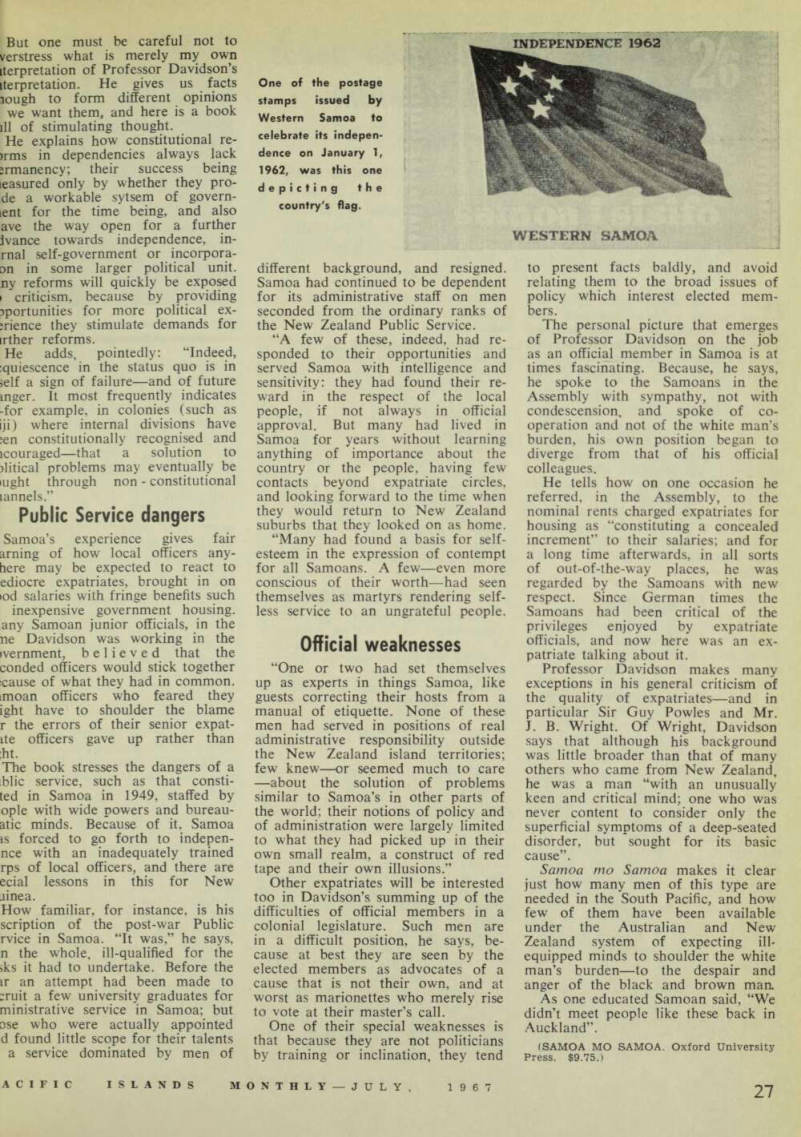
One of the postage stamps issued by Western Samoa to celebrate its indepen dence on January 1, 1962, was this one depicting the country's flag.