friends) won the day
pp. 25-149 · Read in the full issue
Home, $Weet Home!
How the Head Chief (and friends) won the day
By Stuart Inder
With the ownership of Nauru’s phosphate deposits safely signed over to them, the 3,000 Nauruans now look like becom ing the world’s littlest nation on January 31 next year.
N agreement enabling the L Nauruans to buy the assets of ; British Phosphate Commissioners mstralia, NZ and Britain) was ;ned in a formal but friendly cere my in Canberra on June 15 (see :ture p. 117).
The purchase of the assets will be ide over three years from July 1, 67, at a cost of about $2O million.
The only major point still to be tied by the BPC powers and the mruans is the type of association : new Nauru will continue to have th Australia after independence. :>st probably Australia will take an erest in Nauru’s defence and ex nal affairs through a treaty of mdship .
Nauru’s Head Chief Hammer Roburt is not averse to an ar igement of this kind so long as lependence is granted first and the aty negotiated afterwards. He ows from practical experience in )rld War II that in time of war body takes much notice of scraps paper.
And defence and external affairs I be fairly minor matters for iuru in the next few years, for re are more complex problems in ablishing independence.
Behind the success
however these and other details worked out, little Nauru owes big success in a very big world the leadership of Deßoburt and ability to get people working for i. His victory is the result of his ion, and his personal qualities of verity and honesty, which have racted to him a wide team of >erts in the last few years.
Deßoburt is a man who is harder his friends than his enemies (and o expects his friends to be just as d on him). Working for him, d or unpaid, is an experience only the dedicated. Deßoburt thinks hing of 3 a.m. meetings when the
pressure is on, and will move from Melbourne to Canberra to Sydney and back to Melbourne in the course of a day.
He has made frequent trips to the UN in New York, and has spent long periods away from Nauru in his fight for recognition for Nauru. He is as tenacious as a bulldog, with a strong sense of the “rightness” of things.
Lone battle
The people he has leaned on most are Dr. Helen Hughes, senior re search fellow with the Department of Economics at the Australian National University, Canberra; Sydney economic consultants Philip Shrapnel and Ken Walker; Professor I. W.
Davidson, Professor of Pacific History at the Australian National University; and publicist Keith Madden, an account executive of the public relations firm of Eric White Associates.
Until 1964 Deßoburt fought virtu ally a lone battle in his request for phosphate ownership and indepen-
dence. He was not taken very seriously in Canberra. He was pre vented from making his position public by a form of mild blackmail from the Department of Territories, some of whose officials insisted that the Nauruans could put their case only through official channels if they expected it to be heard. They were not permitted outside advisers at their conferences with the department.
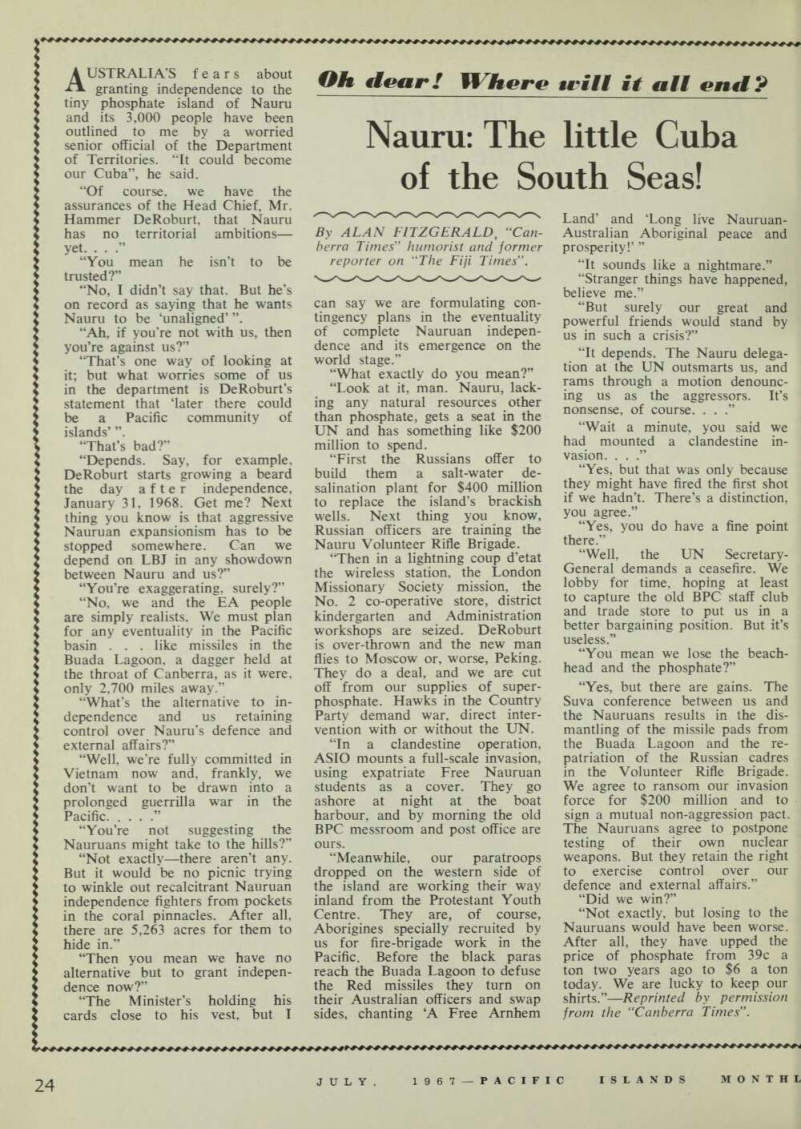
But there were personnel changes in the department, and in addition, in 1964, the Nauruans were allowed their first adviser at the conference table—Dr. Hughes. Now aged 38, she is a former economics consultant in private practice in Melbourne. She was recommended to the Nauruans by the Australian Council of Trade Unions.
The ACTU had earlier taken an interest in the Nauruan request for a basic wage and a Sydney union advocate, Bill Baker, had gone to Nauru to fight, successfully, for this.
Baker had seen that the Nauruans needed professional help if they were to fight the BPC for a fair cut of the phosphate proceeds.
Dr. Hughes decided that facts were wanted on the differences between the costs of production of phosphate on Nauru and the world price. The difficulty was that the BPC was un able to say what the world price was, and its own phosphate economics were so mixed up with those of Christmas Island and Ocean Island that it seemed an impossible task to get an accurate picture. The BPC
(Continued on p. 143)
Dr. Helen Hughes.
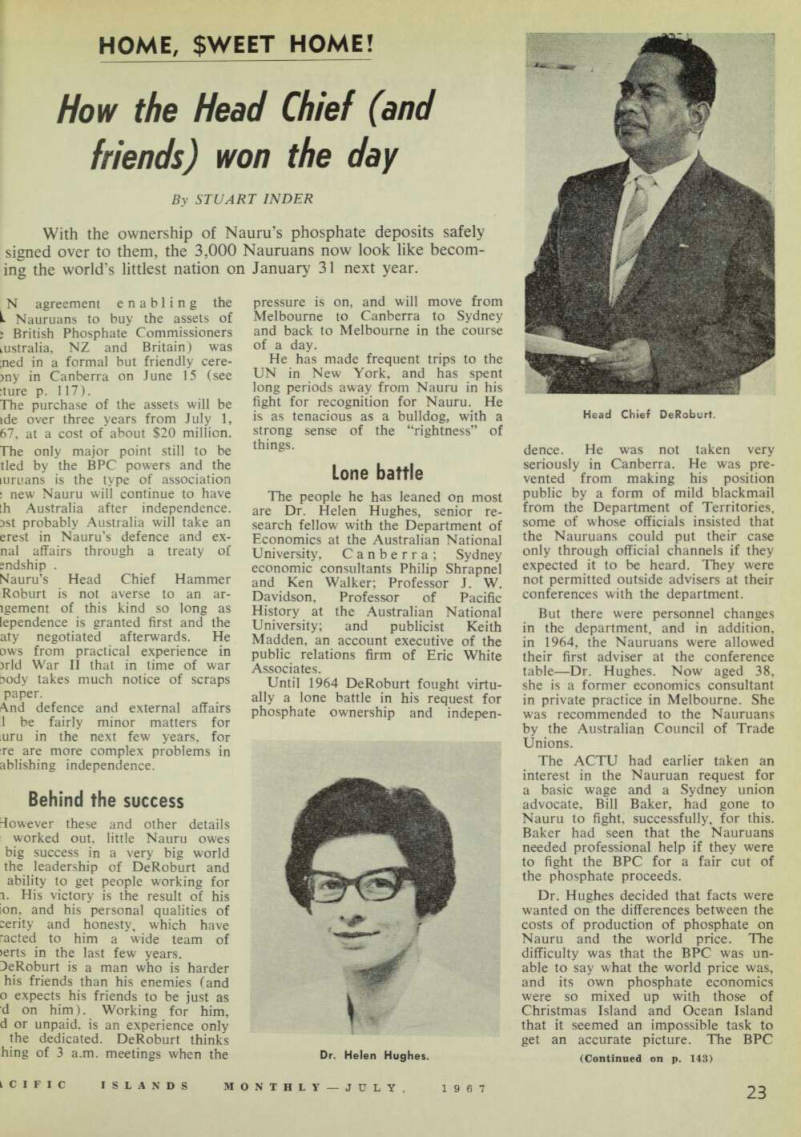
Head Chief DeRoburt.
is not co-operative in helping any dy get an accurate picture.
Dr. Hughes was able to show for i first time that there was such a ng as a world price. She pub tied her findings in a paper in the urnal of the Economic Society of istralia and New Zealand, in :cember, 1964.
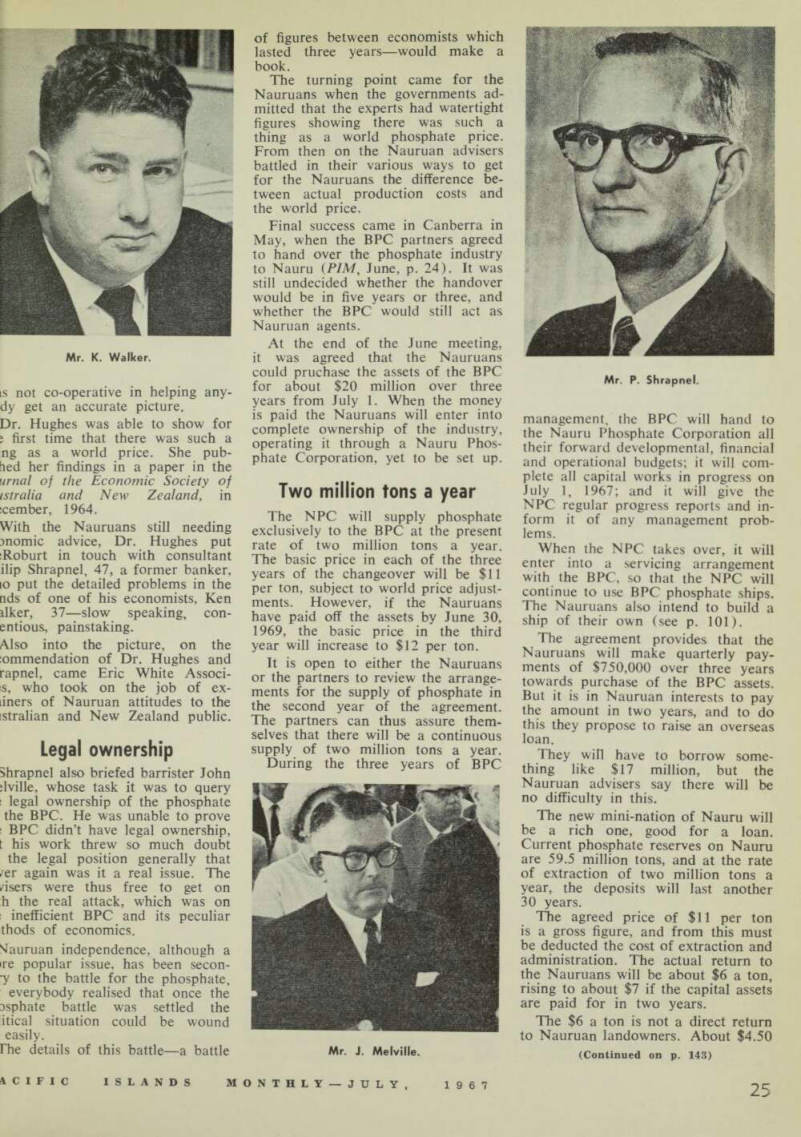
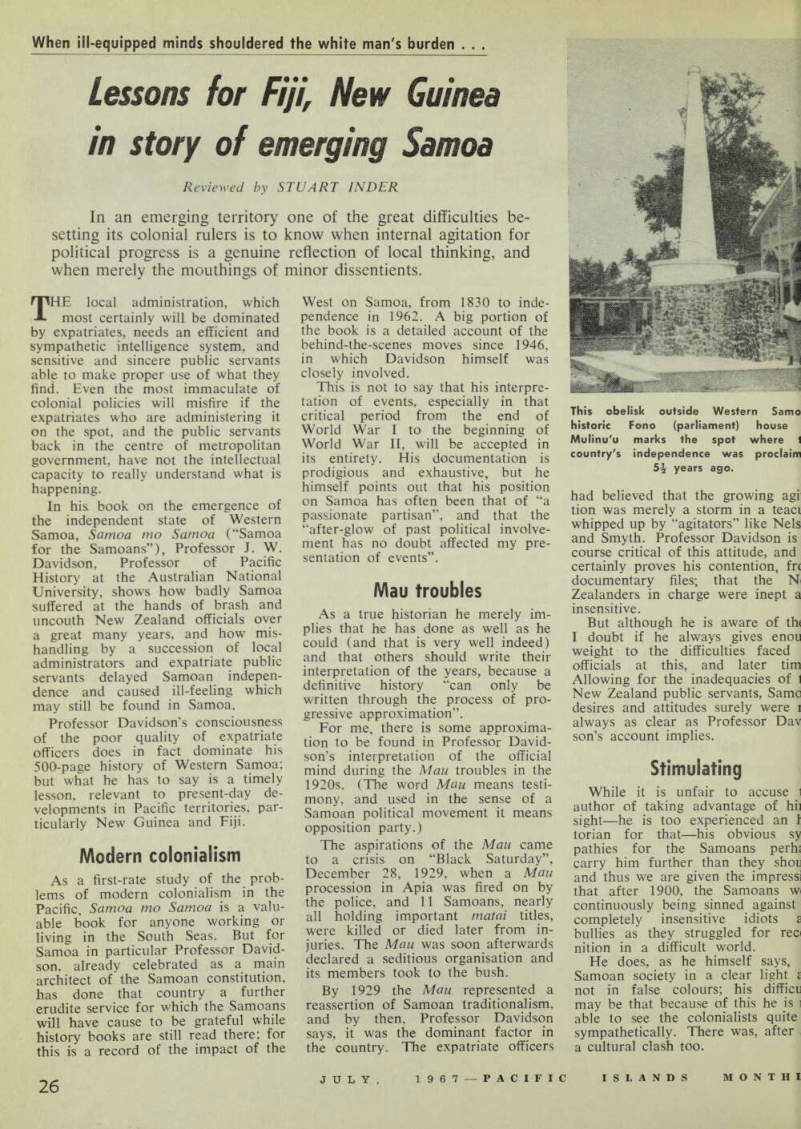
With the Nauruans still needing Dnomic advice, Dr. Hughes put ißoburt in touch with consultant ilip Shrapnel, 47, a former banker, 10 put the detailed problems in the nds of one of his economists, Ken ilker, 37—slow speaking, con entious, painstaking.
Also into the picture, on the :ommendation of Dr. Hughes and rapnel, came Eric White Associ s, who took on the job of ex tiners of Nauruan attitudes to the istralian and New Zealand public.
Legal ownership
Shrapnel also briefed barrister John dville, whose task it was to query ! legal ownership of the phosphate the BPC. He was unable to prove ; BPC didn’t have legal ownership, t his work threw so much doubt the legal position generally that /er again was it a real issue. The /isers were thus free to get on h the real attack, which was on ; inefficient BPC and its peculiar thods of economics.
Nauruan independence, although a •re popular issue, has been secon -7 to the battle for the phosphate, everybody realised that once the Dsphate battle was settled the ideal situation could be wound easily.
Phe details of this battle—a battle
of figures between economists which lasted three years—would make a book.
The turning point came for the Nauruans when the governments ad mitted that the experts had watertight figures showing there was such a thing as a world phosphate price.
From then on the Nauruan advisers battled in their various ways to get for the Nauruans the difference be tween actual production costs and the world price.
Final success came in Canberra in May, when the BPC partners agreed to hand over the phosphate industry to Nauru ( PIM , June, p. 24). It was still undecided whether the handover would be in five years or three, and whether the BPC would still act as Nauruan agents.
At the end of the June meeting, it was agreed that the Nauruans could pruchase the assets of the BPC for about $2O million over three years from July 1. When the money is paid the Nauruans will enter into complete ownership of the industry, operating it through a Nauru Phos phate Corporation, yet to be set up.
Two million tons a year
The NPC will supply phosphate exclusively to the BPC at the present rate of two million tons a year.
The basic price in each of the three years of the changeover will be $ll per ton, subject to world price adjust ments. However, if the Nauruans have paid off the assets by June 30, 1969, the basic price in the third year will increase to $l2 per ton.
It is open to either the Nauruans or the partners to review the arrange ments for the supply of phosphate in the second year of the agreement.
The partners can thus assure them selves that there will be a continuous supply of two million tons a year.
During the three years of BPC
management, the BPC will hand to the Nauru Phosphate Corporation all their forward developmental, financial and operational budgets; it will com plete all capital works in progress on July 1, 1967; and it will give the NPC regular progress reports and in form it of any management prob lems.
When the NPC takes over, it will enter into a servicing arrangement with the BPC, so that the NPC will continue to use BPC phosphate ships.
The Nauruans also intend to build a ship of their own (see p. 101).
The agreement provides that the Nauruans will make quarterly pay ments of $750,000 over three years towards purchase of the BPC assets.
But it is in Nauruan interests to pay the amount in two years, and to do this they propose to raise an overseas loan.
They will have to borrow some thing like $l7 million, but the Nauruan advisers say there will be no difficulty in this.
The new mini-nation of Nauru will be a rich one, good for a loan.
Current phosphate reserves on Nauru are 59.5 million tons, and at the rate of extraction of two million tons a year, the deposits will last another 30 years.
The agreed price of $ll per ton is a gross figure, and from this must be deducted the cost of extraction and administration. The actual return to the Nauruans will be about $6 a ton, rising to about $7 if the capital assets are paid for in two years.
The $6 a ton is not a direct return to Nauruan landowners. About $4.50
(Continued on p. 143)
Mr. K. Walker.
Mr. J. Melville.
Mr. P. Shrapnel.
(Continued from P . 25) the sum will be paid into a specific id which will cover long-term in- Btments, development of alternative lustries and housing, and give rems to landowners. The largest lount will be set aside for the ig-term investment fund which [mot be used until the phosphate posits are exhausted. The retinder of the $6 will go towards ying off the BPC assets.
This $6 windfall compares with the .75 a ton which the Nauruans have »n getting recently as phosphate The June meeting agreed to rease this royalty for the final it, to June 30, 1967, to $4.50 a i—a figure which Head Chief immer Deßoburt had held out for, ;n against advice.
Fhe only point in the long phosate battle which the Nauruans did t win was the matter of rehabilitan of the one-third of Nauru which > been worked out. The Nauruans J asked the partners to pay for : cost of importing soil to fill, but s now appears to be a dead letter. 3n independence the full issues are t yet settled.
Fhe partners in Canberra in June ; two proposals to the Nauruans, :h friendly, sound, and shrewdly
designed to prove to the Nauruans big B brother. ° They first pro posed internal self-governmen t, P with Australia responsible for external affairs and defence the right G f Nauruans’ entry to Australia and promise of all kinds of other help if needed.
A system of government through committees of the legislature could replace the proposed Nauruan presidential system, with the Assembly acting bo [ h a s executive and legislative bodv.
independence Only, TMankS
An example of the shrewdness of this proposal was an oblique reference to the recent phosphate strike on Nauru, which had Red links ( PIM , June, p. 25). The proposal slyly pointed out that the “occasion may arise when the Nauruan Government might wish to seek assistance in maintaining law and order”—e.g., to control internal civil disorders which might arise from the migrant labour force [of Chinese and Gilbert and Ellice islanders]. The normal work force in the phosphate industry, apart from the Nauruans and Europeans, is about 1,600 adult males; the present establishment of the Police Force is
57, and the number of adult male Nauruans is fewer than 600. There are, in very recent history, indica tions of the difficulties which the Nauru Police Force might expect to encounter if determined action were taken by a substantial body of migrant labour. The partner govern ments suggest that the Nauruan dele gation should give careful considera tion to how they would contemplate a Nauruan Government would deal with such a situation.
But the Nauruans politely sniffed at internal self-government, so the second proposal was placed on the meeting table at the last minute. It was the ace up the partners’ sleeve.
The proposal said archly: “Another possibility would be for Nauru to be accorded full independence and make a Treaty of Friendship with Australia under which responsibility for foreign affairs and defence of Nauru would devolve upon Australia . . . Under this proposal it would be possible to give effect to most of the general constitutional proposals put forward by the Nauruan dele gation.”
And this was the position in late June as Deßoburt went off to talk at the UN Trusteeship Council, which twice already has supported the Nauruan demand for full indepen dence by January 31.
The partners’ ace looks like win ning.