To The Point
pp. 63-65 · Read in the full issue
Long journey from bitterness through hope, to what?
With
Percy
Chatterton
Not long after I came to Port Moresby, I found myself involved in the organisation of a concert in aid of some charitable cause; I’ve forgotten now what it was. The concert was given in what was known as the Port Moresby Institute, even then a far-from-new structure and now, under its post-war name of the Arts Theatre, something of an ancient monument.
)ME of the items in this concert were given by Europeans and ic by Papuans, and among the er was a dramatic sketch by a up of young men from Hanua a. This item was prepared behind >ed doors, and we did not know it to expect until the actors took stage. t turned out to be a burlesque of ourt scene. Magistrate, police, in ireters, witnesses and accused were there.
'he dialogue was in English, be se, contrary to the belief of many sent-day members of the staff of Education Department, the world not begin in 1946. Even in the o’s some mission schools were :hing their pupils a modicum of »lish. )f course, language laboratories n’t been invented, teaching hods were crude as compared with elaborate techniques for teaching »lish as a foreign language which e been worked out during the last ade, and opportunities for pupils practise their English outside the ;s-room were almost nil. So in ably the standard reached was not ti.
The vigour of it!
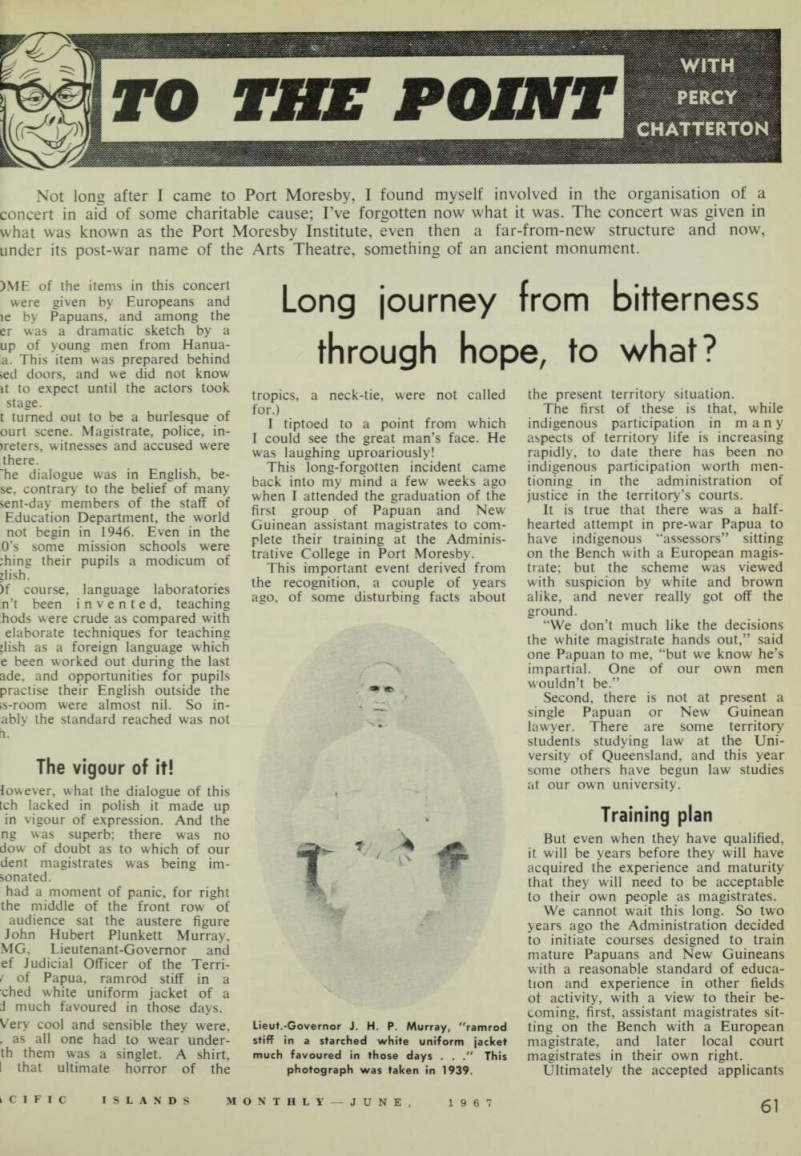
lowever, what the dialogue of this tch lacked in polish it made up in vigour of expression. And the ng was superb; there was no dow of doubt as to which of our dent magistrates was being im sonated. had a moment of panic, for right the middle of the front row of audience sat the austere figure John Hubert Plunkett Murray, MG. Lieutenant-Governor and ef Judicial Officer of the Terri / of Papua, ramrod stiff in a ched white uniform jacket of a d much favoured in those days.
Very cool and sensible they were, , as all one had to wear under th them was a singlet. A shirt, I that ultimate horror of the
tropics, a neck-tie, were not called for.) I tiptoed to a point from which I could see the great man’s face. He was laughing uproariously!
This long-forgotten incident came back into my mind a few weeks ago when I attended the graduation of the first group of Papuan and New Guinean assistant magistrates to com plete their training at the Adminis trative College in Port Moresby.
This important event derived from the recognition, a couple of years ago, of some disturbing facts about
the present territory situation.
The first of these is that, while indigenous participation in many aspects of territory life is increasing rapidly, to date there has been no indigenous participation worth men tioning in the administration of justice in the territory’s courts.
It is true that there was a half hearted attempt in pre-war Papua to have indigenous “assessors” sitting on the Bench with a European magis trate; but the scheme was viewed with suspicion by white and brown alike, and never really got off the ground.
“We don’t much like the decisions the white magistrate hands out,” said one Papuan to me, “but we know he’s impartial. One of our own men wouldn’t be.”
Second, there is not at present a single Papuan or New Guinean lawyer. There are some territory students studying law at the Uni versity of Queensland, and this year some others have begun law studies at our own university.
Training plan
But even when they have qualified, it will be years before they will have acquired the experience and maturity that they will need to be acceptable to their own people as magistrates.
We cannot wait this long. So two years ago the Administration decided to initiate courses designed to train mature Papuans and New Guineans with a reasonable standard of educa tion and experience in other fields of activity, with a view to their be coming, first, assistant magistrates sit ting on the Bench with a European magistrate, and later local court magistrates in their own right.
Ultimately the accepted applicants
Lieut.-Governor J. H. P. Murray, "ramrod stiff in a starched white uniform jacket much favoured in those days . . ." This photograph was taken in 1939.
were divided into two groups, an older group to take a one-year course, and a younger, though nevertheless mature, group to take a two-year course.
It was the graduates from the former of these two courses, mostly men in their forties, who received their certificates of appointment on April 28. The course of training they had undergone was a practical one, which concentrated on those parts of the territory’s laws which they v.'ould be competent, and likely to be called upon, to administer in a local court.
Prototype court house
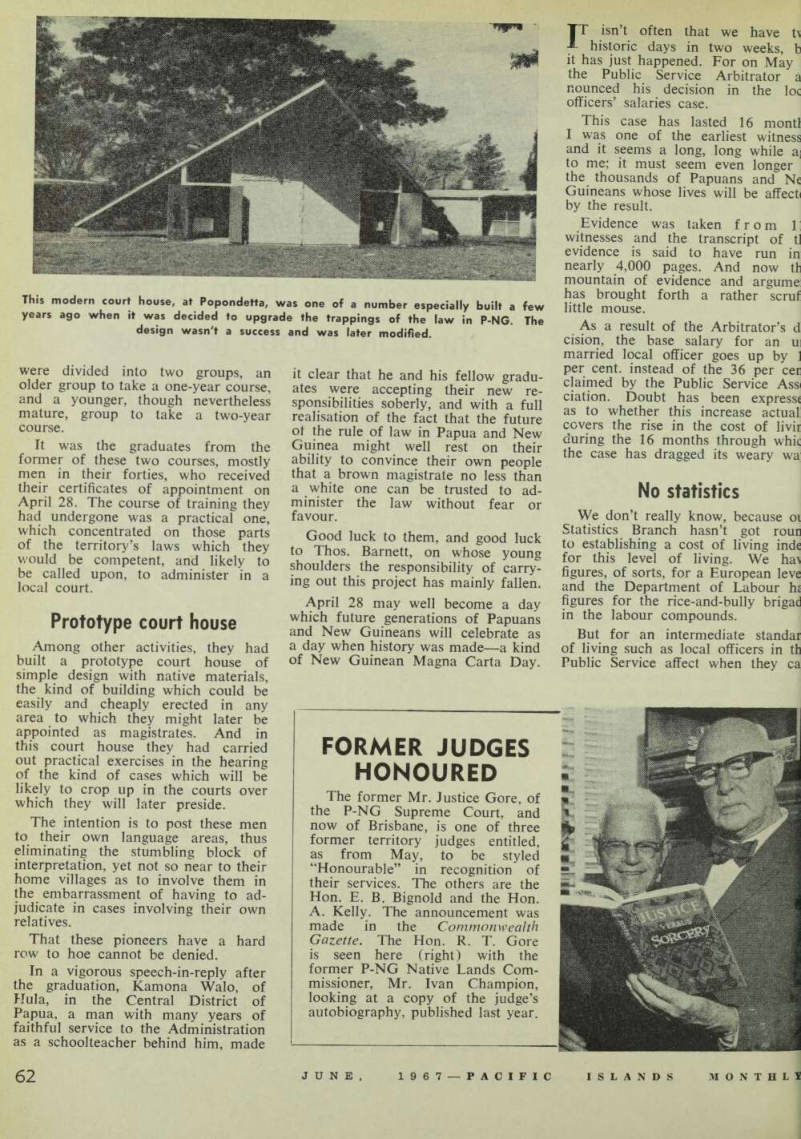
Among other activities, they had built a prototype court house of simple design with native materials, the kind of building which could be easily and cheaply erected in any area to which they might later be appointed as magistrates. And in this court house they had carried out practical exercises in the hearing of the kind of cases which will be likely to crop up in the courts over which they will later preside.
The intention is to post these men to their own language areas, thus eliminating the stumbling block of interpretation, yet not so near to their home villages as to involve them in the embarrassment of having to ad judicate in cases involving their own relatives.
That these pioneers have a hard row to hoe cannot be denied.
In a vigorous speech-in-reply after the graduation, Kamona Walo, of Hula, in the Central District of Papua, a man with many years of faithful service to the Administration as a schoolteacher behind him, made
it clear that he and his fellow gradu ates were accepting their new re sponsibilities soberly, and with a full realisation of the fact that the future of the rule of law in Papua and New Guinea might well rest on their ability to convince their own people that a brown magistrate no less than a white one can be trusted to ad minister the law without fear or favour.
Good luck to them, and good luck to Thos. Barnett, on whose young shoulders the responsibility of carry ing out this project has mainly fallen.
April 28 may well become a day which future generations of Papuans and New Guineans will celebrate as a day when history was made—a kind of New Guinean Magna Carta Day.
IT isn’t often that we have t\ historic days in two weeks, b it has just happened. For on May the Public Service Arbitrator a nounced his decision in the loc officers’ salaries case.
This case has lasted 16 montl I was one of the earliest witness and it seems a long, long while aj to me; it must seem even longer the thousands of Papuans and Ne Guineans whose lives will be affecb by the result.
Evidence was taken from 1; witnesses and the transcript of tl evidence is said to have run in nearly 4,000 pages. And now th mountain of evidence and argume has brought forth a rather scruf little mouse.
As a result of the Arbitrator’s d cision, the base salary for an ui married local officer goes up by 1 per cent, instead of the 36 per cer claimed by the Public Service Assi ciation. Doubt has been expresse as to whether this increase actual covers the rise in the cost of livir during the 16 months through whic the case has dragged its weary wa;
No statistics
We don’t really know, because oi Statistics Branch hasn’t got roun to establishing a cost of living inde for this level of living. We ha\ figures, of sorts, for a European leve and the Department of Labour hz figures for the rice-and-bully brigad in the labour compounds.
But for an intermediate standar of living such as local officers in th Public Service affect when they ca
This modern court house, at Popondetta, was one of a number especially built a few years ago when it was decided to upgrade the trappings of the law in P-NG. The design wasn't a success and was later modified.
rd it, we just haven’t got any res. But it seems clear that any improvement in the lot of these 3S at base level will be negligible. he family needs allowances are tay put at their present level. One he most sensible things which the ministration has done in years was introduction, in July, 1966, of a e structure made up of basic (un ried) salary plus family needs wance, the latter varying from e to place in the territory accord to the cost of living. his was an excellent idea, but the 1 of the allowances was certainly the low side. r the Arbitrator had upped these it, the smallness of the increase ;he base salary would not have i quite such a bitter pill to How. gainst this background the gener conditions made to salary rates positions to which it is unlikely local officers will be appointed a long time to come ring rather ow. fas this journey from bitterness ugh hope to anti-climax really sssary?
lot enough investigation
[ow much better it would have i if the Administration had itself ertaken a more thorough investi on into all the factors involved >re determining that ill-fated ry scale which was made public September 10, 1964 —“Black rsday”, as one very senior over public servant called it. [ow much better it would have i if, when the storm broke, the ministration had been willing to Dtiate, instead of standing pat in tided dignity until, too late to stem tide of arbitration, it introduced more liberal scale of July, 1966. .s it is, this unhappy first experi i of the arbitration system will T serve to prejudice Papuans and v Guineans against it, and make it kely that it will be one of the ures of the Australian way of life :h an independent New Guinea want to adopt.
Wider question
l wider question poses itself. ; the system under which legal ffitioners are paid very large sums loney to play a game of advocatory »s, with the witnesses as the pawns pieces, before a distinguished ex er who sees through the gambits, only way in which the rule of can be maintained and impartial
judgments reached? Is it a practic able way for a non-affluent society?
A poet has said that “the mills of God grind slowly but they grind ex ceeding small”. Still, they operate free of charge. This is more than can be said for the mills of the law.
Will the people of an independent New Guinea have either the money or the patience to keep them grind ing? I doubt it.
“Sir”, said a group of my con stituents to me on one occasion, “can you do anything to help us to get our case heard soon? Three of our four witnesses have died.”
Would it not be better to try to find a quicker and cheaper way of maintaining the rule of law and reaching impartial judgments now, before we are pushed to one side and “people’s courts” and other forms of skulduggery, take over?
There doesn’t seem to be very much hope that the winds of change will blow through the corridors of the Department of Law.
But perhaps from those magis trates who set out on their new career in April, or from the young Papuans and New Guineans now studying law, and particularly those who are lucky enough to be studying under the stimulating and provocative Pro fessor Gerard Nash at our own uni versity, the break-through may come.
Let’s hope it doesn’t come too late.
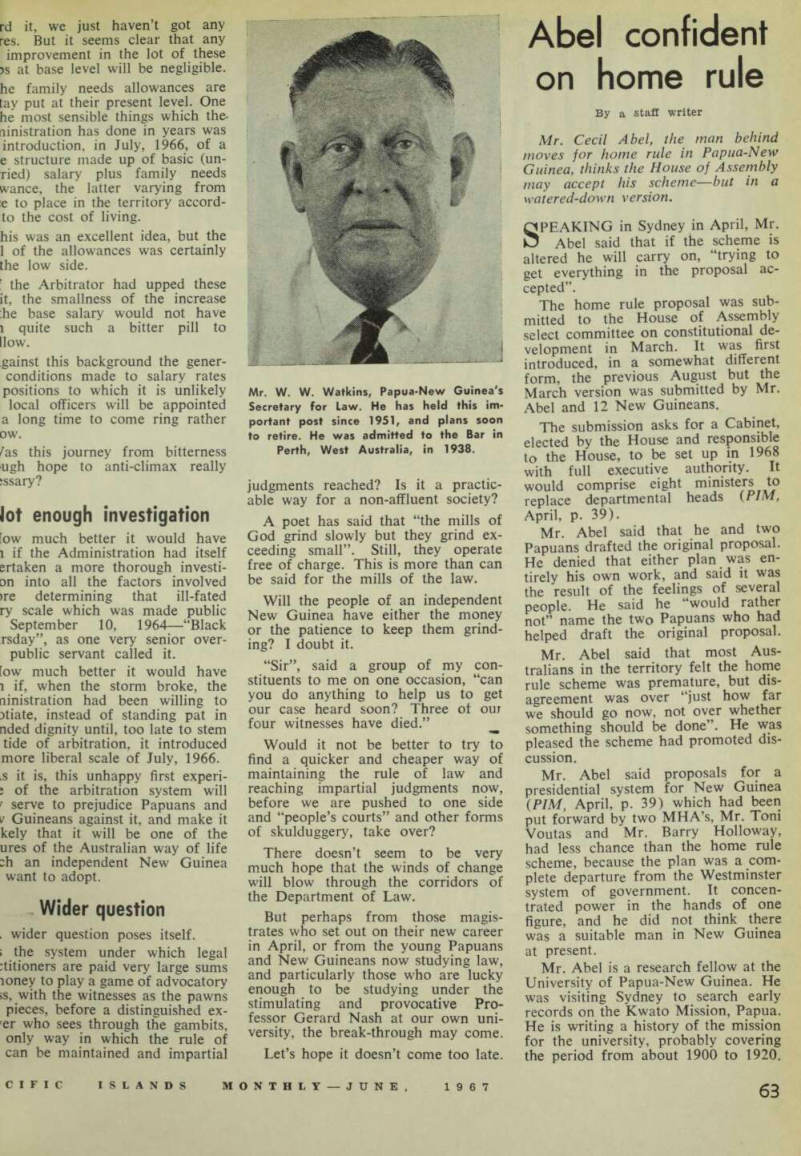
Mr. W. W. Watkins, Papua-New Guinea's Secretary for Law. He has held this im portant post since 1951, and plans soon to retire. He was admitted to the Bar in Perth, West Australia, in 1938.