it will probably look like this
pp. 59-128 · Read in the full issue


When the Republic of Nauru gets going, it will probably look like this
The Australian, British and New Zealand Governments in late May were considering the de tails of a plan aimed at making the phosphate island of Nauru an independent sovereign State.
The plan, in the form of constitutional proposals for independence, was handed to them at a conference held in Canberra in May to discuss Nauru’s future.
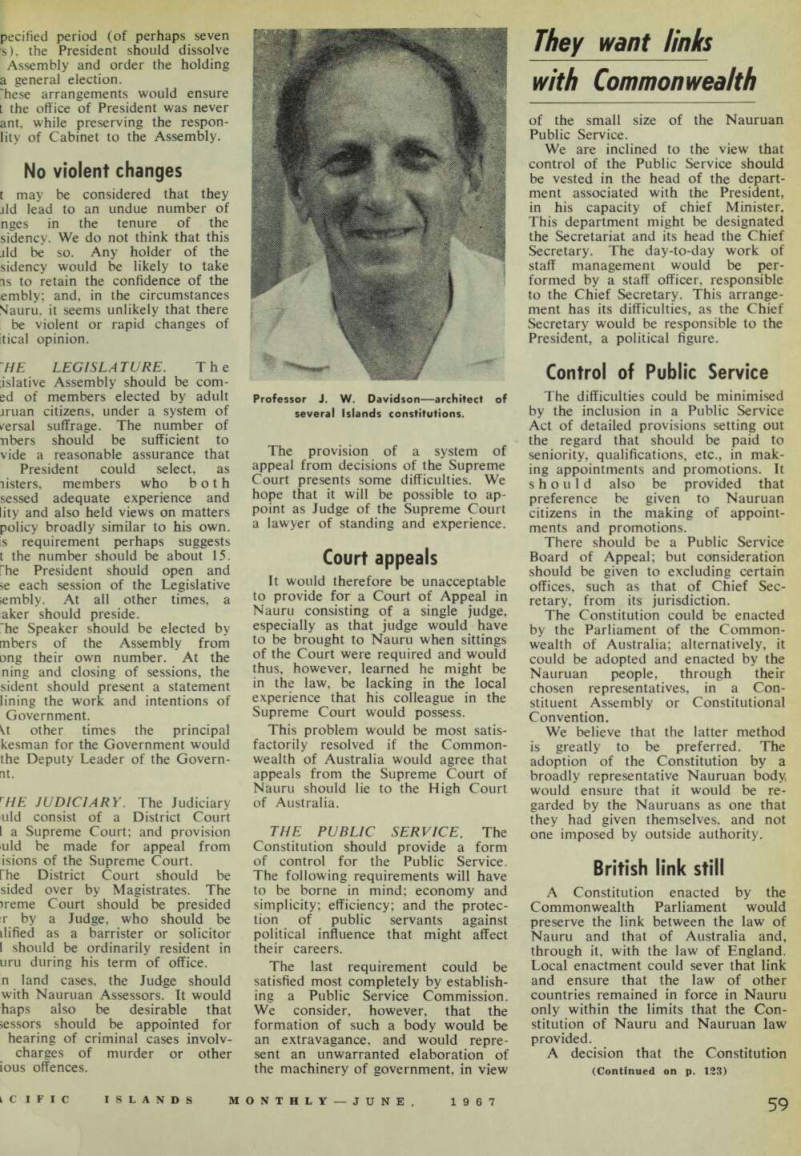
OVERING 16 quarto pages of 1 typescript, the plan was drawn by Professor J. W. Davidson, afessor of Pacific History at ; Australian National University, nberra, who is a constitutional Dert. He has been retained by the turuan Local Government Council, th the agreement of the three rtner governments.
The statement asks that Nauru be en independence on January 31, 68. “in accordance with the terms resolutions adopted by the UN :neral Assembly in 1965 and 1966”.
It emphasises that the proposals not represent the Canberra dele :ion’s final conclusions, or those the Nauruan people, but that they 3 demonstrate that we have already en considerable thought to the way which Nauru might be governed an independent State and to show it a solution to the constitutional }blems of Nauruan independence in broad outline at least, already thin sight”.
Much to be done yet
The document says that much »rk would have to be done, both the Nauruans and the partner vernments, to help put indepen nce into effect by next January; d asks that the partners give help various kinds. One need, for stance, is for a detailed study of ; effects of a proposed reorganised blic service structure on Nauru.
The Nauruan document was cepted at the conference “for trans ission to the various governments”, t there was no official indication /en as to whether the plan would accepted.
Unofficially, reaction was favour le.
It was felt that the scheme for dependence was a workable one, id that when independence was anted it could proceed generally □ng the lines proposed in the docu ent.
This is not surprising, as Pro-
fessor Davidson was largely re sponsible for working out highly satisfactory constitutions for both Western Samoa and the Cook Islands.
PIM publishes here a slightly abridged version of the Nauru pro posals as they were presented to the partner governments. The paper reads:
The main text
We consider that Nauru should become a republic and should be known as the Republic of Nauru, Its form of government should be based on the British parliamentary system, modified in certain ways to suit local circumstances. The political structure should be as simple as possible, in view of the small size and population of Nauru.
THE PRESIDENT. The President should be elected by the Legislative Assembly; he should vacate office within a specified period after the commencement of the first session of the Assembly following each general election, and the Assembly should be required to conduct a new election for President shortly before his vaca tion of office. The President should perform the formal duties of a Head of State and also be the head of the executive government.
During any period in which the
President was absent from Nauru or incapacitated, his duties should be performed by the Deputy Leader of the Government, as Acting President.
Power of President
The Executive. The Con
stitution should provide for the vest ing of executive power in the Presi dent and a Cabinet of Ministers. The President would perform certain formal acts, such as assenting to orders and regulations made by Cabinet or a Minister in accordance with the powers delegated to them by law.
He should also be the chief Minister, selecting the other Ministers, and presiding over meetings of Cabinet. The other Ministers, who should be three or four in number, should be selected from members of the Legislative Assembly.
One of the Ministers should be appointed by the President as Deputy Leader of the Government. He would act as the principal spokesman for the Government in the Assembly.
The dual position proposed for the President in the executive govern ment presents some difficulties; but, in view of the small size of Nauru, it does not seem desirable to create two separate offices of President and Premier, respectively.
The principal difficulty relates to the relationship between the Cabinet and the Legislative Assembly. The Cabinet—including the President, as its Leader—should be collectively responsible to the Assembly, as in a normal parliamentary system. In the event of Cabinet’s defeat on an issue of confidence, both the Presi dent and the other Ministers should resign.
In this event, the resignation of the Ministers, other than the Presi dent, should take effect immediately.
The President should remain in office, however, till a new election to the Presidency had been com pleted. If the Assembly should fail to complete such an election within
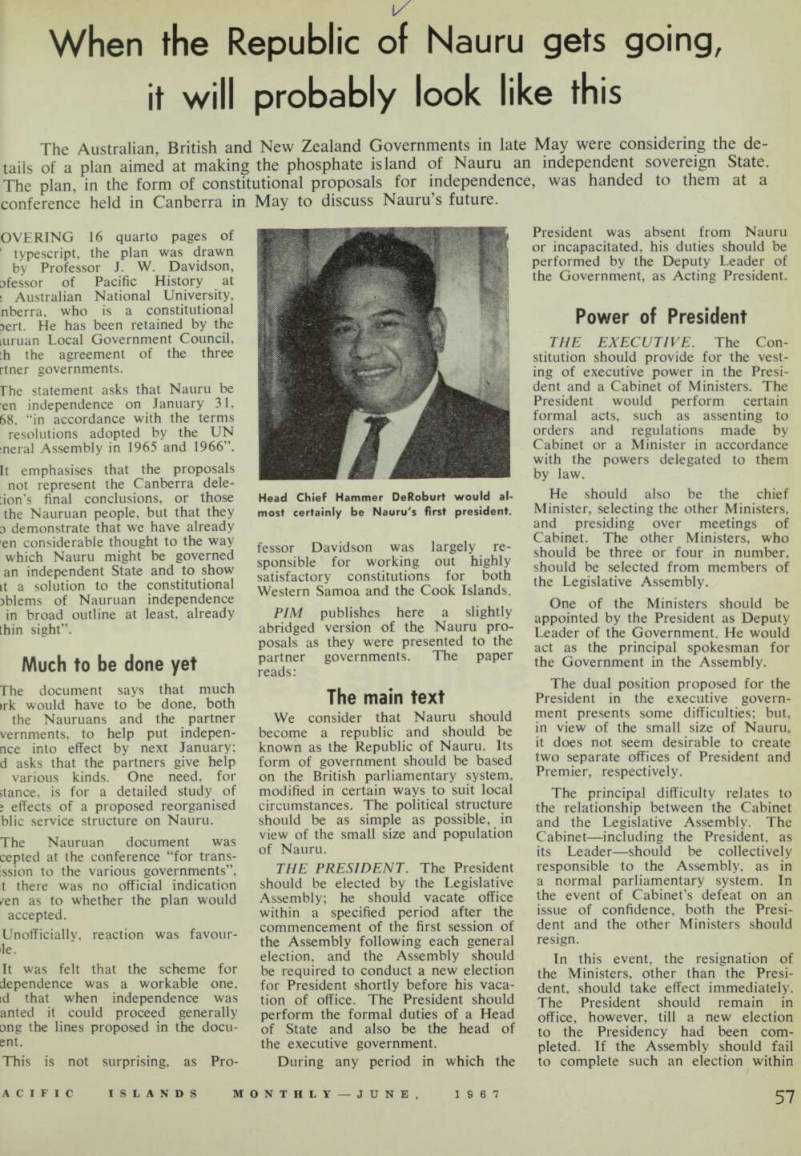
Head Chief Hammer DeRoburt would al most certainly be Nauru's first president.
pecified period (of perhaps seven s). the President should dissolve Assembly and order the holding a general election.
'hese arrangements would ensure t the office of President was never ant, while preserving the respon lity of Cabinet to the Assembly.
No violent changes
t may be considered that they jld lead to an undue number of nges in the tenure of the sidency. We do not think that this ild be so. Any holder of the sidency would be likely to take ns to retain the confidence of the embly; and, in the circumstances Sauru. it seems unlikely that there be violent or rapid changes of itical opinion,
7 Ie Legislature. The
islative Assembly should be corn ed of members elected by adult jruan citizens, under a system of /ersal suffrage. The number of nbers should be sufficient to vide a reasonable assurance that President could select, as listers, members who both sessed adequate experience and lity and also held views on matters policy broadly similar to his own. s requirement perhaps suggests t the number should be about 15. fhe President should open and >e each session of the Legislative iembly. At all other times, a aker should preside.
'he Speaker should be elected by inbers of the Assembly from ong their own number. At the ning and closing of sessions, the sident should present a statement lining the work and intentions of Government.
Vt other times the principal kesman for the Government would the Deputy Leader of the Govern nt. r HE JUDICIARY. The Judiciary uld consist of a District Court I a Supreme Court: and provision uld be made for appeal from isions of the Supreme Court, fhe District Court should be sided over by Magistrates. The )reme Court should be presided r by a Judge, who should be dified as a barrister or solicitor I should be ordinarily resident in uru during his term of office, n land cases, the Judge should with Nauruan Assessors. It would haps also be desirable that jessors should be appointed for hearing of criminal cases involv charges of murder or other ious offences.
The provision of a system of appeal from decisions of the Supreme Court presents some difficulties. We hope that it will be possible to ap point as Judge of the Supreme Court a lawyer of standing and experience.
Court appeals
It would therefore be unacceptable to provide for a Court of Appeal in Nauru consisting of a single judge, especially as that judge would have to be brought to Nauru when sittings of the Court were required and would thus, however, learned he might be in the law, be lacking in the local experience that his colleague in the Supreme Court would possess.
This problem would be most satis factorily resolved if the Common wealth of Australia would agree that appeals from the Supreme Court of Nauru should lie to the High Court of Australia.
The Public Service. The
Constitution should provide a form of control for the Public Service.
The following requirements will have to be borne in mind; economy and simplicity; efficiency; and the protec tion of public servants against political influence that might affect their careers.
The last requirement could be satisfied most completely by establish ing a Public Service Commission.
We consider, however, that the formation of such a body would be an extravagance, and would repre sent an unwarranted elaboration of the machinery of government, in view
They want links with Commonwealth
of the small size of the Nauruan Public Service.
We are inclined to the view that control of the Public Service should be vested in the head of the depart ment associated with the President, in his capacity of chief Minister.
This department might be designated the Secretariat and its head the Chief Secretary. The day-to-day work of staff management would be per formed by a staff officer, responsible to the Chief Secretary. This arrange ment has its difficulties, as the Chief Secretary would be responsible to the President, a political figure.
Control of Public Service
The difficulties could be minimised by the inclusion in a Public Service Act of detailed provisions setting out the regard that should be paid to seniority, qualifications, etc,, in mak ing appointments and promotions. It should also be provided that preference be given to Nauruan citizens in the making of appoint ments and promotions.
There should be a Public Service Board of Appeal; but consideration should be given to excluding certain offices, such as that of Chief Sec retary, from its jurisdiction.
The Constitution could be enacted by the Parliament of the Common wealth of Australia; alternatively, it could be adopted and enacted by the Nauruan people, through their chosen representatives, in a Con stituent Assembly or Constitutional Convention.
We believe that the latter method is greatly to be preferred. The adoption of the Constitution by a broadly representative Nauruan body would ensure that it would be re garded by the Nauruans as one that they had given themselves, and not one imposed by outside authority.
British link still
A Constitution enacted by the Commonwealth Parliament would preserve the link between the law of Nauru and that of Australia and, through it, with the law of England.
Local enactment could sever that link and ensure that the law of other countries remained in force in Nauru only within the limits that the Con stitution of Nauru and Nauruan law provided.
A decision that the Constitution
(Continued on p. 123)
Professor J. W. Davidson—architect of several Islands constitutions.
jld be enacted locally would re e immediate consideration of the s necessary to the attainment of objective. If Nauru is to attain pendence by January 31, 1968, k will have to begin without delay the preparation of constitutional >osals and the examination of 1 problems. rrangements will have to be made the election in September or )ber of a Constitutional Con ion; and the Convention will have omplete its work before the end he year. (It would be desirable the Constitution of Nauru should idopted in time for it to be pre id to the General Assembly of United Nations before it adjourns Christmas). ich a programme would require full co-operation of the partner rnments, in particular by their ing available the expert legal and r assistance that will be ssary. regard to the formation of a stitutional Convention, we believe we could draw substantially on experience of Western Samoa, example, the membership of the ititutional Convention of Western Da included the elected members ie Legislative Assembly and three ;ional representatives of each tituency. We believe that bership along similar lines would uitable in our own case.
Citizenship problems
is desirable that those who elect members of the convention should arsons who will possess Nauruan nship after independence, is our desire that Nauruan nship should be largely restricted ose who are Nauruan by descent, use of the small size and limited irces of the island, and the high of increase of the Nauruan lation, no other policy is open ; do not wish that those who to Nauru to work in the phos ‘ industry should acquire the to apply for naturalisation. We Drepared, however, to admit to )rivileges of citizenship a small )er of persons of non-Nauruan nt who are permanently resi on the island. is raises two questions. On what itions should non-Nauruans who long been resident in Nauru be ed to opt for Nauruan citizen when it is first introduced? What
conditions should apply to later applications for naturalisation? These are questions to which immediate attention should be given.
On one matter, our opinion is already clear: the problems of “dual citizenship” that may result from the admission of non-Nauruan to Nauruan citizenship must be minimised. We think that such persons should be required to take an oath, in which they would renounce their foreign allegiance, and that the law of Nauru should provide for the loss of Nauruan citizenship by any citizen exercising any right pertaining to the citizenship of another country.
Dealing with the structure of the administration, because of the small size of the Nauruan Public Service we cannot expect to have many senior permanent officers of the quality and experience required; nor, indeed, would j t be economically sound for us to obtain the services of a greater number of such men than is necessary, Moreover, the duties of the heads of some existing departments demand professional or technical knowledge, rather than the general administrative ability to which we have been re ferring. We therefore believe that the present departmental structure should
be reorganised and the number of departments be decreased, so that, as far as possible, each Minister would be responsible for only one depart ment. It would then become possible to appoint as heads of department officers able to work effectively with their Ministers.
External affairs
Since we are seeking the agree ment of the Partner Governments that Nauru should become an independent state, it will already be
clear that final authority in all matters of external relations will rest with the Government of Nauru.
This does not mean, of course, that the Government of Nauru will not be ready to enter into treaties and agreements with other countries or that it will not seek the assistance of another country, or other countries, in the handling of Nauruan affairs overseas.
But we are convinced that such treaties and agreements should not be entered into, or such arrangements be made, until Nauruan independence
has been attained. Only then will the Government of Nauru be able to negotiate with other governments on terms of legal equality.
There is one matter of a rather special character on which we can make a positive statement. The desire of the Nauruan people to retain an association with the British Commonwealth has already been placed on record. This remains our desire.
In view of our small size, we would not expect to take part in all the conferences attended by repre sentatives of the larger Common wealth countries.
On the other hand, once we have attained our independence, our relationship with the Commonwealth would have to be a direct one, not a relationship through Australia. We hope that the partner governments will inform their fellow members of the Commonwealth of our desire to maintain an association with them and that a suitable form of associa-i tion will be agreed upon.
The external relations of Nauru will be far simpler than those of almost any other independent country. We have at present only one export; and the disposal of this will continue to be controlled by agree-J ments.
We are at present served by noj regular air-service or shipping line,] other than the ships calling for phos-j phate. We receive no tourists. More-1 over, our small size will make it impossible for us to take any but the most limited part in international affairs.
Brigadier L. D. King, Nauru's last Ad ministrator?