New Guinea's Between-Wars Administration
pp. 62-64 · Read in the full issue
Eric Feldt believes ( and he was there)
Is Too Frequently Misunderstood
By ERIC FELDT, pre-war District Officer
A new edition of Dr. Peter Lawrence’s, Road Belong Cargo, issued in paperback by the Melbourne University Press in April, will give many people the chance to read the work of an anthropologist who applies his specialist knowledge to New Guinea as it is, and does not inhabit an ivory tower in a static native society.
DR. LAWRENCE’S book is an investigation of cargo cult in the southern part of the Madang District, and he derives most of his informa tion from natives. To do so he had to win their confidence, and thus his book is not only a work of anthropo logy but a valuable account of the course of native thought.
As such, it is a book that I wel come and it should, I think, be re quired reading for all at the United Nations who make trusteeship decisions.
Dr. Lawrence traces the rise of cargo cult from the landing of Baron Miklouho-Maclay on the Rai Coast in 1871 to the beliefs which have persisted to the present day.
When Maclay landed, the white man’s goods—firearms, knives, axes, cloth, ships, shoes and sealing wax— were so far beyond native com prehension that they could only ascribe the creation of such goods to magic. And yet today the beliefs persist despite the evidence of the participants’ own eyes that bullocks can be turned into tinned meat.
Future not easy
Dr. Lawrence points out that cargo cult can become an important feature in the political relationship between Australia and Papua-New Guinea, and discusses ways in which the belief may be guided into an evolution towards modern thinking.
But in my view it will not be easy.
The native has such an ability to twist anything he is told into his own dif ferent version that no one can be assured of the outcome.
It is, for instance, because Dr.
Lawrence has derived so much of his information from native sources that he is, I think, less than iust to the between-wars Administration of New Guinea. For the record. I would like to say something on these aspects.
In the early twenties, our first con
cern was to avoid the drastic decline in population which had taken place in every other Pacific area after contact with western culture. Anthropological advice at the time was to leave the native, as far as possible, to lead his own life in his own way until he adjusted himself to a commercial world.
There was no real fall tion in New Guinea, but for this we get no thanks.
Dr. Lawrence reports the plea that natives were deprived of their land.
I do not defend the acquisitions by the Germans in the early days, but it should be pointed out that all of
these were investigated and the wrong righted as far as possible.
Today in New Guinea the plea i being raised that natives did no understand the transaction and s< the land should be restored to them First of all, such a small proportioi of land has been alienated that thi cannot be a general claim.
Further, it is noteworthy that nativi claims to restoration are almos always for valuable land—land whicl has only become valuable by reasoi of European development. There an claims today for land at Lae, bu none for land at Morobe and Sala maua.
We had no financial assistance fron the Commonwealth in those earlj days but lived on our own revenue Our first duty was to bring the country under control and so establish a peaceful order. This with the super vision of native labour and the supply of medical services (which themselves cost more than the head-tax col lected), left no money for anything else.
Cultural indigestion
We could have done more in education, but not much more in view of the cultural indigestion of the natives.
Opportunities were there for the native to make money if he would.
He had his own land, he knew how to grow coconuts and make copra, as he had worked at it on plantations, and there was a ready market. But only rarely would he do it.
In the early twenties, I remember that Goi, of Namatanai, was one man who did so, and he had a European style cottage. His wife would not live in it, and occupied a native material hut alongside.
Some officers, at the risk of being accused of having used forced labour, ordered natives to plant coconuts on the excuse that they were food crops,
>ut really with the object of increas ng their money income. But the latives were lethargic.
It has been pleaded that the natives lad no money, but it was later ;stimated that 10 million shillings vere hoarded in villages by the time Vorld War II broke out. Another :xcuse is that they did not know ;nough about money, but anyone who ried to take it off them found, finally, hat they knew something.
When the depression came, many >f us believed that the native producer, laving no overhead, would weather t better than the planter. But it did lot work out that way. Native-pro luced copra was of such poor quality hat it could not be sold, and copra nspection had to be introduced to irotect the market. There was no inister plot to prevent the native naking copra.
Wages compared well
Incidentally, native wages were not educed during the big economic de iression—a rare distinction. Overall, he wages of the unskilled worker :ompared well with those in such :ountries as the Philippines, Hong £ong, Malaya and Java. And there vere so few skilled native workers n New Guinea that no comparison :an be made at this level.
But copra production was for the :oastal natives. For the inlanders
there was no economic solution apart from going off to work, unless the country round was auriferous. Though hundreds of them had worked alluvial gold, they would not work their own areas. Both as DO and as Warden, I tried to induce them to do so without success. The Waria Valley was perfect for it.
Today natives are working gold but there is no reason why they should not have done so 30 years ago— nothing except conservatism and laziness.
Our Administration was admittedly paternal. But I still believe it was
the most humane way of governing the country at the time. If we had forced the native into a civilised commercial way of life then, he would have died off in thousands. The other alternative was to have imported Eastern coolie labour, in which case the result would have been worse still.
Such a long time
We waited for the native to adjust himself to modern life, giving him the opportunity to learn from what went on around him, and from activities in which be participated.
But we did not realise that it would take such a long time.
While we were doing what we could with a shortage of money and staff, cargo cult waxed and waned through the years, as Dr. Lawrence now tells us. It never died out, even with missionary influence—for Christianity had them searching for a new way to break the white man’s hold on cargo—the search for the correct ritual.
Most whites knew nothing of any of this at the time. In the two years I was District Officer at Madang I heard not a whisper of it (although, admittedly DO’s, like husbands, are the last to hear).
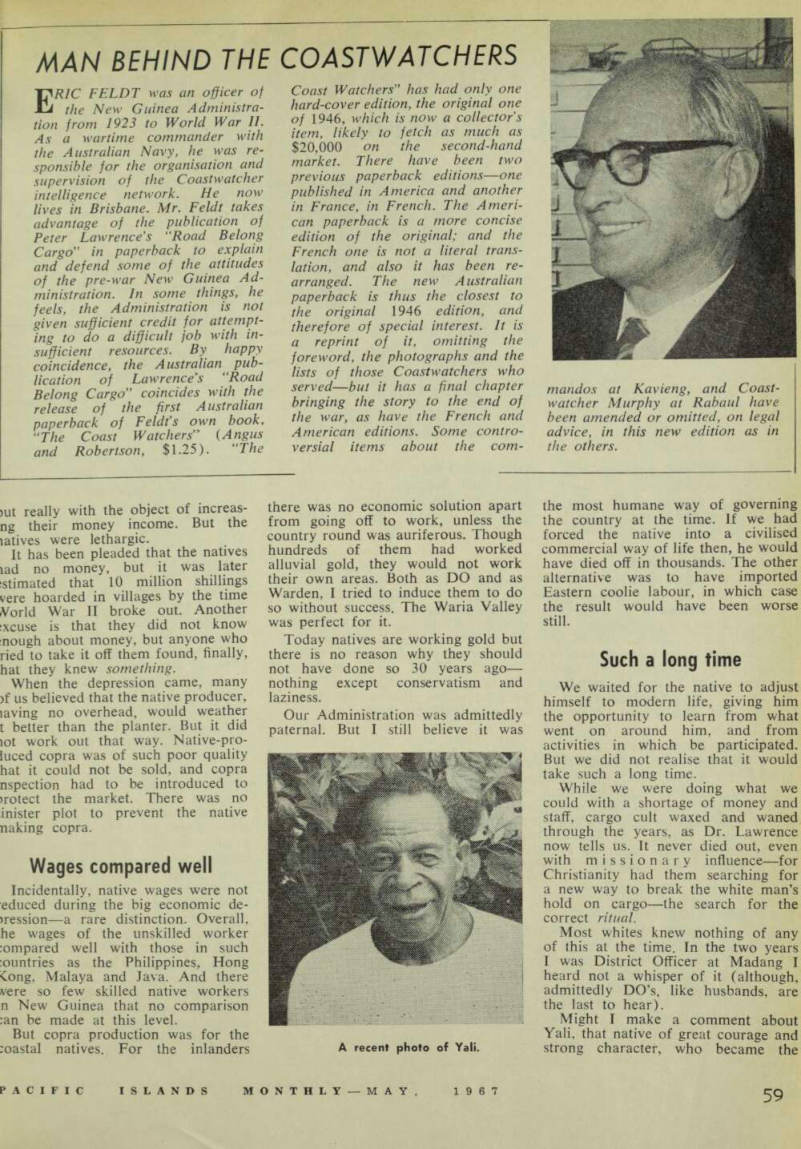
Might I make a comment about Yali, that native of great courage and strong character, who became the
A recent photo of Yali.
cult leader? He claimed that promises were made during the war but were not kept.
Colourful but vague promises were made, but it is just possible that Yali asked someone if ships would bring cargo (in the cult sense) and had got an affirmative reply meant in the ordinary commercial sense.
I think it is important to remember that Yali gave his story after his failure, when he was an embittered man following his savage gaol sentence (and he has my full sympathy for what happened to him there). But after failure we all enhance points which protect our self esteem.
There is criticism of our Admin istration that any District Officer could legally put any native in gaol if he set out to do so; for that matter any traffic cop can catch any motorist in Sydney or Brisbane if he tries hard enough.
Cargo cult is, basically, a belief in a ritual solution of a practical problem. But ritual cannot be dis missed altogether; we have our own people who believe in it. Apart from religious ritual, some people vote for the same political party every elec tion; some attend universities and acquire degrees they will never use; others collect orders and decorations.
In Road Belong Cargo, Dr.
Lawrence shows how native thought works when confronted by the modern world, which is a step towards know ing why he thinks that way, and so combating it.
But it remains to be explained why, in areas as far apart as Bougainville and the Vailala. whose myths are quite different, the same cargo cult beliefs have appeared. I hope that Dr. Lawrence will be able to apply himself to this problem.