To The Point
pp. 59-61 · Read in the full issue
With
Percy
Chatterton
I sensed that I had lost the attention of my pupils and looked round to discover why. The reason was immediately apparent. The village constable was standing in the doorway, and he didn’t look at all pleased. I took him into my office to find out what was the matter. He was very hot and very annoyed, and he plunged straight into his story.
i N overseas vessel had been in port x over the weekend, and, as was ic custom in those days, a number I small boys from the village had liled across the harbour in a canoe i provide the passengers with enter inment, and themselves with pocket oney, by diving for pennies. Stand g on their canoe or splashing about the water they shouted “Throw e”, “Throw me”, to the passengers tiing the rail. (Incidentally this practice added neologism to the Motu language, iha teroumi”, volunteered a young lice in explanation of a fellow-pupil’s isence from roll call . . . “He’s gone i dive for pennies”. Puzzling at st hearing, but simple enough when lu’ve worked it out).
A quarrel
Presently a quarrel had arisen nong the young divers, and they had arted abusing one another in good, ilourful Australian. Unfortunately •r them, our Resident Magistrate he pre-war Papuan equivalent of istrict Officer) had been on board siting friends among the passengers, id he had overheard them.
Now, our RM had been recently ansferred to Port Moresby from an itstation, and was unaware that the ustralian expressions he had over jard were among the small change : Hanuabadan conversation. He was locked.
So on this Monday morning, as »on as the village constable had ported at the RM’s office, he was ■dered back to the village to scover the young culprits and bring iem in for a magisterial reprimand.
The VC was not amused. He had ready walked the 2i miles from anuabada to the RM’s office in iwn; there was no motor transport i speak of in those days.
He had had to retrace his steps, id he would now have to return to iwn with the culprits, and finally
Role of the New Guinea police
trudge back to the village in the afternoon —ten miles instead of five.
I assembled the school, between 400 and 500 young Papuans of both sexes and all ages from six to 16, and handed over to him. From my own experience in similar situations, I ex pected that it would take him several hours to uncover his victims.
I misjudged him; it took him five minutes.
The seven small swearers were lined up in front of the school, the cynosure of all eyes. Then the VC turned to the assembled pupils and addressed them.
The use of European swearwords, he said, was reserved for Europeans only. Europeans did not like to hear Papuans, and particularly Papuan children, using them.
Their use was forbidden by the Government and (with a deferential
gesture in my direction) frowned on by the Church. Moreover it was quite unnecessary.
As his hearers well knew, the Motu language contained some expressions quite as abusive, and reflecting quite as unfavourably on the abused person’s parentage, as any of those introduced by the white men.
These could safely be used in front of, and even about, Europeans, as very few Europeans understood what these expressions meant except (with another deferential gesture in my direction) quite unusual ones such as their missionary.
But the use of European swear words was an offence against God and the Establishment, and worse still, caused him, their constable, a great deal of trouble. This must not occur again.
His eyes travelled slowly over the
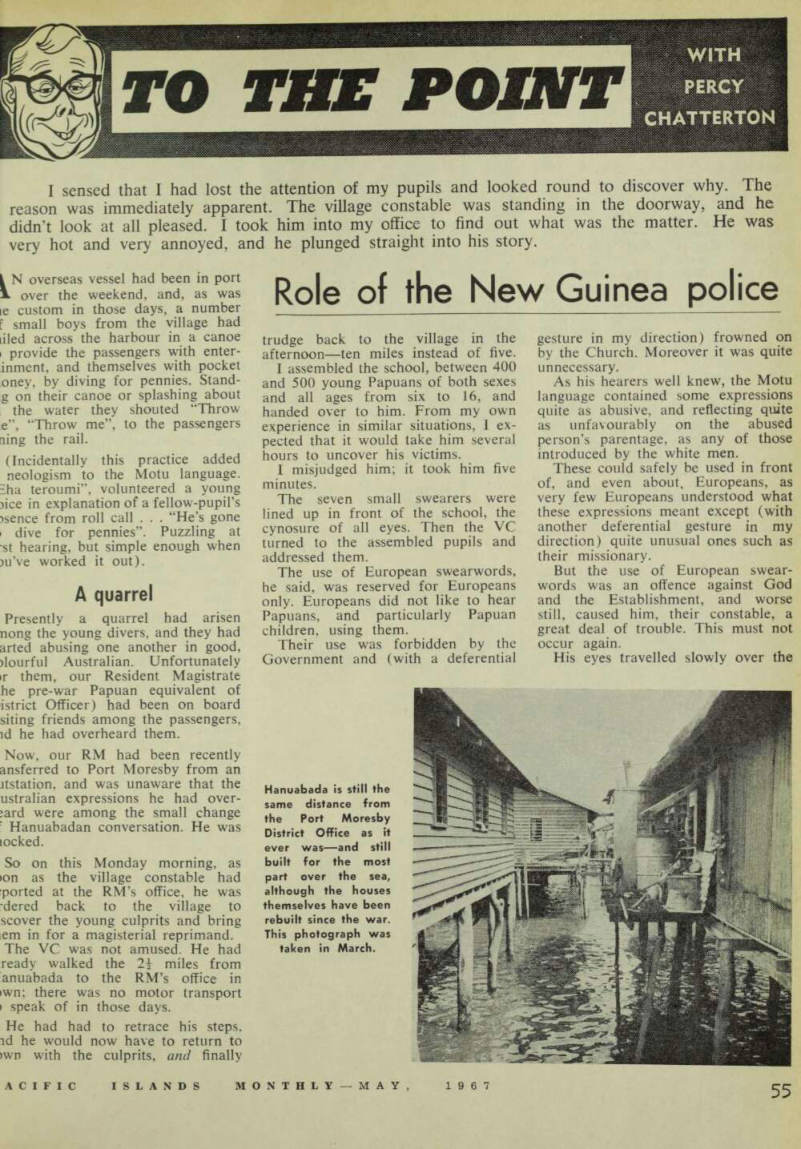
Hanuabada is still the same distance from the Port Moresby District Office as it ever was—and still built for the most part over the sea, although the houses themselves have been rebuilt since the war.
This photograph was taken in March.
lines of children, producing an effect reminiscent of a gust of wind passing over a wheatfield. Then he turned menacingly on the luckless seven.
“Now”, he roared, “you come with me, you little b s”.
The cortege withdrew. The sudden expulsion of air from the lungs of nearly 500 children who had all been holding their breath at the same time dislodged a large map of the world, which fell to the floor with a crash. Peace reigned.
He wasn't a bad VC, though, that chap; and Hanuabada was a better behaved village then than it is today.
Village constables are a dying race. As local government comes in, the VC’s are retired. Many of their former functions are now performed by local government council officials, while their purely police functions have been taken over by regular police of the Royal Papua and New Guinea Constabulary.
'Amateur' village constable
In an increasingly sophisticated society in which the force of “tribal law” is fading, it is probably just as well that the professional policeman should take over from the amateur, which is what the village constable generally was.
Of course, it did occasionally hap pen that an ex-regular policeman
But is Port Moresby really so lawless?
was appointed as VC of his home village. But often village constables were chosen for qualities which were not immediately apparent.
“He was my cook for years and looked after me well,” said an ADO of one of these. “When he decided to go back to his village I thought it would be fair enough to make him VC”. He may have been a good cook, but he was a very indifferent village constable.
As I have said, Hanuabada was a more law-abiding place in pre-war days than it is now. So, for that matter, was Port Moresby town, with its one European policeman, Tom Gough, assisted by a small squad of Papuan constables.
True, there were only about 400 Europeans in the place, and a mere handful of non-local Papuans, mainly cooks from Suau and wharfies from Goaribari. And Tom, trudging around on foot, gentle and soft-spoken, managed to keep us in order without too much trouble.
Today, with 10,000 Europeans and 30,000 Papuans and New Guineans, it takes a small army of police— European and indigenous—dashing around in patrol cars equipped with sirens and searchlights, to keep the
place under control; and according to some of my fellow MHA’s the control is not too good.
At the last meeting of the House of Assembly, some members had hard things to say about what they regarded as the lawlessness of Port Moresby, the inadequacy of the police, the too lenient sentences passed on offenders, and the too luxurious conditions in the gaols.
On the last point, our Controller . Corrective Institutions has reacted with vigour, commenting tartly that the honourable member who com pared our Port Moresby Gaol with the Chevron-Hilton Hotel had pro bably never stayed in either.
I certainly haven’t, so I refrain from comment. But I do think that a point made by the Controller, that the most rigorous and austere con ditions which our civilised consciences will allow us to impose may well appear luxurious to some of the ter ritory’s more primitive citizens is well taken.
No easy solution
There doesn’t seem to be any easy solution to this difficulty, short of acceding to the demands of those Highlands leaders who cry with Alice’s Duchess, “Off with their heads!”
On the general question of law lessness, we cannot expect as low a crime rate now as we had when the town population was numbered in hundreds and tribal sanctions were still strong in the neighbouring villages. Lawlessness has been on the increase during the intervening years not only in Port Moresby, but throughout the “civilised” world.
Is Port Moresby really so lawless?
To date we have had no bank hold ups, and I have heard of only one mass-rape case.
We don’t have raids on betting offices, because, fortunately, we don’t have any TAB offices to be raided.
We have our occasional murder, but so have Australian cities.
Not a high crime rate
I have no'figures to go on, but I would venture to guess that, in pro portion to population, our rate for murder, rape and other crimes of violence is not higher than that for Sydney or Melbourne.
My wife and I live in an area which was shown by the 1966 census to be the most thickly populated
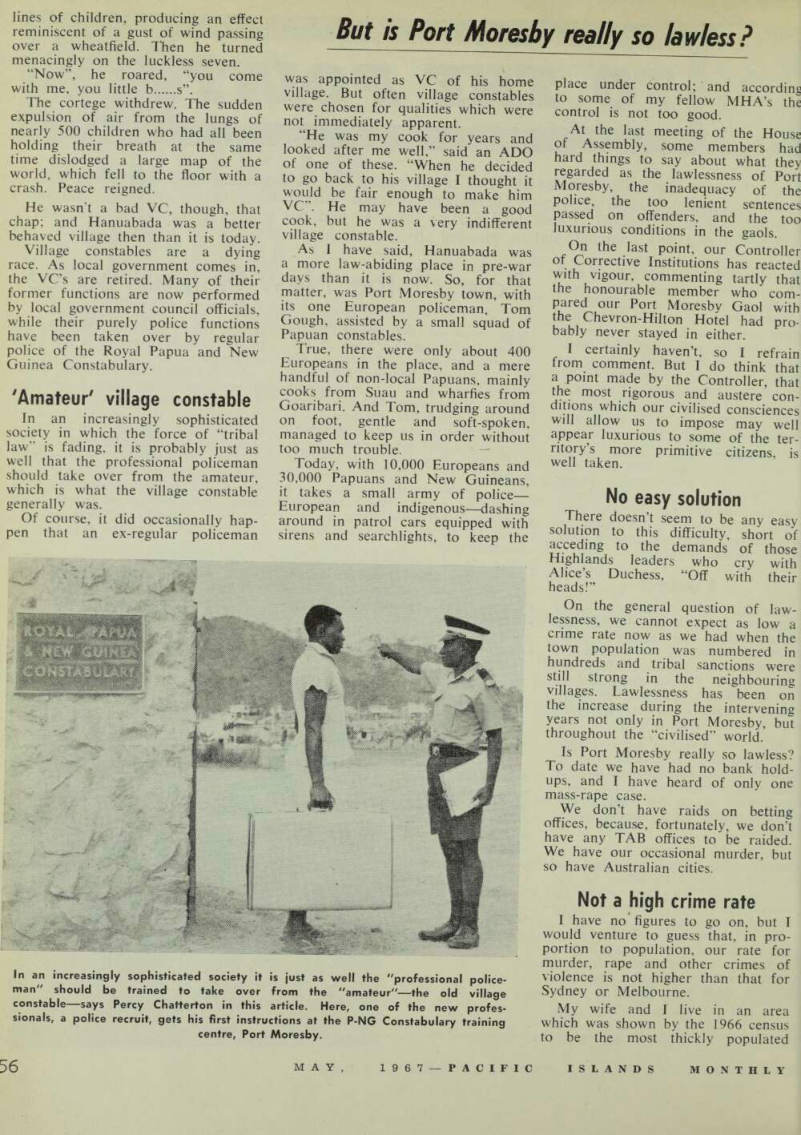
In an increasingly sophisticated society it is just as well the "professional police man" should be trained to take over from the "amateur"—the old village constable —says Percy Chatterton in this article. Here, one of the new profes sionals, a police recruit, gets his first instructions at the P-NG Constabulary training centre, Port Moresby.
:ctor of the town, and the popula on of this area is predominantly idigenous. But we have no worries; e feel at least as safe as we would [ a Sydney or Melbourne suburb, irhaps safer.
Our nights are quiet enough too, Lcept for an occasional guitar party i pay night. Occasionally a brawl •eaks out, and then, as we have le of the very few telephones in e area, I am generally asked to ng for the police.
My experience is that on such oc isions they arrive with a minimum ; delay and, contrary to criticism hich has been levelled at them from me quarters, deal with the situation omptly and effectively.
It is an advance in relations ;tween police and public that in ich situations the police are called r at all. Only a few years ago, if had approached the scene of a awl, half-a-dozen of the brawlers ould have rushed up to me and id, “Don’t call the police, we’ll ttle this ourselves”.
So on the whole I don’t go along ith the critics.
Police are improving
I think that the police are not too id, and are steadily improving in ficiency and, in spite of some dis mtent over pay and working con tions. improving in morale.
The change to a more sensible if 5S picturesque, uniform, and the lining of Papuans and New uineans as sub-inspectors, has a t to do with this. And I think that ly increase in lawlessness which s taken place here is far less serious an the increase in lawlessness which is taken place in Australia, or in most any country you could name the “western world”.
Anyway, our police force is now nipped with all mod cons, includ g photography, ballistics and finger inting. We have police dogs too, id by all account these live in some easure of luxury even if the gaol rds don’t.
Finally we have a Special Branch, lould we have a Special Branch? so, what should it do and how ould it go about it?
Individual freedom
That enterprising body, the Papua id New Guinea Society, recently aged a panel discussion in Port oresby on “Individual Freedom and e Police Special Branch”.
Two of the three speakers who )ened up the subject were lawyers, ae being the Professor of Law at
the University of Papua and New Guinea. The third speaker was a Papuan high school teacher who is also a part-time student at the univ ersity.
The stream of questions which fol lowed their addresses reflected the keen public interest in this subject.
It appeared to be generally agreed that in this age of conflicting ideo logies we have got to learn to live with a “special branch”; though the Papuan member of the panel had reservations about this, and thought that Australia should have waited until the indigenous people asked for
Particular 0/ the Special Branch
one instead of wishing one on to them.
The lawyers made great play with the fact that members of the Special Branch have no powers over and above those possessed by other members of the police force, but some members of the audience seemed sceptical about the value of this safeguard.
It emerged very clearly that what Papuans and New Guineans fear is not that the Special Branch will take them to court, where their guilt or innocence can be established before an impartial tribunal, but that it won’t.
Instead, so the fear goes, it will communicate inadequately substan tiated reports on its files to employers, to the detriment of the employee’s chances of promotion, op portunities for educational visits overseas, and even continued employ ment.
This fear undoubtedly, and under standably, looms large in a situation in which a very large majority of educated and politically aware indigenes are employed by the Administration itself.
Assurance needed
An assurance that the contents of the Special Branch’s files will not be divulged either to Government departments or to outside employers unless and until it has been decided to institute court proceedings against the persons to whom the files refer, would do much to reconcile Papuan and New Guinean public opinion to the existence of the Special Branch.
A second point which emerged from the discussion was that special branches throughout the Common wealth seem to have adopted “Eyes Left” as their motto, and don’t seem to be much worried about threats to security from other sources than Communism.
Is this attitude realistic in the ter ritory situation? In the light of events in other parts of the world, is not an army take-over at least as likely as a communist one?
And in our local situation, is a seizure of power by a communist minority more likely than a coup d’etat by fanatical seventh-staters, or a secession plot by Western High landers bent on establishing a Rajahdom of Pyrethrumia?