To The Point
pp. 57-61 · Read in the full issue
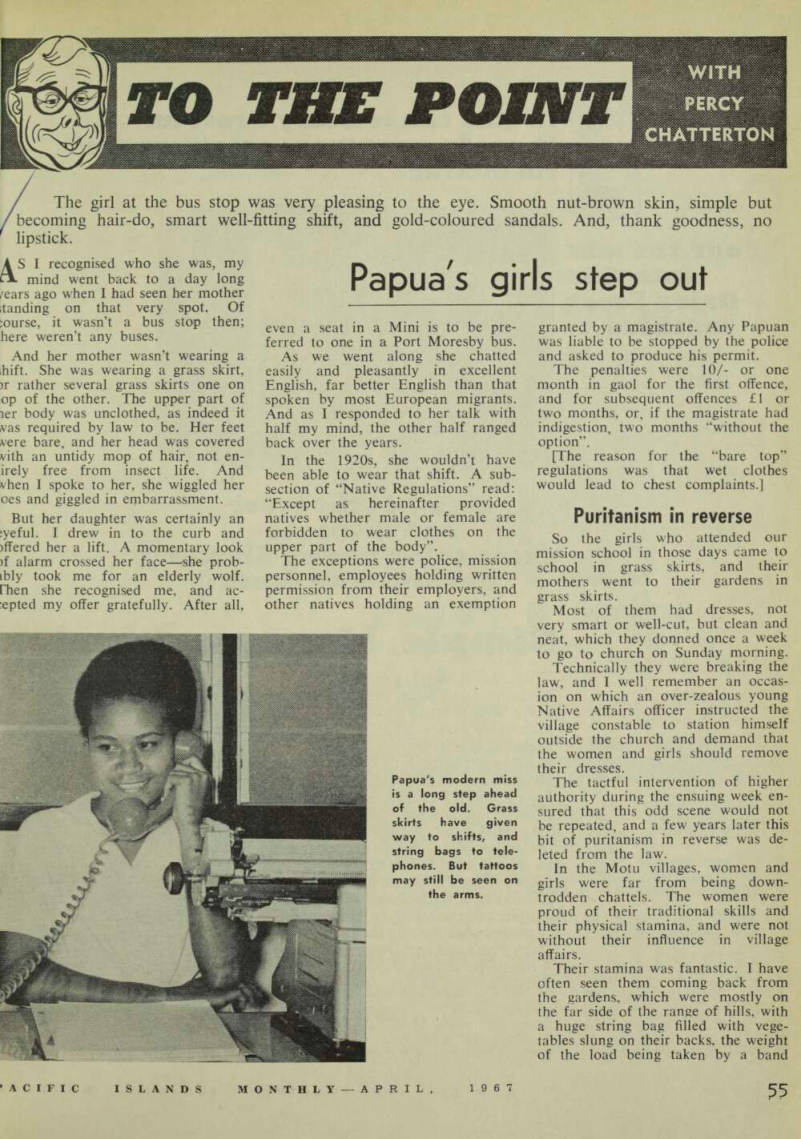

With
Percy
Chatterton
/The girl at the bus stop was very pleasing to the eye. Smooth nut-brown skin, simple but becoming hair-do, smart well-fitting shift, and gold-coloured sandals. And, thank goodness, no lipstick.
AS I recognised who she was, my nL mind went back to a day long ago when I had seen her mother itanding on that very spot. Of course, it wasn’t a bus stop then; here weren’t any buses.
And her mother wasn’t wearing a ihift. She was wearing a grass skirt, )r rather several grass skirts one on op of the other. The upper part of ler body was unclothed, as indeed it vas required by law to be. Her feet vere bare, and her head was covered vith an untidy mop of hair, not en irely free from insect life. And vhen I spoke to her, she wiggled her oes and giggled in embarrassment.
But her daughter was certainly an :yeful. I drew in to the curb and iffered her a lift. A momentary look )f alarm crossed her face—she prob ibly took me for an elderly wolf, fhen she recognised me, and ac :epted my offer gratefully. After all,
Papua's girls step out
even a seat j n a jyji n i j s be pre ferred to one in a Port Moresby bus.
As we went along she chatted easily and pleasantly in excellent English, far better English than that spoken by most European migrants, And as I responded to her talk with half my mind, the other half ranged back over the years, In the 192 0 5 , she wouldn’t have been able to wear that shift. A sub section of “Native Regulations” read: “Except as hereinafter provided natives whether male or female are forbidden to wear clothes on the upper part of the body”.
The exceptions were police, mission personnel, employees holding written permission from their employers, and other natives holding an exemption
granted by a magistrate. Any Papuan was liable to be stopped by the police and asked to produce his permit.
The penalties were 10/- or one month in gaol for the first offence, and for subsequent offences £1 or two months, or, if the magistrate had indigestion, two months “without the option”. [The reason for the “bare top” regulations was that wet clothes would lead to chest complaints.]
Puritanism in reverse
So the girls who attended our mission school in those days came to school in grass skirts, and their mothers went to their gardens in grass skirts.
Most of them had dresses, not very smart or well-cut, but clean and neat, which they donned once a week to go to church on Sunday morning.
Technically they were breaking the law, and 1 well remember an occas ion on which an over-zealous young Native Affairs officer instructed the village constable to station himself outside the church and demand that the women and girls should remove their dresses.
The tactful intervention of higher authority during the ensuing week en sured that this odd scene would not be repeated, and a few years later this bit of puritanism in reverse was de leted from the law.
In the Motu villages, women and girls were far from being down trodden chattels. The women were proud of their traditional skills and their physical stamina, and were not without their influence in village affairs.
Their stamina was fantastic. I have often seen them coming back from the gardens, which were mostly on the far side of the range of hills, with a huge string bag filled with vege tables slung on their backs, the weight of the load being taken by a band
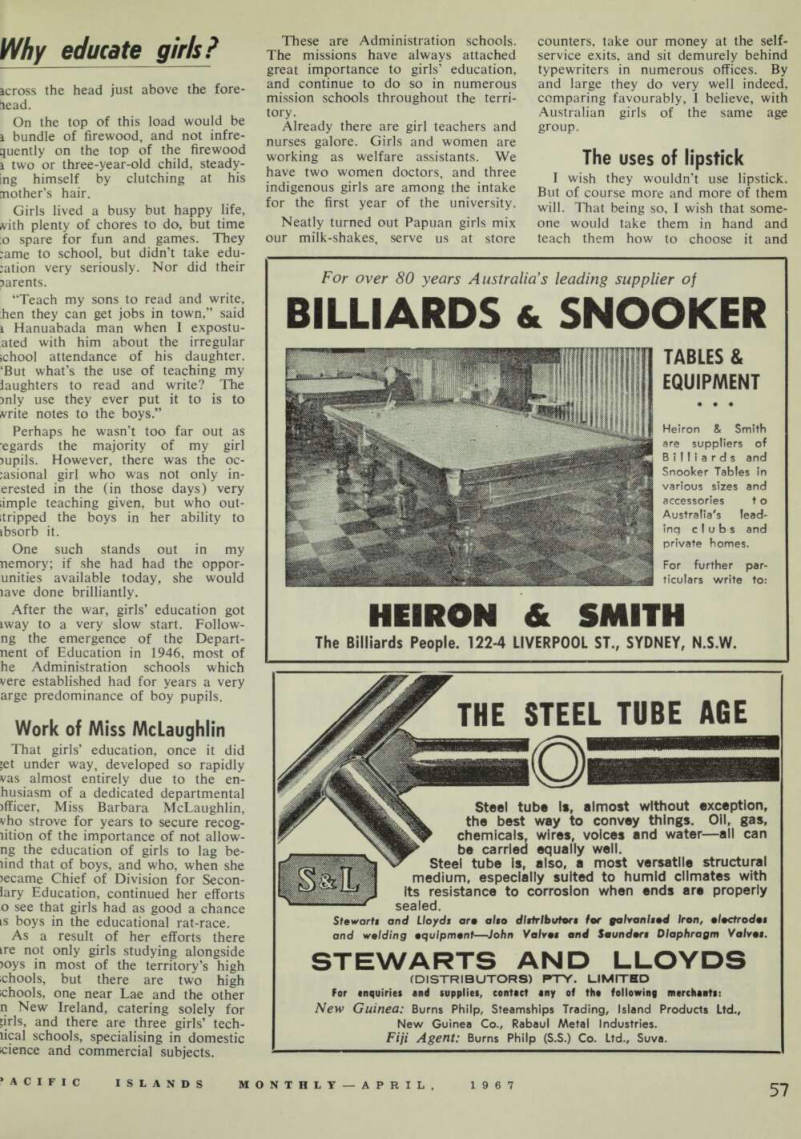
Papua's modern miss is a long step ahead of the old. Grass skirts have given way to shifts, and string bags to tele phones. But tattoos may still be seen on the arms.
Why educate girls?
across the head just above the fore head.
On the top of this load would be a bundle of firewood, and not infre quently on the top of the firewood a two or three-year-old child, steady ing himself by clutching at his mother’s hair.
Girls lived a busy but happy life, vith plenty of chores to do, but time ;o spare for fun and games. They :ame to school, but didn’t take edu ction very seriously. Nor did their parents.
“Teach my sons to read and write, hen they can get jobs in town,” said i Hanuabada man when I expostu ated with him about the irregular school attendance of his daughter. ‘But what’s the use of teaching my laughters to read and write? The inly use they ever put it to is to vrite notes to the boys.”
Perhaps he wasn’t too far out as •egards the majority of my girl mpils. However, there was the oc casional girl who was not only in erested in the (in those days) very simple teaching given, but who out stripped the boys in her ability to ibsorb it.
One such stands out in my nemory; if she had had the oppor unities available today, she would lave done brilliantly.
After the war, girls’ education got iway to a very slow start. Follow ng the emergence of the Depart nent of Education in 1946, most of he Administration schools which vere established had for years a very arge predominance of boy pupils.
Work of Miss McLaughlin
That girls’ education, once it did ;et under way, developed so rapidly vas almost entirely due to the en husiasm of a dedicated departmental ifficer, Miss Barbara McLaughlin, vho strove for years to secure recog lition of the importance of not allow ng the education of girls to lag be lind that of boys, and who, when she lecame Chief of Division for Secon lary Education, continued her efforts o see that girls had as good a chance is boys in the educational rat-race.
As a result of her efforts there ire not only girls studying alongside ioys in most of the territory’s high ichools, but there are two high ichools, one near Lae and the other n New Ireland, catering solely for jirls, and there are three girls’ tech lical schools, specialising in domestic science and commercial subjects.
These are Administration schools.
The missions have always attached great importance to girls’ education, and continue to do so in numerous mission schools throughout the territory.
Already there are girl teachers and nurses galore. Girls and women are working as welfare assistants. We have two women doctors, and three indigenous girls are among the intake for the first year of the university.
Neatly turned out Papuan girls mix our milk-shakes, serve us at store
counters, take our money at the self service exits, and sit demurely behind typewriters in numerous offices. By and large they do very well indeed, comparing favourably, I believe, with Australian girls of the same age group,
The USDS of lipstick
, wjsh th wouldn ’ t use lipstick, But of course more and more o{ them wil |. being so j wish that some . one would take them in hand and teach them how to choose it and
Marriage conventions are in confusion
how to put it on. There must be some lipstick colours that look well against their brown complexions, but they don't seem to have much luck in finding them.
Of course, this revolution in a decade has not been accomplished without growing pains. What I have said in praise of these lasses is on the whole true, but there are some dreadful exceptions—girls who have lost the traditional graces and skills of their grandmothers, and in ex change have found nothing but vulgarity, empty-headedness, and idle hands for which Satan seems to have no difficulty in providing mischief.
But this happens in plenty of other places as well as New Guinea.
The parents have on the whole taken the revolution calmly. There has been a certain amount of grumbling that today’s young people have no respect for their elders. This also is not peculiar to New Guinea.
The marriage problem
But many parents are anxious that their daughters should have educa tional opportunities and they are proud of their achievements; and some of them are generous beyond their means in providing them with clothes and pocket money.
The biggest area of tension relates to marriage.
Many parents still want to select their daughter’s husband, and are quite prepared to pull her out of college and marry her off to some long-haired, betelnut-chewing type in the village.
They resent the thought of her choosing a husband for herself, par-
ticularly when that choice, as it in creasingly does, cuts across the boun daries of tribe and language.
All this is bound up, of course, with the bride-price system, which has not only survived but, in a money economy, has often become com mercialised. The abandonment of the bride-price, with the obligations in which it involves the bride towards her husband’s relations, will have to come, as the ties of village and tribe are broken; but it won’t come over night.
At present the marriage conven tions are in a state of confusion.
Papuans and New Guineans can be married either under the Marriage Ordinance or by “native custom”.
But there is no one native custom; there are a multitude of tribal cus toms. How can you have a marriage by native custom when a Tolai marries a Motu girl, or when a girl from Milne Bay marries a boy from Manus?
When my wife and I lived close to a relatively unchanged Papuan village, we always knew who were married and who were not. If we didn’t the first villager we asked could tell us without hesitation.
But if you ask the same question here in Port Moresby, the answer will probably be “Sedira”—a handy Motu word with a wide range of meaning depending largely on the tone of voice in which it is uttered.
In this instance it might be trans lated, “Who knows?”
But ARE they married?
For in the towns there is a whole gamut of relationships ranging from
marriage through informal temporary
associations to casual cohabitation, with no sharp boundary lines.
At present marriages by native custom are recognised by law for some purposes, but it becomes in creasingly difficult to come up with a clear-cut answer to the question, “Are these two people married or not?”
I think that the time is fast ap proaching when it will have to be laid down that a marriage by native custom will not be recognised in the courts unless it has been validated under the Marriage Ordinance.
Even then there will be a tremen dous backlog of complicated cases in which Papuan couples married under the Marriage Ordinance in the days when legal divorce was for Europeans only, and then, after
separating by mutual consent, were remarried by native custom to new partners.
It would be an interesting exercise for an anthropologist to work through the Registrar-General’s records and find out how many of the Papuans whose marriages are registered there are now living with spouses other than their legal ones.
I remember one flighty lass who set the courts a problem. She was married by native custom, then cut the ties and married another man under the Marriage Ordinance. Then she changed her mind again and went back to her former native-custom husband.
The “legal” husband then laid a complaint in the Court for Native Matters alleging that the native custom husband had committed adultery with his wife—adultery being a criminal offence under the Native Regulations.
If I remember rightly the case was dismissed. But it must have given the officer quite a headache!
The new Marriage Ordinance, en acted a few years ago, together with the opening of legal divorce to in digenes, have between them un ravelled some of the tangles, but not all of them.
However, I felt these problems were still in the future for my passen ger as I put her down at the entrance to Koki market. She wanted to buy some fish to take home. As she got out of the car she thanked me charmingly, and “Please give my best regards to Mrs. Chatterton”, she said.
Then she flitted away into the market —a gay, incongruous figure amid the gaunt sheds, the heaped bunches of bananas, the piles of betel nut, and the shabby, unkempt vendors.