Trouble Looms On
p. 55 · Read in the full issue
P-Ng's Electoral
Boundaries
From a Port Moresby correspondent Although redistribution of *apua-New Guinea electorates in eadiness for the big new House if Assembly in 1968 is almost ompleted, there is no certainty bat this vital task will remain rouble-free. There are difficul es built into the electoral ordi ance.
PHE 1968 elections will be held in February or March, The As jmbly will be enlarged from the resent 64 to 94 members—lo of lem official members, as at present, here will be 69 members from open lectorates, open to all, and 15 from new type of regional electorate, pen to everybody with the inter lediate school certificate or its juivalent. The 15 regional elec irates will cover the same area as ic 69 open electorates.
All these boundaries are fixed by ie Distribution Committee, compris g five members. These are the hief Electoral Officer (chairman), ie Commissioner for Local Govern ent, the Surveyor-General and two her members—in the present in ance a Papuan, Paul Mea, and a ew Guinean, Samson Purapura. bis team has travelled extensively recent months asking questions on e spot.
Boundary procedure
Under the electoral laws the next *P is for the committee to prepare aps of the boundaries of each elec rate and display these publicly.
There will be three months for e public to make objections (the
iblic presumably including sitting
id would-be politicians). These ob :tions will be studied by the com ittee and a final report, including ty amendments will go to the House r ratification. This is expected to June.
And this is where the trouble may ise. Some sitting members of the ouse are awaiting the boundary de dons to decide whether they can md in 1968. In Australian State litics it is a common allegation of position parties that there has been ditical gerrymandering over election
boundaries, designed to give the gov ernment an advantage. The allega tions are rarely soundly based, but you can’t convince politicians of this when their own seat is likely to be in doubt.
But in Australia the matter is re solved by the simple fact that gov ernments are in power with the num bers to push through the bill.
This is not so in P-NG, where the “opposition” is in the majority, and if the politicians don’t like parts of the new electoral distribution the House can reject them, although it can’t alter them.
What then? The boundaries go back to the committee, to be returned again to the House. In theory, this sort of thing could continue. Yet there is no time for the machinery to be stopped if nominations for the 1968 elections are to close this November. In the 1964 elections it took six months for the rolls to be produced centrally from Port Moresby, so the electoral boundaries need to be approved in June if the work is to be done on time.
The 1964 boundaries were settled without fuss by a committee set up by the Administrator. The boundaries weren’t exactly ideal, and some of the weaknesses have since been pointed out by successful and un sucessful politicians, and more re cently by the select committee on constitutional development, whose recommendations last September were approved by Federal Parliament.
Some peonle in the Administration are certainly hoping that the poli ticians will keep their fingers out of the distribution report in June.
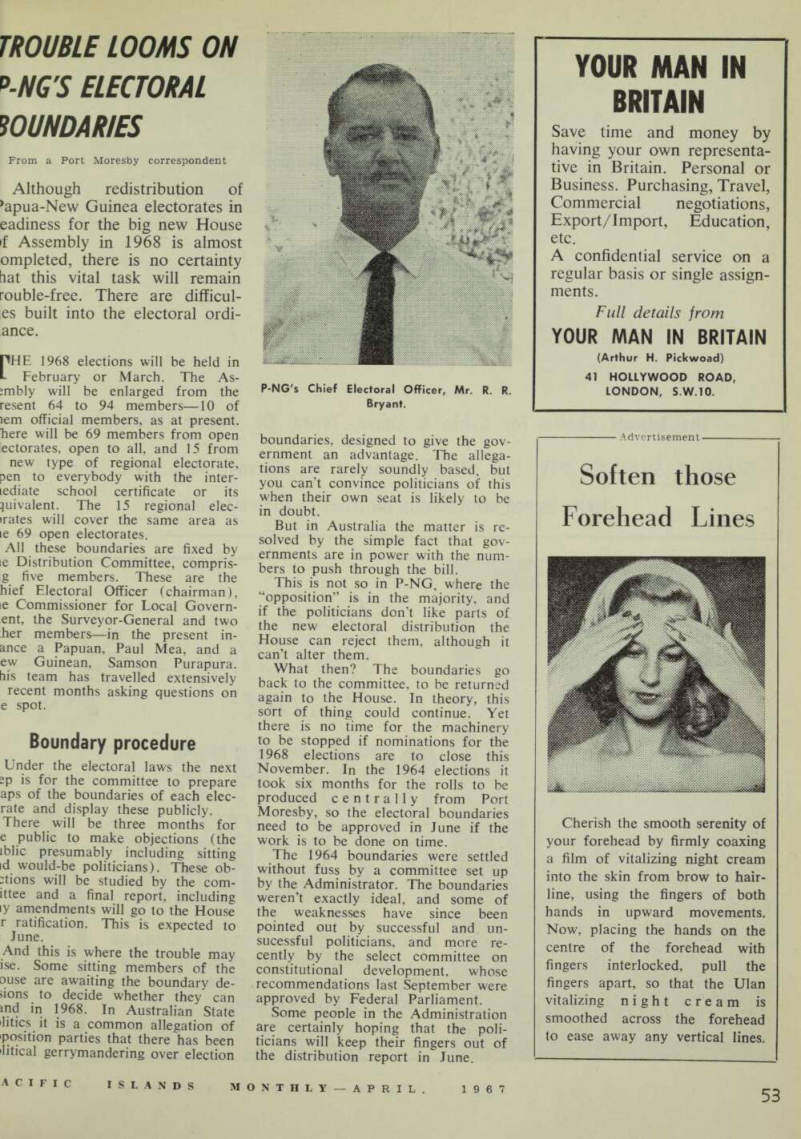
P-NG's Chief Electoral Officer, Mr. R. R.
Bryant.