Much Faster Than Fijian
p. 17 · Read in the full issue
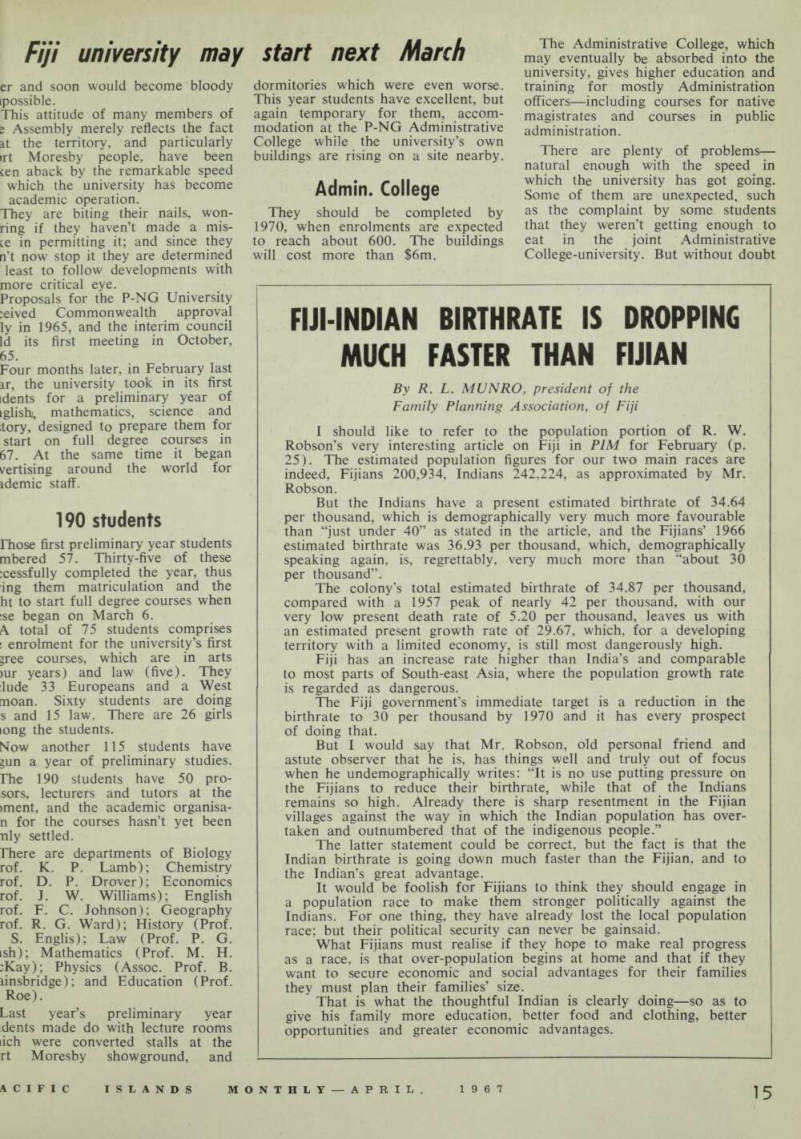
Fiji-Indian Birthrate Is Dropping
By R. L. MUNRO, president of the Family Planning Association, of Fiji
I should like to refer to the population portion of R. W.
Robson’s very interesting article on Fiji in PIM for February (p, 25). The estimated population figures for our two main races are indeed, Fijians 200,934, Indians 242,224, as approximated by Mr.
Robson.
But the Indians have a present estimated birthrate of 34.64 per thousand, which is demographically very much more favourable than “just under 40” as stated in the article, and the Fijians’ 1966 estimated birthrate was 36.93 per thousand, which, demographically speaking again, is, regrettably, very much more than “about 30 per thousand”.
The colony’s total estimated birthrate of 34.87 per thousand, compared with a 1957 peak of nearly 42 per thousand, with our very low present death rate of 5.20 per thousand, leaves us with an estimated present growth rate of 29.67, which, for a developing territory with a limited economy, is still most dangerously high.
Fiji has an increase rate higher than India’s and comparable to most parts of South-east Asia, where the population growth rate is regarded as dangerous.
The Fiji government’s immediate target is a reduction in the birthrate to 30 per thousand by 1970 and it has every prospect of doing that.
But 1 would say that Mr. Robson, old personal friend and astute observer that he is, has things well and truly out of focus when he undemographically writes: “It is no use putting pressure on the Fijians to reduce their birthrate, while that of the Indians remains so high. Already there is sharp resentment in the Fijian villages against the way in which the Indian population has over taken and outnumbered that of the indigenous people.”
The latter statement could be correct, but the fact is that the Indian birthrate is going down much faster than the Fijian, and to the Indian’s great advantage.
It would be foolish for Fijians to think they should engage in a population race to make them stronger politically against the Indians. For one thing, they have already lost the local population race; but their political security can never be gainsaid.
What Fijians must realise if they hope to make real progress as a race, is that over-population begins at home and that if they want to secure economic and social advantages for their families they must plan their families’ size.
That is what the thoughtful Indian is clearly doing—so as to give his family more education, better food and clothing, better opportunities and greater economic advantages.