Universities for the South Seas:
pp. 15-18 · Read in the full issue
suddenly there were two!
From PIM correspondents in Suva and Port Moresby
In Fiji in March members of the Legislative Council patted themselves on the back and basked in reflected glory as they gave approval for the Fiji Government to establish a University of the South Pacific, in Suva. At the same time in Port Moresby, members of the House of Assembly sniffed somewhat as the South Pacific’s first university, the newly-established University of Papua-New Guinea, opened its lecture rooms for its first degree courses.
JJNIFFED” is the word, because 5 there was no concerted attack l or overt objection to the university the P-NG Assembly. Merely umbling, and some cheeky asides d suspicion that New Guinea was tting something that it didn’t need >w, and which would turn out to .ve cost a lot more money than
anybody had admitted. And which would be filled with great numbers of overpaid academics forcing radical ideas into black skulls not ready to receive them.
Members commented, to each other more than to the record, on the numbers of professors and lecturers now to be seen loping
around Port Moresby and meeting in select groups (easily identified, as it was said, by their informal dress), and on the number of young men now inquiring into this or that bit of territory history for some thesis or other.
Port Moresby, it was pointed out, had become more ivory tower than
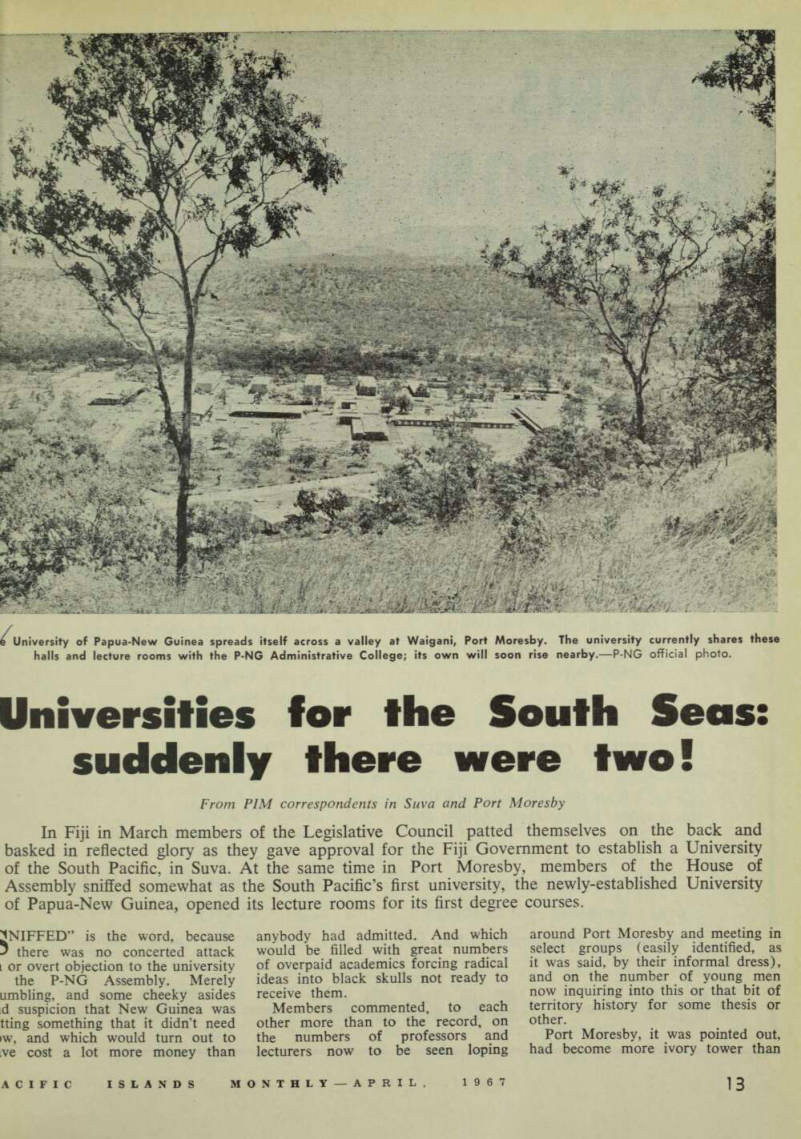
University of Papua-New Guinea spreads itself across a valley at Waigani, Port Moresby. The university currently shares these halls and lecture rooms with the P-NG Administrative College; its own will soon rise nearby.— P-NG official photo.
Fiji university may start next March
er and soon would become bloody [possible.
This attitude of many members of 2 Assembly merely reflects the fact at the territory, and particularly irt Moresby people, have been ten aback by the remarkable speed which the university has become academic operation.
They are biting their nails, won ring if they haven’t made a mis ce in permitting it; and since they n’t now stop it they are determined least to follow developments with more critical eye.
Proposals for the P-NG University :eived Commonwealth approval ly in 1965, and the interim council Id its first meeting in October, 65.
Four months later, in February last ar, the university took in its first idents for a preliminary year of iglish/, mathematics, science and lory, designed to prepare them for start on full degree courses in 67. At the same time it began vertising around the world for idemic staff.
190 students
Fhose first preliminary year students mbered 57. Thirty-five of these :cessfully completed the year, thus ing them matriculation and the ht to start full degree courses when :se began on March 6.
A total of 75 students comprises ; enrolment for the university’s first jree courses, which are in arts >ur years) and law (five). They lude 33 Europeans and a West moan. Sixty students are doing s and 15 law. There are 26 girls long the students.
Now another 115 students have ?un a year of preliminary studies.
Fhe 190 students have 50 pro sors, lecturers and tutors at the >ment, and the academic organisa n for the courses hasn’t yet been nly settled.
Fhere are departments of Biology rof. K. P. Lamb); Chemistry rof. D. P. Drover); Economics rof. J. W. Williams); English rof. F. C. Johnson); Geography rof. R. G. Ward); History (Prof.
S. Englis); Law (Prof. P. G. ish); Mathematics (Prof. M. H. :Kay); Physics (Assoc. Prof. B. dnsbridge); and Education (Prof.
Roe), Last year’s preliminary year dents made do with lecture rooms lich were converted stalls at the rt Moresby showground, and
dormitories which were even worse.
This year students have excellent, but again temporary for them, accom modation at the P-NG Administrative College while the university’s own buildings are rising on a site nearby.
Admin. College
They should be completed by 1970, when enrolments are expected to reach about 600. The buildings will cost more than S6m.
The Administrative College, which may eventually be absorbed into the university, gives higher education and training for mostly Administration officers—including courses for native magistrates and courses in public administration.
There are plenty of problems— natural enough with the speed in which the university has got going.
Some of them are unexpected, such as the complaint by some students that they weren’t getting enough to eat in the joint Administrative College-university. But without doubt
Will Australia help Fiji, too ?
P-NG now has a university that is a going concern.
Fiji’s first university may get going by March, 1968. It will be estab lished at the RNZAF base at Laucala Bay, near Suva, which is being closed.
Fiji University
New Zealand has offered the build ings free and the British Government in March offered £ 1.25 m sterling to wards the capital costs, and said it would help meet the cost of employ ing British staff for a time, if Fiji was agreeable.
At the March meeting of the Fiji Legco, members were unanimous in being agreeable. The university, they thought, was a fine idea and every body hoped some of the credit would rub off on them.
There was almost a row when the Member for Social Services, Mr.
Vijay R. Singh, in moving the motion, said, “We, the Alliance Government, are taking a positive step forward in our declared aims of building a racially integrated society”.
The Leader of the Opposition, Mr.
A. D. Patel, who has talked about a university for years, not unreasonably thought the Alliance Government was trying to steal the thunder of the Federation group.
Other Federation Party speakers stressed the big part that Mr. Patel had played in pressing for a uni versity, and Mr. James Madhavan, the Deputy Speaker, went so far as to laud Mr. Patel as the man who “wholly and solely had implemented the idea of a university in Fiji”.
Mr. Wes Barrett, an Alliance man, thought the establishment had been a co-operative effort over some time, and he protested.
Some criticism
Mrs. Jai Narayan, the only woman on the Opposition benches, took the feminine view with the comment that Mr. Singh’s job, speaking of his role as mover of the motion, had been “to hold the baby for its christening”.
Mr. Singh in his turn, replied that his job hadn’t been to hold the baby but to take the pregnant mother to the maternity hospital. This brought a return to good humour all round, and Fiji agreed to have its university.
But not before some criticism was voiced of the university’s academic planner, Sir Norman Alexander.
Sir Norman had said in his report that the university must be auto nomous and not under immediate Government direction though set up
by Government legislation; that academic matters must be completely under the control of the appropriate university authority.
Sir Norman had added: “Auto nomy does not mean, however, that a university is entitled to go its own way regardless of the wishes of the Government or Governments which support it. As but one arm of the whole educational system, it must meet the needs and wishes of the area, as interpreted by the Govern ments concerned. It must work within the limits of a policy laid down; but it must be autonomous in its internal affairs.”
This attracted fire from Mr. Koya, another Opposition member.
“Who are we to dictate to pro fessors what the curriculum should be?” asked Mr, Koya indignantly.
And he warned: “You will kill the university the moment you say ‘Here is Government policy and your free dom is within this framework 4 .”
He pointed to “what happened in Nazi Germany, in Russia and in some South African universities and the so called cultural revolution in Red China”, as examples of what happens when academic freedom is interfered with.
All were agreed, including Mr.
Singh and Mr. Patel, that the new university must be free of any shadow of political pressure.
The Leader of Government Busi ness, Ratu K. K. T. Mara, who is Fiji’s “Premier”, praised the gene rosity of the British and New Zealand governments and added, pointedly, “I am sure that sooner or later we will be able to include the Australian Government—l hope”.
The new university will be for English-speaking students in various
territories of the South Pacific well as from Fiji, but who exac: these will be is not yet known.
There has in fact been son* criticism outside Fiji that with ft establishment of the New Guim University there is not now the san urgent need of a “South Pacii university” in Fiji.
What Fiji report says
Sir Norman says in his report, i leased in March: “There is perhaps no parallel the proposed university—one un versity serving a number of territorr under a number of governments widely differing pattern and certain no single university which caters ft such an enormous area. Spec: problems will require special measui and precedents from more develop: countries simply will not apply.”
Sir Norman proposes that t) university should provide a core studies leading to university degre of international standard. Work ft higher degrees should be introduc: as soon as possible.
In addition, there should be ass; ciated institutions offering diplon and certificate courses below the lev of a degree.
He says initially the subjects offen in degree courses should be confinr to English, history, geography, eduo tion, economics and sociology in ft Arts Faculty and mathematii physics, chemistry and biologic sciences in the Science Faculty, was hoped that the degrees would regarded as comparable with those Australia and New Zealand.
Sir Norman estimates capital coc from 1967 to 1970 at £1,520,000 ai the net recurrent cost at £80,400 tl; year rising to £513,530 in 1971. I suggests several possible sources external aid.