Bikes are 'carry-alls'
pp. 32-35 · Read in the full issue

exception of a few of the larger islands where the co-operative societiu operate trucks for the collection o copra and distribution of cargo 1 the village branches.
On these islands the roads, of corn mud, soon become pot-holed witi consequential wear and tear o vehicles.
The bicycle is the carry-all of tH islands, and I have seen some fanj tastic loads being carried by cyck and even ridden with them. The mo:c memorable was a pig which ws riding on the crossbar with its from trotters over the lamp. The ridel had no need for a bell!
The village stores’ usual stock com prises the basic necessities, such s rice, flour, salt, etc.—most of strewn on the floor of the crude teWs huts.
The stores open at the whim of thri storeman, and as the Gilbertese shoe on a meal-to-meal basis, there i likely to be a demand for the ston to open from dawn to dark.
All in all it is a simple life, fas from the maddening throng, but fen all its apparent idyllic nature economic pressures make themselve felt.
On the one hand, land is severe!! limited; and, on the other, the peopll increase steadily in numbers, as thr birthrate, allied with a better survives rate brought about by better medics care, is beginning to make the Resh dent Commissioner feel like the old woman who lived in a shoe.
We thus find conditions forcing thr overcrowded people in the outes islands to seek relief and employment! at colony headquarters on Tarawa.
Employment opportunities
As Betio is the main port of entni for the colony, all heavy cars, trucks and food arrives them from overseas to be offloaded for distribution to all the other islands.
In addition, Betio is the collection and dispatch point for the colony’;' l copra—an average of 6,000 ton:r being picked up in four to six loadd per year.
There is therefore employment opc portunities for labourers unloading! and loading copra from the outer: islands and also discharging overseas* vessels.
This employment is such that ili alternates between periods of intense; activity using the maximum available) labour to almost complete stagnation: r and we all know the saying that “thei Devil soon finds work for idle hands”
“The Bright Lights of Betio” is a lomewhat sarcastic term used by Europeans on Tarawa, yet it is per laps more apposite than they realise, n contrast with the other islands, Setio must seem to be a veritable Broadway to the Islanders.
There is electric power 24 hours i day, and many an Islander spends lappy hours switching on and off this niracle of instant light.
There are two open-air cinemas >ffering a choice of entertainment :very day of the week and twice on Sundays. To people who may never lave seen the “movies” at all until hey came to Betio, all this is heaven md no more to be wondered at than he rabid “watch-anything-as-long-as t-moves” TV addict in NZ, Australia >r Britain,
Plenty of merchandise
There are some 10 or 12 stores m Betio, from the “giant” Wholesale Society to the humble mronron, or amily store.
In the Wholesale Society store, here is a selection of upwards of 1,000 items of merchandise—food, Nothing, tools, outboard motors, fisti ng gear, radios, watches and motor cycles. (What a status symbol the notor cycles are, especially with ilenty of chromium plating and at east two rear vision mirrors!) Betio people have a choice of at east three cafes, including Bong Kum Cee Brothers’ Chinese restaurant, vhich rivals Sydney’s Haymarket area hop suey joints.
Bong will provide a delicious chow nein or steak a la Australian for >ne or 100; and one thing you can )e sure of is that there will be too nuch to be able to eat it all.
Last, but by no means least, there ire the bars where Australian beer s served “in the can”.
Nei Binobino is the most prominent bar. It is open on three sides—the bar has to be somewhere—and the tables and form are just like a Victorian beer garden.
The volcano-like heap of silver, green and blue cans outside the bar every morning is a pretty (nauseating) sight.
Unfortunately, the number of “drunk and incapable” rises in direct ratio to the heap of cans, and at least ensures a steady supply of prisoners for such tasks as cleaning grease traps and pulling up the meagre grass from outside the police station.
ProblGm of / bubuti /
All the foregoing is routine in some other parts of the Pacific, but what makes the urbanisation of Betio such a problem is the Gilbertese custom of bubuti.
Under this custom of family fellowship, if you have two bananas and your wife’s cousin twice removed asks to share them, it would be most shameful not to give him (or her) at least one of the two bananas.
Consequently, if a relative turns up on Betio and bubutis accommodation,
it matters little that you already have 20 people living in a hut about 10 feet square. Everyone moves up a bit more, Thus life on Betio is becoming quite a squeeze, particularly as the end nearest to Bairiki is only about 100 yards wide for at least a half to three-quarters of a mile. The normal population is about 1,500 men, women and children, War loft itc crarc dr 15 5Ld 5 The entire tree population was devastated during the Battle of Tarawa in 1943. Consequently, palm growth is comparatively new; but much of this is stunted because the B ro “ nd was compacted to make the wartime airstrip, Present estimates of population are conservatively put at 4,500. Natural food supplies are totally inadequate for this number, and, what is more important, water supplies are always at . a critical level after only a month w ' ,h ° ut ram—and this in an area whlch c ?n go. a whole year without measurable rainfall.
Sanitation, too, presents a problem, not only on the score of excremental
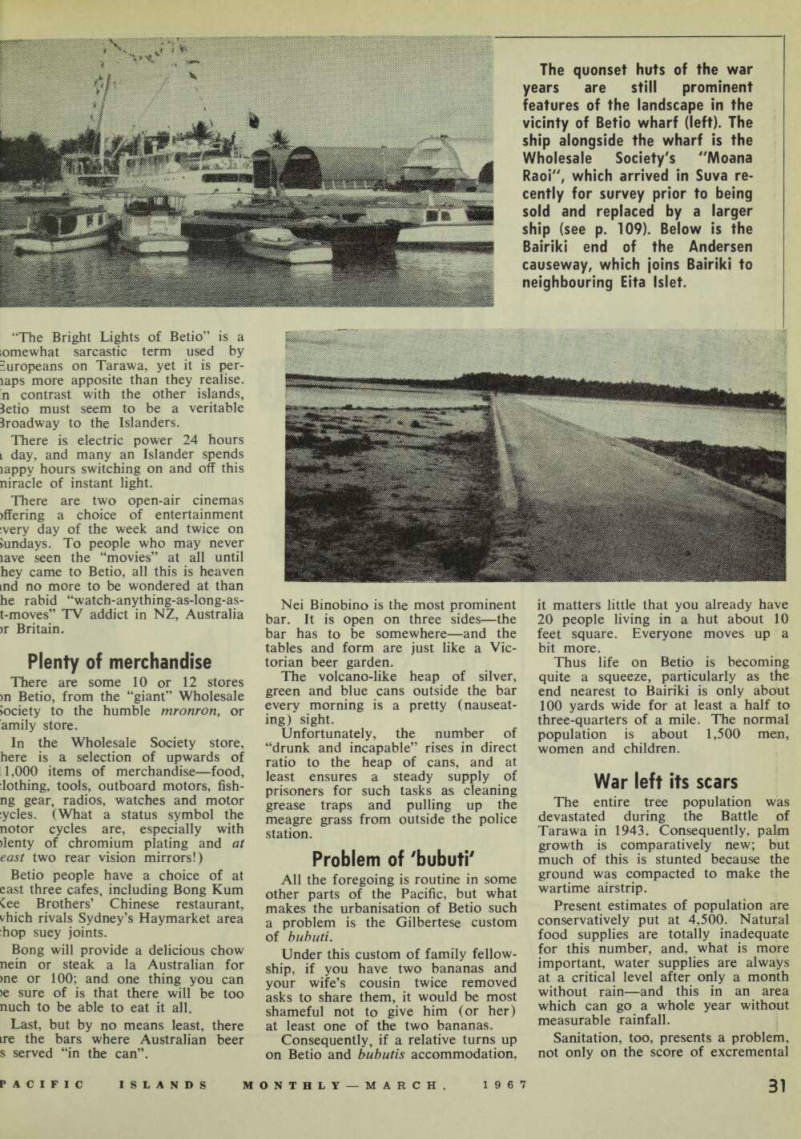
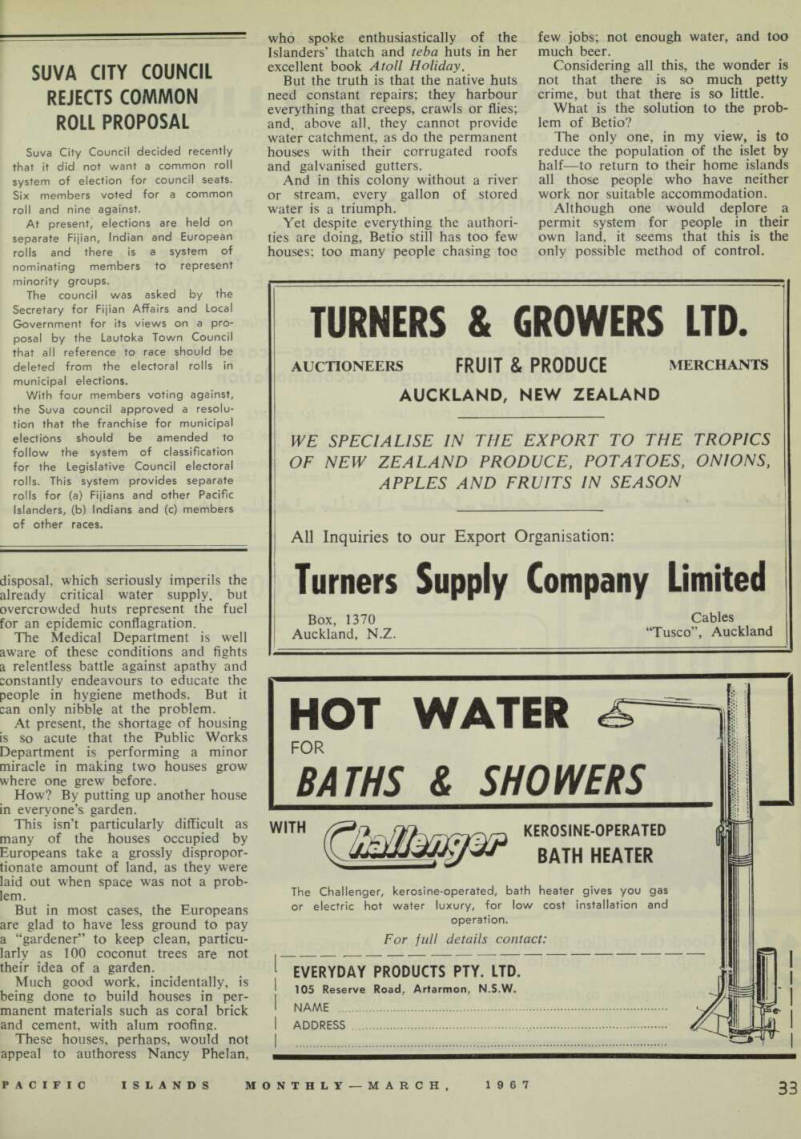
The quonset huts of the war years are still prominent features of the landscape in the vicinty of Betio wharf (left). The ship alongside the wharf is the Wholesale Society's "Moana Raoi", which arrived in Suva re cently for survey prior to being sold and replaced by a larger ship (see p. 109). Below is the Bairiki end of the Andersen causeway, which joins Bairiki to neighbouring Eita Islet.
disposal, which seriously imperils the already critical water supply, but overcrowded huts represent the fuel for an epidemic conflagration.
The Medical Department is well aware of these conditions and fights a relentless battle against apathy and constantly endeavours to educate the people in hygiene methods. But it can only nibble at the problem.
At present, the shortage of housing is so acute that the Public Works Department is performing a minor miracle in making two houses grow where one grew before.
How? By putting up another house in everyone’s garden.
This isn’t particularly difficult as many of the houses occupied by Europeans take a grossly dispropor tionate amount of land, as they were laid out when space was not a prob lem.
But in most cases, the Europeans are glad to have less ground to pay a “gardener” to keep clean, particu larly as 100 coconut trees are not their idea of a garden.
Much good work, incidentally, is being done to build houses in per manent materials such as coral brick and cement, with alum roofing.
These houses, perhaps, would not appeal to authoress Nancy Phelan,
who spoke enthusiastically of the Islanders’ thatch and teba huts in her excellent book Atoll Holiday.
But the truth is that the native huts need constant repairs; they harbour everything that creeps, crawls or flies; and, above all, they cannot provide water catchment, as do the permanent houses with their corrugated roofs and galvanised gutters.
And in this colony without a river or stream, every gallon of stored water is a triumph.
Yet despite everything the authori ties are doing, Betio still has too few houses; too many people chasing too
few jobs; not enough water, and too much beer, Considering all this, the wonder is not that there is so much petty crime, but that there is so little, What is the solution to the prob lem of Betio?
The only one, in my view, is to reduce the population of the islet by half—to return to their home islands all those people who have neither work nor suitable accommodation, Although one would deplore a permit system for people in their own land, it seems that this is the only possible method of control.