Geic's Outer Islanders
p. 31 · Read in the full issue
Flock To The "Bright
Lights" Of Tiny Betio
Prom a Tarawa correspondent Except for the people of the Gilbert and Ellice Islands Colony and the Americans who fought there during World War 11, few people, as yet, are familiar with the name of Betio
(pronounced Bay-she-oh).
LOOK up any atlas you like, look up any gazeteer, and you will irobably find that the existence of letio has not even been recognised ti the outside world.
But Betio is real enough, for, since he war it has become to the people if the Gilbert and Ellice Islands Colony what Suva is to Fiji, what •apeete is to French Polynesia, or t'hat Port Moresby is to Papua-New Juinea.
It is the chief port and commercial entre of the GEIC, and, for that eason, a place of “bright lights”, /hich continually attract more and lore people from the outer islands.
Betio, indeed, has grown so big hat it now has the dignity of a town ouncil, which, in December last year, iassed a series of by-laws in an ffort to control and regulate its rowth.
Two square miles
And Betio’s growth certainly needs ome controlling, for unlike Suva, ‘apeete, Port Moresby and any other sland capital, Betio has no more han two square miles in which to xpand.
The reason for this is simple
enough, for Betio is only an islet some 2i miles long by 800 to 1,200 yards wide on average.
Situated at the south-western end of Tarawa Atoll, it has developed into its present state largely because the Japanese occupied it, built an air strip there, and strongly fortified it during World War 11.
In late November, 1943, Betio became the scene of one of the fiercest and bloodiest battles of the war when northward-sweeping United States forces attacked and captured it.
This was the famous Battle of Tarawa.
Good anchorage
The Americans immediately re stored the Japanese-built airfield on Betio and built a new bomber strip; while British administrative officers, who had landed with the Americans, re-established civil government in the colony.
After the war, there was a good deal of official shilly-shallying about where the colony’s administrative headquarters should be, and it was not until 1952 that it was decided to site them on neighbouring Bairiki Islet.
However, by this time the Colony
Co-operative Wholesale Society and other commercial interests had in vested a lot of capital in Betio, and they stayed there, as did the District Commissioner and his staff.
Betio, in any case, had superior advantages as a port, as it is the nearest islet to the entrance to Tarawa lagoon, and has a good an chorage.
Nowadays, administrative offices and facilities of one sort and another are spread all the way from Betio to Bonriki Islet at the south-eastern corner of the atoll.
Through the construction of two causeways in 1963, it is possible to drive all the way from Bonriki to Bairiki, a distance of 20 miles.
Betio, however, is isolated except by boat. But that does not detract from it in the eyes of the Islanders, who flock to it from the outer islands in the same way as outer islanders in other parts of the Pacific have been flocking to their capitals.
Simple life
To understand what Betio means to the people of the GEIC, one must first consider what life is like on the outlying islands.
On these islands everyone exists on a coconut and fish diet, supple mented by taro and babai (pandanus palm nuts), with an occasional chicken or pork feast.
Very few islands have roads and consequently motor vehicles, with the
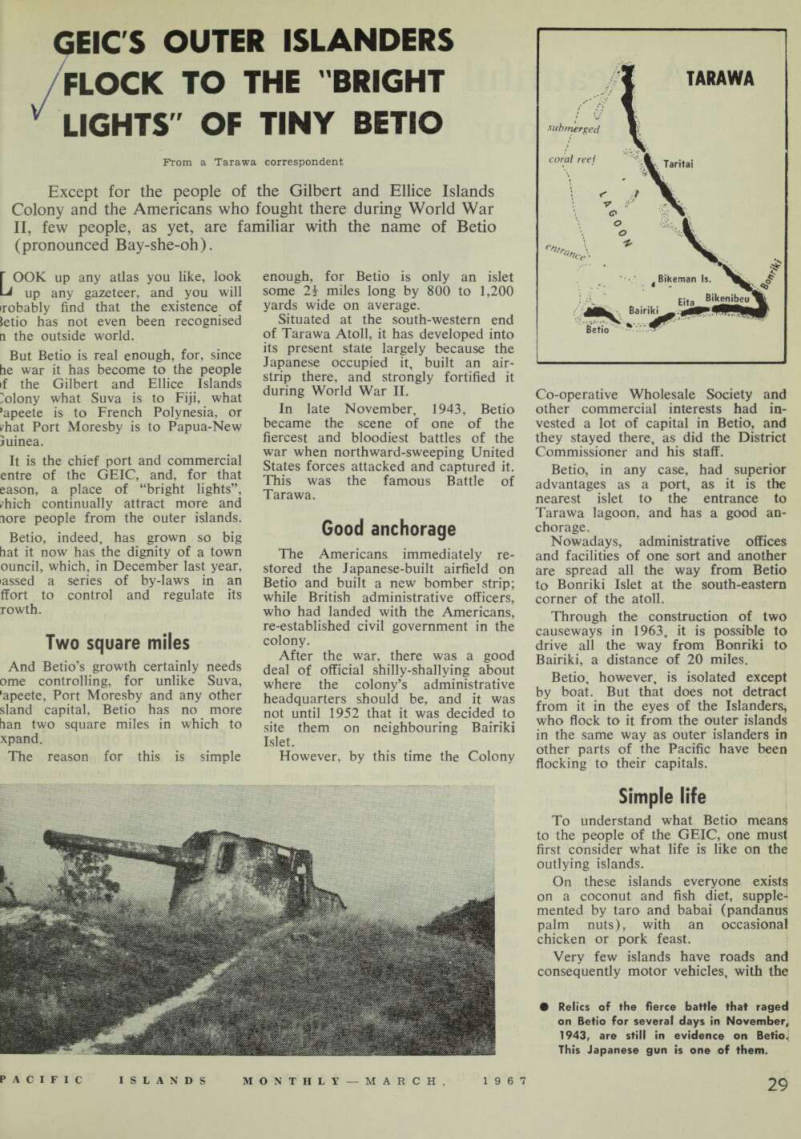
Relics of the fierce battle that raged on Betio for several days in November, 1943, are still in evidence on Betio.
This Japanese gun is one of them.