Brisk prosperity has come
pp. 18-157 · Read in the full issue
Goodbye , leisurely ways!
Brisk prosperity has come to Norfolk Island
From Merval Hoare on Norfolk Island It’s a case of hurry if you want to visit Norfolk Island to catch something of the leisurely atmosphere of island life. For this atmosphere is disappearing as the island moves forward in a phase of unprecedented prosperity.
NORFOLK had its convict era with mass misery highlighted by rebellions and executions. Then came more than 100 years of peace—if not plenty—following the arrival of the Pitcairners in 1856. And now it’s in the tourist era.
Recent publicity overseas has brought a large number of new settlers and a record number of tourists to this isolated spot in the Pacific.
There are more people to build shops, guest houses and motels, more people to cater for tourists, and more tourists to use the accommodation and spend money in the shops.
So Norfolk, which in 1961 had a population of 884 and 978 visitors, in 1966 had a population of 1,152 and 6,178 tourists. But for the currency restrictions imposed on New Zealanders travelling overseas and the recent Qantas strike, the island would have had even more visitors in 1966.
Before World War 11, Norfolk had no tourist industry to speak of, but the laying of the airstrip in the early 1940’s provided an air link with the mainland and opened up possibilities of a thriving tourist trade which are now being realised. At present Qantas planes fly in from the mainland daily.
Islanders outnumbered
The influx of settlers and tourists and the associated prosperity are, to
a degree, changing Norfolk.
Mainlanders outnumber the Islanders. Hire-cars and motor scooters overrun the island day in and day out. Shops and blocks of flats cover up some of the empty spaces as the building boom started around 1964 continues apace. And some of the shops catering for
visitors are open seven days a week.
There is full employment on the island today. Many people formerly engaged in seasonal work have been drawn into regular employment to maintain their present standard of living, which, indeed, is higher than ever.
People do not gossip on the roads as often as they did 10 years ago. It would be foolish to linger around the corner of New Cascade Road and Taylors Road these days, because the traffic there is often thick and fast.
Although the speed limit in this area is 25 miles an hour, it’s amaz ing how many people drive through at 40.
Superb views
True, the scenery is still something to write home about. Towering dark green pines stud the landscape in every direction; the sea foams up against the precipitous cliffs ringing most of the island and crashes whitely on the reef at Kingston; colourful birds haunt the valleys.
But there is a plan to build a new coast road on the east side of the island which will link up with the existing road running from Kingston through to Headstone on the west coast and on to Anson Bay.
Then people will be able to driv right round the island.
The views will be superb and thi scenic drive deservedly popular. Bu some of the loveliest and mo« secluded spots will be cut through bd the main highway.
However, this road is still in thrl planning stage and is not expectes to become a reality for at least twv years.
Faith in Norfolk’s future has bees shown by business groups who haw recently invested heavily in new enter prises.
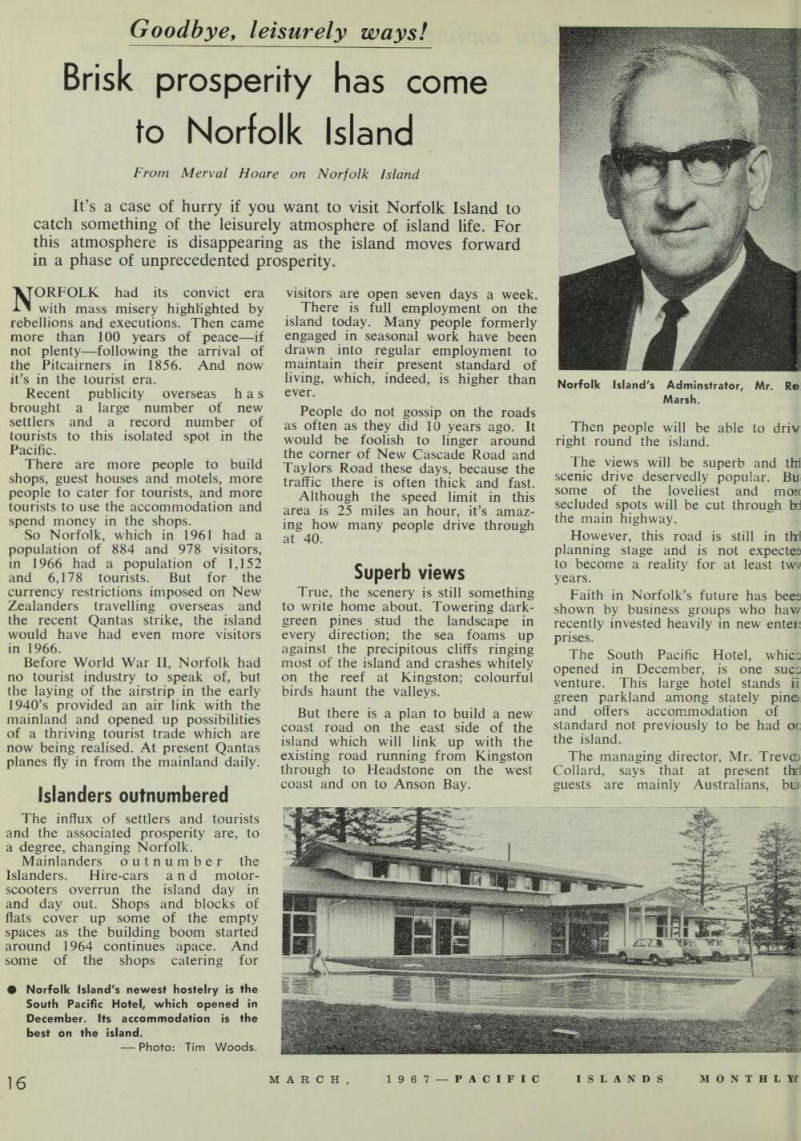
The South Pacific Hotel, whies opened in December, is one sues venture. This large hotel stands ii green parkland among stately pin© and offers accommodation of standard not previously to be had oc the island.
The managing director, Mr. Trevco Collard, says that at present thd guests are mainly Australians, biu
Norfolk Island's newest hostelry is the South Pacific Hotel, which opened in December. Its accommodation is the best on the island. -Photo: Tim Woods.
Norfolk Island's Adminstrator, Mr. Re Marsh.
°w fishing plan
jkings are coming in steadily from er countries, Jood accommodation was once icult to get on Norfolk but this 10 longer the case. from the South Pacific the nd has three other large hotels, fhere are also a number of guest ises, flats and holiday cottages, ny of these are brand-new and 1-appointed, Accommodation Proprietors lociation formed last year has as i of its aims the healthy develop nt of the island’s accommodation ustry.
Flying plan
dr. Don Reidpath, managing ;ctor of Norfolk Enterprises Ltd., plans for an aviation service rating scenic flights for tourists, s a pilot-training scheme.
Jut Australia’s Department of Civil iation will not grant approval to y an aircraft for the service—a v 1967 Cessna 172—from Coffs rbour to Norfolk Island on the und of long exposure over water, io Mr. Reidpath is still trying to rk out a way to get his service ted.
Another industry which is about to started is fishing, for which a fish lory, being built at Cascades by rfolk Island Processes Ltd., was ring completion in February, n January the first of the com y’s aluminium fishing boats, the itai, arrived from Sydney and has :e undergone trial runs, fhe crew of this vessel will consist local fishermen, and local women 1 be employed in the factory’s king department.
Norfolk Island Processes Ltd. has assured market in Australia for its zen fish.
Opportunists
slot everyone is enthusiastic about ne of the latest commercial pro ts, which, in general, are in the ids of newcomers, iome people regard the owners of new shops and businesses as Dortunists who have come to the ind with the intention of making quick fortune and leaving.
Fhis was the feeling that prompted : previous council in 1965 to re nmend that persons other than •rfolk Islanders must be resident the island for five years before ting up any business other than a tst house, private hotel or agri- Itural project; and that persons dung to start in business within it period should apply to the Ad
ministrator, who would refer the matter to council. These recom mendations did not become law, but the same feeling that prompted them lingers on.
Bound up with the island’s pro gress are increasing land transactions.
The number of land transactions, for the year ending June, 1966, was 212 —an increase of 61 on the previ ous year.
There are still farms, building blocks and good areas of grazing land for sale, but in keeping with the
times, prices are high.
Many residents with leased land are patiently waiting for the con version of leasehold land to freehold which was mooted several years ago, but the necessary legislation has not yet been passed.
The Minister for Territories re cently approved a draft Land (Sub division) Ordinance and as council has stressed the need for urgency, land laws may soon be up to date.
As Norfolk is only a small place,
(Continued p. 155)
:annot accommodate an unlimited riber of people. Consequently, re has been some concern about d being bought by persons who /c not been accepted as residents. 3y notices in the Government zette, the Administration has ified the public that the purchase land —including the transfer of a own lease to which official ?roval has been given—will not in ;lf create any right to permanent idency.
Applicants for permanency must vc an independent income $l,OOO a year in the case of a gle person and $1,500 for a irried couple, plus a reserve ain s t contingencies. Additional alifications include character re ences, a health certificate and a ;st X-ray as proof of freedom »m tuberculosis.
Norfolk still gets a generous hand t from the Commonwealth Gov iment in the form of a grant, but ; amount allotted is falling slightly.
In 1964 it was £33,700; the fGi ving year it was reduced by £3OO d last year it had fallen to $66,000 13,000).
The continuing healthy state of the and’s economy will no doubt bring rther reductions in the Common :alth grant.
Topping the island’s list of money inners are the attractive postage imps now being issued regularly. ;venue from this source during 65-6 totalled $172,233.
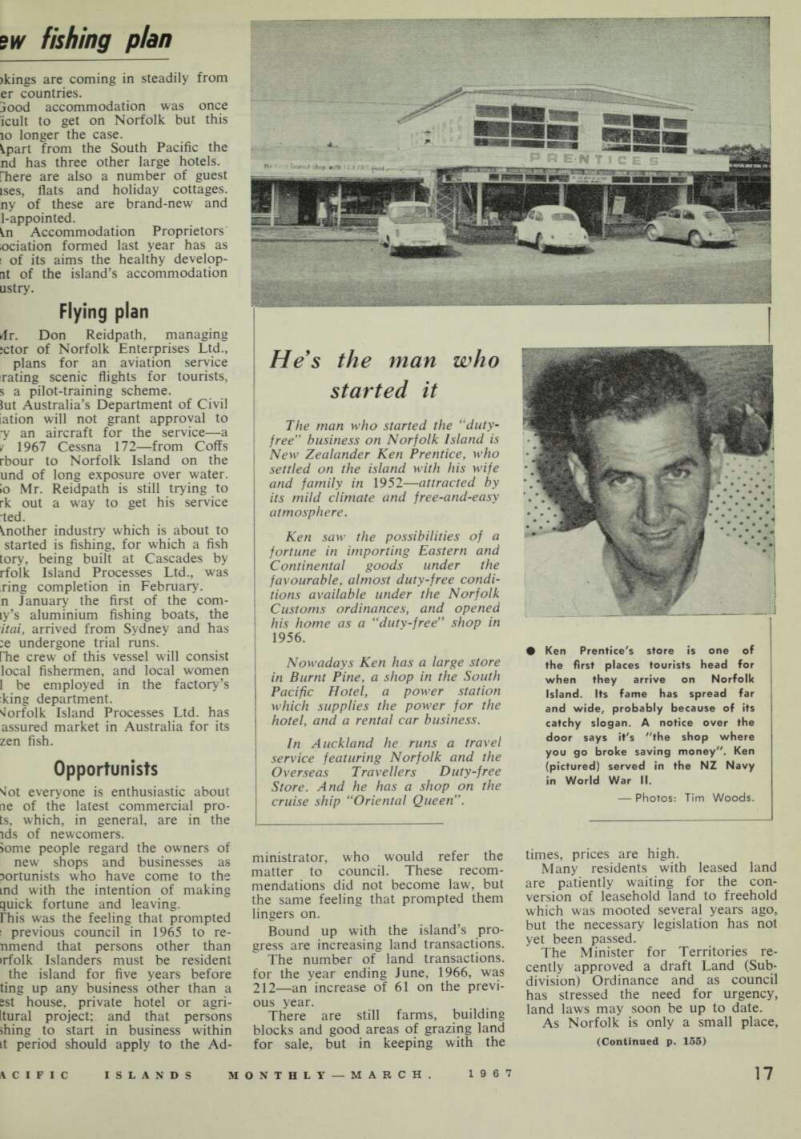
Customs duty for the same period ought in $85,054. Some of this aney came from duty levied on s “duty-free” goods sold in the i “duty-free” shops catering especi ly for tourists.
These articles, as a matter of in rest, have a low duty imposed i them, and the term “duty-free” used by retailers to boost sales.
Liquor profits
Norfolk’s liquor is still imported >lely by the Administration and ofit on sales from the Liquor Bond another good source of revenue, or the period under review (1965- 3), this amounted to $40,784.
The Accommodation Proprietors’ ssociation recently asked the coun -1 to reduce the cost of liquor sold i its members to enable them to :tail it in their guesthouses at rices comparable with the Bond’s rices.
The Chamber of Commerce, at its February meeting, carried a motion recommending that public bar licences be issued and that the council be informed of their wishes in this re spect.
However, these proposals are not expected to be favoured by council.
One reason is that their inclusion in the new ordinance could channel useful revenue away from the public purse.
The Administration’s major ex penditure at the moment is on education. This is a programme in which the Administrator, Mr. Reg Marsh, a former school teacher, is keenly interested.
Additional accommodation is be ing built for new teachers, and a class assembly block will be erected at the school.
The administrator and council also have plans to develop Philip Island as a tourist attraction; and there is no doubt that this colourful island, with its abundance of bird life, would be of great interest to visitors.
But first it will be necessary to make a suitable landing place and cut a road up the steep cliffs sur rounding the island.
Political changes
Politically, things are changing too.
When Mr. Marsh took office nine months ago he suggested to the Council the creation of committees of economic affairs and social affairs, in addition to the existing works and finance committees.
This was done and the four com mittees have since handled a pro digious amount of work.
The present council is probably the busiest ever. The administrator,
who is chairman of the council, likewise maintains a full schedule.
Norfolk citizens are aware of the changes taking place and the faster pace of life, and from time to time voices are raised in the council and letters appear in the weeklv roneoed newspaper The Norfolk Islander, calling for the preservation of “the island way of life”.
This traditional feature—unhurried and unsophisticated—has a definite appeal to Mainlanders wishing to get away with it all, and it has be come an important commodity locally now that it is marketable.
Complaint over hoardings
In 1965 a number of residents petitioned the council on the sub ject of hoardings—complaining that they defaced the beauty of the island and asking that something be done about them.
Some of the offending signs, in turn, were defaced by persons un known. But today hoardings are accepted: they have become part of the landscape.
An obvious incompatibility exists between the former leisurely atmos phere and the brisk prosperity geared to tourism that is part of Norfolk life today.
To arrest the deterioration in the island way of life it would be neces sary to limit the number of visitors and stifle business expansion.
In short, it would be necessary to turn back the clock, which can’t be done.
The "Maitai", the aluminium fishing boat which arrived at Norfolk Island for Norfolk Island Processes Ltd., in January, is seen here undergoing trials off the island.— Photo: Tim Woods.