Stamps, Stamps, Stamps
pp. 13-15 · Read in the full issue
Everyone's Joining The
Philatelic Bandwagon
By a staff writer
Until the beginning of World War 11, about the only in dustries that anyone had dreamed up to keep the islands of the South Pacific on their economic feet were copra, coffee, cocoa, sugar, gold-mining, timber, phosphate, and vanilla.
SEN, in the year 1939, someone in the British Colonial Service the brilliant idea of issuing a of postage stamps for tiny, isola- Pitcairn Island (which had /iously used New Zealand stamps) nd, 10, the Great Postage Stamp astry of the South Pacific was n.
IM commented sourly when the Pitcairn stamps were mooted that r issue would be “a gentlemanly P against philatelists”. ut it predicted that every stamp .ctor in the world would soon ll k ~c ry a^ter the new stamps, t sf t . the , st ?^ ps . should bring in i £W°(m to £2*ooo IM’s prediction for Pitcairn id has more than come to pass e last 27 years, for Pitcairn is indulging in its gentlemanly ramp nst the world’s stamp collectors, is still making a lot of money of them ntil well after World War 11, urn Island was pretty well the
only South Pacific territory which deliberately made a business of its postage stamps, Nowadays, however, almost every territory has hopped on the philatelic bandwagon to rake in the stamp col lectors’ shekels. About the only ex ceptions are American Samoa (which uses US stamps), Nauru (which makes so much money out of phosphate that postal revenue is un important) and Niue (which has not woken up to the idea of money making stamp issues yet).
Even the most unlikely territories have blossomed forth with philatelic bureaus to keep the collectors and informed 0f ,heir forthcoming The Solomon Islands, with only six post offices, has just produced the first issue of a quarterly stamp magazine; the Fiji Post Office has its regular Philatelic Bulletin; and almost all the other territories produce a regular stream of literature ranging from attractive three-colour brochures from the New Hebrides to single
duplicated sheets issued by the Central Post Office at Tarawa, Gilbert and Ellice Islands Colony.
A perusal of this philatelic litera ture makes it clear that the various Islands administrations are constantly trying harder to snare more and more of the stamp collectors’ dis cretional dollars.
New definitive issues, commemora tive issues, and issues overprinted on one pretext or another seem to roll off the presses at the rate of about one a week these days, and the un initiated observer might well wonder who on earth is ever going to collect them all.
It seems, however, that the Islands have no need to worry about finding collectors to buy their stamps, so long as the stamps are attractive and “philatelically clean” (i.e., that thev are free of deliberate printing errors and there is no suggestion of the market being cornered with offi cial connivance, etc.).
At present, according to leading Sydney stamp dealers, Islands stamps are enjoying an unprecedented boom in popularity among collectors. This is because the South Pacific has previously been a largely neglected area; because its stamps are exotic and romantic in the eyes of most collectors; and because, in the case of some territories, it is still possible to obtain all the stamps ever issued
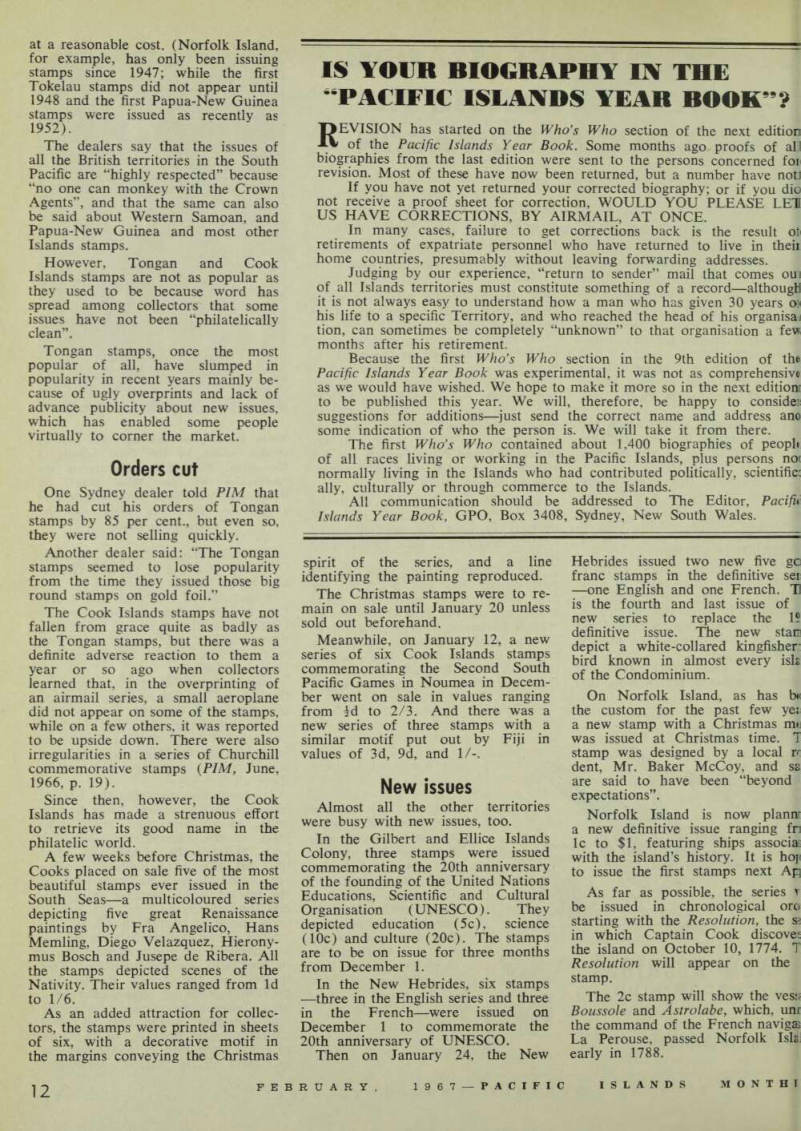
Part of any modern post office's duty when issuing a new stamp these days is to provide an attractive first day cover to go with it.
This design, printed in red, green and black, appeared on the first day cover put out by the New Hebrides recently for a new definitive issue.
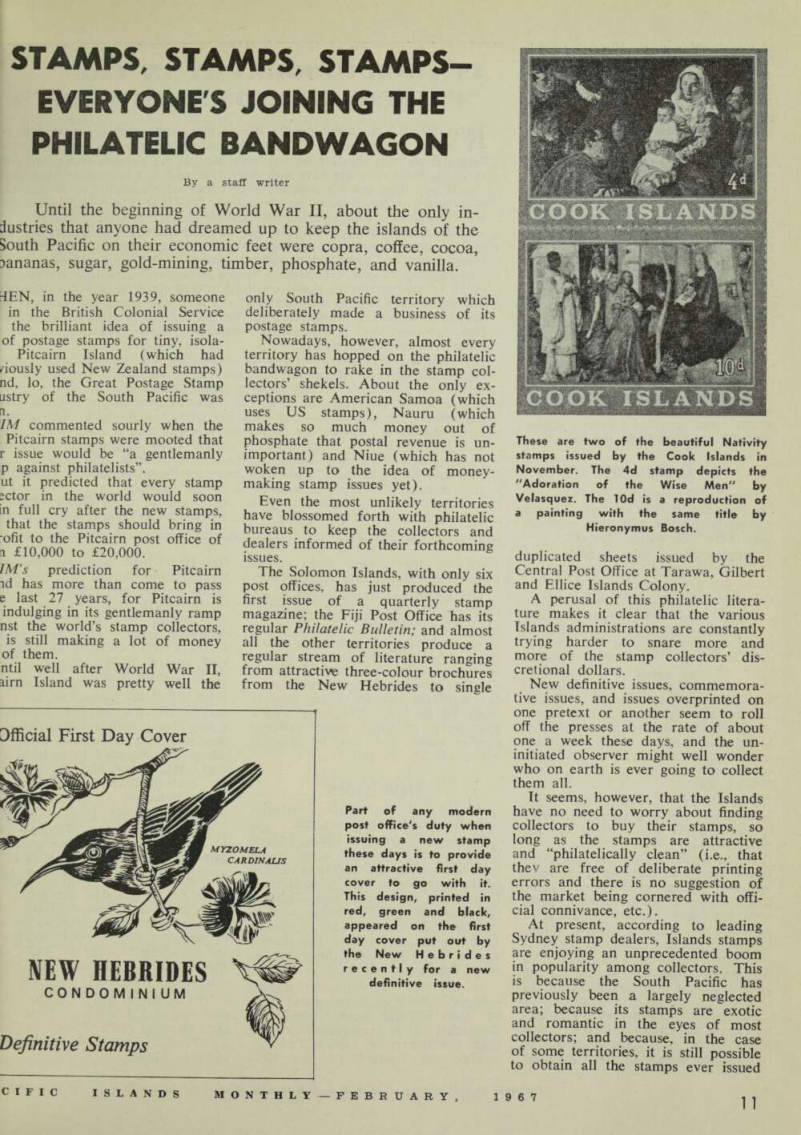
These are two of the beautiful Nativity stamps issued by the Cook Islands in November. The 4d stamp depicts the "Adoration of the Wise Men" by Velasquez. The 10d is a reproduction of a painting with the same title by Hieronymus Bosch.
at a reasonable cost. (Norfolk Island, for example, has only been issuing stamps since 1947; while the first Tokelau stamps did not appear until 1948 and the first Papua-New Guinea stamps were issued as recently as 1952).
The dealers say that the issues of all the British territories in the South Pacific are “highly respected” because “no one can monkey with the Crown Agents”, and that the same can also be said about Western Samoan, and Papua-New Guinea and most other Islands stamps.
However, Tongan and Cook Islands stamps are not as popular as they used to be because word has spread among collectors that some issues have not been “philatelically clean”.
Tongan stamps, once the most popular of all, have slumped in popularity in recent years mainly be cause of ugly overprints and lack of advance publicity about new issues, which has enabled some people virtually to corner the market.
Orders cut
One Sydney dealer told PIM that he had cut his orders of Tongan stamps by 85 per cent., but even so, they were not selling quickly.
Another dealer said: “The Tongan stamps seemed to lose popularity from the time they issued those big round stamps on gold foil.”
The Cook Islands stamps have not fallen from grace quite as badly as the Tongan stamps, but there was a definite adverse reaction to them a year or so ago when collectors learned that, in the overprinting of an airmail series, a small aeroplane did not appear on some of the stamps, while on a few others, it was reported to be upside down. There were also irregularities in a series of Churchill commemorative stamps {PIM, June, 1966, p. 19).
Since then, however, the Cook Islands has made a strenuous effort to retrieve its good name in the philatelic world.
A few weeks before Christmas, the Cooks placed on sale five of the most beautiful stamps ever issued in the South Seas—a multicoloured series depicting five great Renaissance paintings by Fra Angelico, Hans Memling, Diego Velazquez, Hierony mus Bosch and Jusepe de Ribera. All the stamps depicted scenes of the Nativity. Their values ranged from Id to 1/6.
As an added attraction for collec tors, the stamps were printed in sheets of six, with a decorative motif in the margins conveying the Christmas
spirit of the series, and a line identifying the painting reproduced.
The Christmas stamps were to re main on sale until January 20 unless sold out beforehand.
Meanwhile, on January 12, a new series of six Cook Islands stamps commemorating the Second South Pacific Games in Noumea in Decem ber went on sale in values ranging from id to 2/3. And there was a new series of three stamps with a similar motif put out by Fiji in values of 3d, 9d, and 1/-.
New issues
Almost all the other territories were busy with new issues, too.
In the Gilbert and Ellice Islands Colony, three stamps were issued commemorating the 20th anniversary of the founding of the United Nations Educations, Scientific and Cultural Organisation (UNESCO). They depicted education (sc), science (10c) and culture (20c). The stamps are to be on issue for three months from December 1.
In the New Hebrides, six stamps —three in the English series and three in the French —were issued on December 1 to commemorate the 20th anniversary of UNESCO.
Then on January 24, the New
Hebrides issued two new five go franc stamps in the definitive sex; —one English and one French, T 1 is the fourth and last issue of new series to replace the 15 definitive issue. The new stain depict a white-collared kingfisher: bird known in almost every isls of the Condominium.
On Norfolk Island, as has b« the custom for the past few ye;; a new stamp with a Christmas m«j was issued at Christmas time. T stamp was designed by a local rn dent, Mr. Baker McCoy, and ss, are said to have been “beyond expectations”.
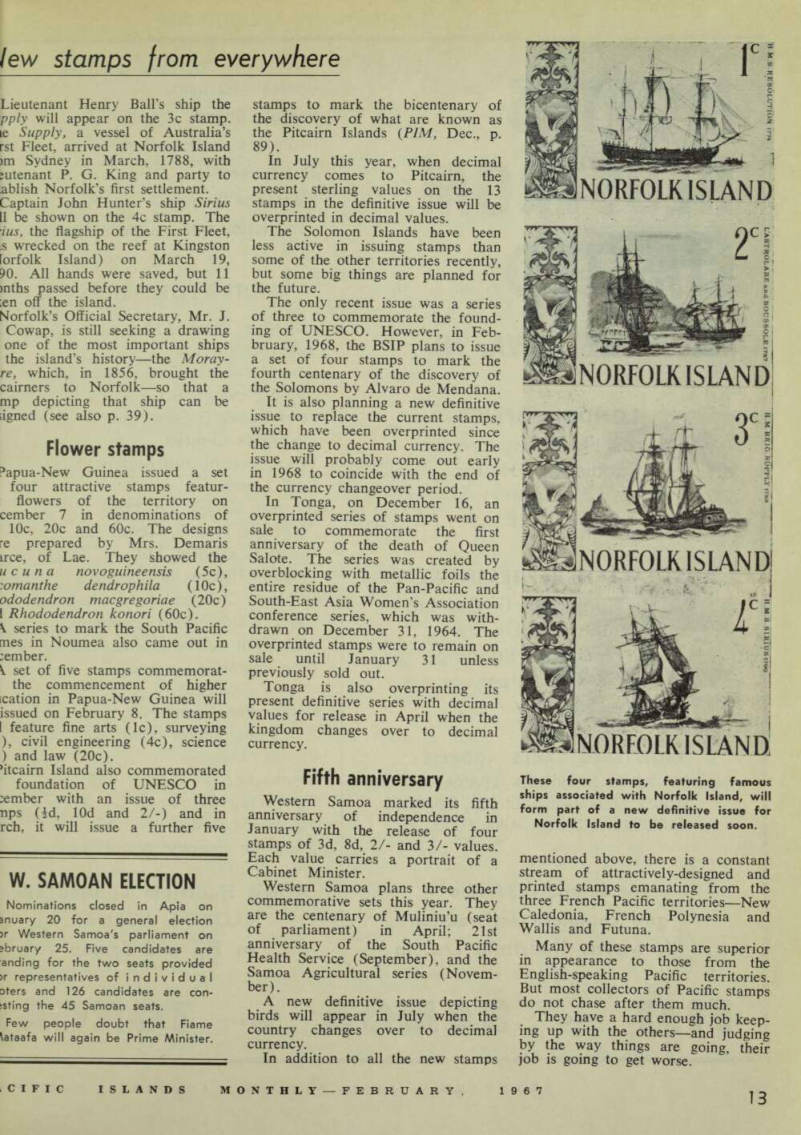
Norfolk Island is now plannr a new definitive issue ranging fn 1c to $l, featuring ships associas with the island’s history. It is hoj( to issue the first stamps next An As far as possible, the series ▼ be issued in chronological oro starting with the Resolution, the s in which Captain Cook discover the island on October 10, 1774. T Resolution will appear on the stamp.
The 2c stamp will show the vesj< Boussole and Astrolabe, which, unr the command of the French navigas La Perouse, passed Norfolk IshJ early in 1788.
New stamps from everywhere
Lieutenant Henry Ball’s ship the pply will appear on the 3c stamp, le Supply, a vessel of Australia’s rst Fleet, arrived at Norfolk Island >m Sydney in March, 1788, with jutenant P. G. King and party to ablish Norfolk’s first settlement.
Captain John Hunter’s ship Sirius 11 be shown on the 4c stamp. The ius, the flagship of the First Fleet, is wrecked on the reef at Kingston forfolk Island) on March 19, 90. All hands were saved, but 11 mths passed before they could be :en off the island.
Norfolk’s Official Secretary, Mr. J.
Cowap, is still seeking a drawing one of the most important ships the island’s history—the Moray re, which, in 1856, brought the cairners to Norfolk—so that a mp depicting that ship can be iigned (see also p. 39).
Flower stamps
?apua-New Guinea issued a set four attractive stamps featur flowers of the territory on cember 7 in denominations of 10c, 20c and 60c. The designs re prepared by Mrs. Demaris tree, of Lae. They showed the ucu n a novoguineensis (sc), :omanthe dendrophila (10c), ododendron maegregoriae (20c) I Rhododendron honori (60c). k series to mark the South Pacific mes in Noumea also came out in :ember.
V. set of five stamps commemorat the commencement of higher ication in Papua-New Guinea will issued on February 8. The stamps [ feature fine arts (1c), surveying ), civil engineering (4c), science ) and law (20c). fitcaim Island also commemorated foundation of UNESCO in member with an issue of three nps (id, lOd and 2/-) and in rch, it will issue a further five
stamps to mark the bicentenary of the discovery of what are known as the Pitcairn Islands ( PIM, Dec., p. 89).
In July this year, when decimal currency comes to Pitcairn, the present sterling values on the 13 stamps in the definitive issue will be overprinted in decimal values.
The Solomon Islands have been less active in issuing stamps than some of the other territories recently, but some big things are planned for the future.
The only recent issue was a series of three to commemorate the found ing of UNESCO. However, in Feb bruary, 1968, the BSIP plans to issue a set of four stamps to mark the fourth centenary of the discovery of the Solomons by Alvaro de Mendana.
It is also planning a new definitive issue to replace the current stamps, which have been overprinted since the change to decimal currency. The issue will probably come out early in 1968 to coincide with the end of the currency changeover period.
In Tonga, on December 16, an overprinted series of stamps went on sale to commemorate the first anniversary of the death of Queen Salote. The series was created by overblocking with metallic foils the entire residue of the Pan-Pacific and South-East Asia Women’s Association conference series, which was with drawn on December 31, 1964. The overprinted stamps were to remain on sale until January 31 unless previously sold out.
Tonga is also overprinting its present definitive series with decimal values for release in April when the kingdom changes over to decimal currency.
Fifth anniversary
Western Samoa marked its fifth anniversary of independence in January with the release of four stamps of 3d, Bd, 2/- and 3/- values.
Each value carries a portrait of a Cabinet Minister.
Western Samoa plans three other commemorative sets this year. They are the centenary of Muliniu’u (seat of parliament) in April; 21st anniversary of the South Pacific Health Service (September), and the Samoa Agricultural series (Novem ber).
A new definitive issue depicting birds will appear in July when the country changes over to decimal currency.
In addition to all the new stamps
mentioned above, there is a constant stream of attractively-designed and printed stamps emanating from the three French Pacific territories—New Caledonia, French Polynesia and Wallis and Futuna.
Many of these stamps are superior in appearance to those from the English-speaking Pacific territories.
But most collectors of Pacific stamps do not chase after them much.
They have a hard enough job keep ing up with the others—and judging by the way things are going, their job is going to get worse.
These four stamps, featuring famous ships associated with Norfolk Island, will form part of a new definitive issue for Norfolk Island to be released soon.