P-Ng; Mr. Hay Takes Over
pp. 11-12 · Read in the full issue
backward look and a forward glance as . . .
[?]Ir Donald Steps Down In
By a staff writer
In the first week in January, Papua-New Guinea said good bye to Sir Donald Cleland, who had been Adminstrator for 14i years—l3i if you subtract the year Canberra kept him “acting”— and welcomed the new Administrator, Mr. David O. Hay.
4 the length of his administrator ship, Sir Donald was second only the doyen of them all, Sir Hubert irray, whose reign in Papua lasted im 1907 until he died, still in ice, in February 1940.
But in political and economic mge, Sir Donald’s era was the ist remarkable and this gave the ech-makers and prognosticators eral field-days in early January.
J robably the most remarkable thing all about the last 14 years, vever, has been the lack of per lal controversy that attended the ministrator —something that neither Sir Donald’s predecessors, Colonel K. Murray, nor the illustrious Sir bert, escaped. iven the machiavellian aspects of al political manipulation seemed come from subordinates, while the ministrator continued to stolidly up there at the top, apparently noved and unmoving. Yet, in w of his history before he became
Administrator, and the method of his appointment, it is hard to believe that this was really so.
From 1945 to 1951, Donald Mackinnon Cleland was director of the Federal Secretariat of the Liberal Party and it was largely due to his organisation that the Menzies Liberals swept Labour from power in 1949.
It was the new Australian Govern ment’s intention to reverse the process of socialisation that had been the policy of the Labour government in Papua-New Guinea, and their prime target was the then Administrator, Colonel Murray, who had been ap pointed in 1946 and reappointed for a further five years in 1949.
Getting rid of Colonel Murray did not prove easy, although the first Liberal Minister for Territories, Mr.
Percy Spender, tried hard and, although, as a step in the right direction, Mr. D, M. Cleland was appointed Assistant Administrator in 1951.
But what Spender failed to do, the next Territories Minister, Mr.
Paul Hasluck, did do in 1952, After what Colonel Murray later described as a year in which he had been sub jected to an organised war of nerves, Colonel Murray’s appointment was terminated in 1952 and Mr. Cleland appointed Acting Administrator.
The way in which this was done caused misgivings among many Ter ritorians who had a high personal regard for Colonel Murray and his wife (Colonel Murray’s policies, in retrospect, seem mild in comparison with what came later), and storms from the Labour opposition in Can berra.
Although the Liberals had had a landslide win in the 1949 elections, their austerity budgets (to right the economic blunders of the previous Labour administration) had produced a mini-depression in 1951-52 and their stocks were correspondingly down.
After his head
Labour confidently expected to win the next election and promised that the first head to roll would be that of Administrator Cleland.
In the event, Labour did not win (nor has it yet) and Mr. Cleland was confirmed in office. But those who expected a dynamic political leader were disappointed.
He never wielded a big stick nor indulged himself in a personality cult; his arguments, if any, with Canberra were not public.
He never attempted—as many in 1952 thought that he might— tear loose to play hell and break things.
In fact, on the surface, his period in office might be interpreted as a
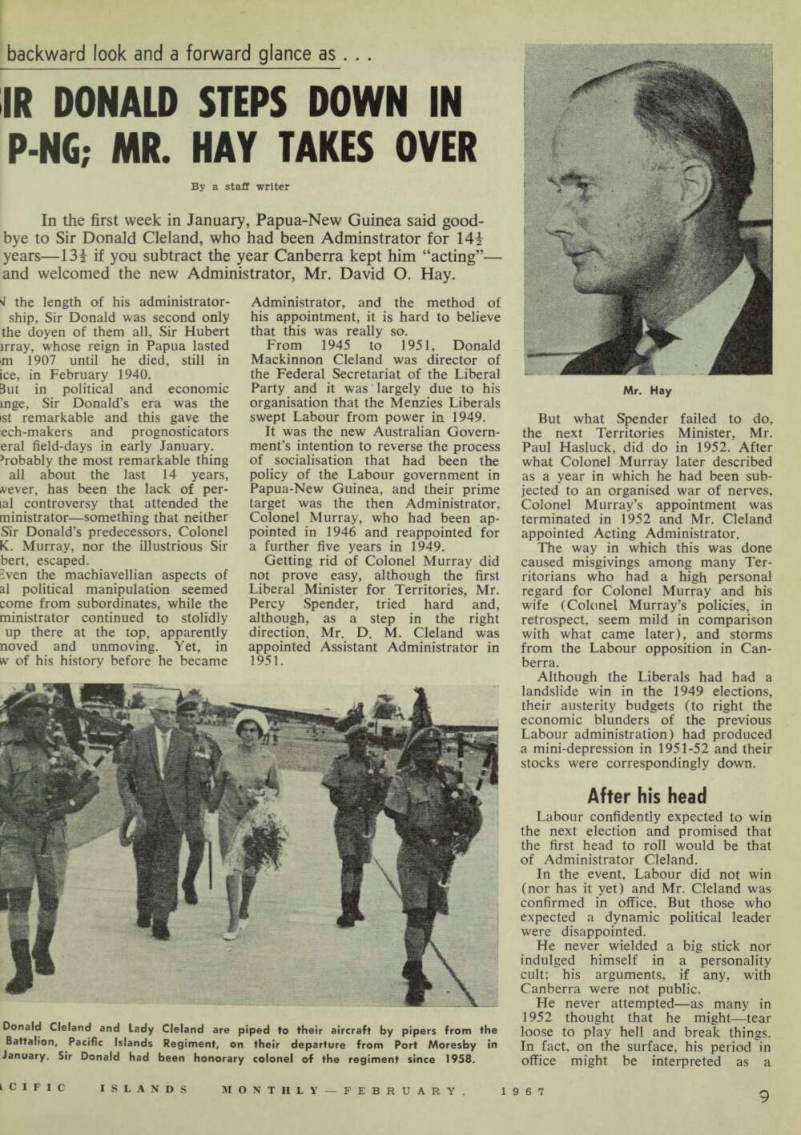
Donald Cleland and Lady Cleland are piped to their aircraft by pipers from the Battalion, Pacific Islands Regiment, on their departure from Port Moresby in January. Sir Donald had been honorary colonel of the regiment since 1958.
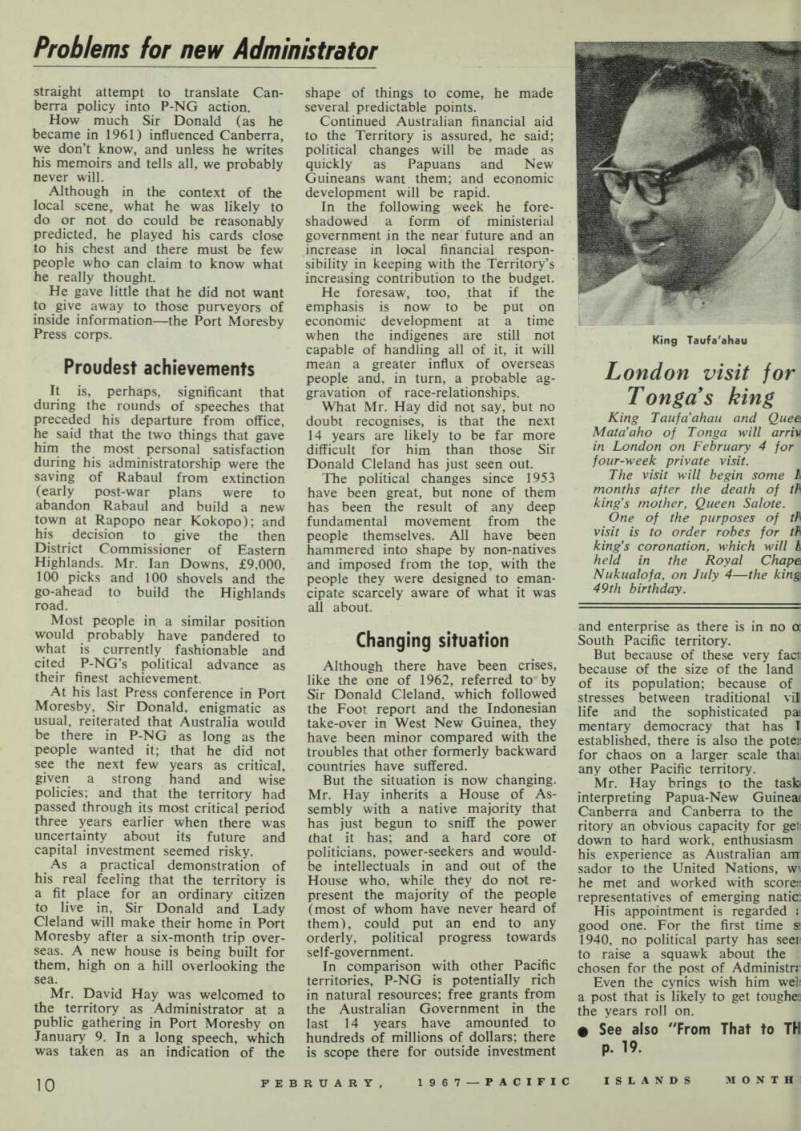
Mr. Hay
Problems for new Administrator
straight attempt to translate Can berra policy into P-NG action.
How much Sir Donald (as he became in 1961) influenced Canberra, we don’t know, and unless he writes his memoirs and tells all, we probably never will.
Although in the context of the local scene, what he was likely to do or not do could be reasonably predicted, he played his cards close to his chest and there must be few people who can claim to know what he really thought.
He gave little that he did not want to give away to those purveyors of inside information—the Port Moresby Press corps.
Proudest achievements
It is, perhaps, significant that during the rounds of speeches that preceded his departure from office, he said that the two things that gave him the most personal satisfaction during his administratorship were the saving of Rabaul from extinction (early post-war plans were to abandon Rabaul and build a new town at Rapopo near Kokopo); and his decision to give the then District Commissioner of Eastern Highlands. Mr. lan Downs, £9,000, 100 picks and 100 shovels and the go-ahead to build the Highlands road.
Most people in a similar position would probably have pandered to what is currently fashionable and cited P-NG’s political advance as their finest achievement.
At his last Press conference in Port Moresby, Sir Donald, enigmatic as usual, reiterated that Australia would be there in P-NG as long as the people wanted it; that he did not see the next few years as critical, given a strong hand and wise policies; and that the territory had passed through its most critical period three years earlier when there was uncertainty about its future and capital investment seemed risky.
As a practical demonstration of his real feeling that the territory is a fit place for an ordinary citizen to live in, Sir Donald and Lady Cleland will make their home in Port Moresby after a six-month trip over seas. A new house is being built for them, high on a hill overlooking the sea.
Mr. David Hay was welcomed to the territory as Administrator at a public gathering in Port Moresby on January 9. In a long speech, which was taken as an indication of the
shape of things to come, he made several predictable points.
Continued Australian financial aid to the Territory is assured, he said; political changes will be made as quickly as Papuans and New Guineans want them; and economic development will be rapid.
In the following week he fore shadowed a form of ministerial government in the near future and an increase in local financial respon sibility in keeping with the Territory’s increasing contribution to the budget.
He foresaw, too, that if the emphasis is now to be put on economic development at a time when the indigenes are still not capable of handling all of it, it will mean a greater influx of overseas people and, in turn, a probable ag gravation of race-relationships.
What Mr. Hay did not say, but no doubt recognises, is that the next 14 years are likely to be far more difficult for him than those Sir Donald Cleland has just seen out.
The political changes since 1953 have been great, but none of them has been the result of any deep fundamental movement from the people themselves. All have been hammered into shape by non-natives and imposed from the top, with the people they were designed to eman cipate scarcely aware of what it was all about.
Changing situation
Although there have been crises, like the one of 1962, referred to by Sir Donald Cleland, which followed the Foot report and the Indonesian take-over in West New Guinea, they have been minor compared with the troubles that other formerly backward countries have suffered.
But the situation is now changing.
Mr. Hay inherits a House of As sembly with a native majority that has just begun to sniff the power chat it has; and a hard core of politicians, power-seekers and would be intellectuals in and out of the House who, while they do not re present the majority of the people (most of whom have never heard of them), could put an end to any orderly, political progress towards self-government.
In comparison with other Pacific territories, P-NG is potentially rich in natural resources; free grants from the Australian Government in the last 14 years have amounted to hundreds of millions of dollars; there is scope there for outside investment
and enterprise as there is in no oc South Pacific territory.
But because of these very fad: because of the size of the land of its population; because of stresses between traditional vil life and the sophisticated pa£ mentary democracy that has I established, there is also the potei; for chaos on a larger scale thar any other Pacific territory.
Mr. Hay brings to the tasld interpreting Papua-New Guineat Canberra and Canberra to the ritory an obvious capacity for gel: down to hard work, enthusiasm his experience as Australian arrr sador to the United Nations, w\ he met and worked with score:; representatives of emerging natica His appointment is regarded j good one. For the first time s? 1940, no political party has seer; to raise a squawk about the chosen for the post of Administrr Even the cynics wish him wel; a post that is likely to get toughea the years roll on.
• See also "From That to TH p. 19.