Yesterday
p. 103 · Read in the full issue
Most of the items in PIM of 20 years ago were con cerned with picking up the pieces following the war, and were still looking backwards. But one forward-looking report told how representatives of five metropolitan Paci fic powers were to meet in Canberra later in the month to discuss establishment of a “regional advisory commis sion” for the non-self-governing territories. Thus was heralded the birth of the South Pacific Commission.
COMMENTING editorially. PIM said there was no indication of where the headquarters of the new body was to be, although there was indiction that it could be kept in Canberra. This would be “a grave error”. The obvious site was Suva.
Here are other items from that issue of January, 1947.
THERE was the first detailed account of the sinking off the south coast of Papua in 1942 of the M.V. Mamutu and the machine-gunning of the survivors by a Japanese submarine.
The tragedy cost the lives of all but one of the Mamutu's 81 passengers and crew—most of them mixed race residents of Port Moresby, who were being eva cuated to Dam for the duration of the war. Among the dead was well-known Port Moresby clergy man, the Rev. H. Matthews.
FORMER ANGAU chief Major- General B. M. Morris severely criticised the Australian Government policy in New Guinea. He cited the rebuilding of Hanuabada village, Port Moresby, at a cost of £llB,OOO as “windowdressing” for tourists and an example of the worst aspects of Government policy.
He said that although the Hanuabadans had lost their vil lages during the war they were evacuated, fed, and received free medical treatment for 3J years.
Many natives were far worse off but received nothing.
He wanted also a P-NG member of Parliament in Canberra with the same powers as the Northern Territory member.
F Tonga, all but a few of the 1,200 residents of Niuafo’ou were evacuated by the Matua fol lowing an eruption in September 1946.
Once known as the “garden of Tonga”, the island had become less fertile and productive over the years as successive eruptions
covered arable land with lava and ash.
After the last eruption the Tongan Government decided the island was unsafe and to move the people to another island in the group.
IN contrast to its present financial problems, Western Samoa was enjoying unprecedented prosperity.
First grade cocoa beans had risen to a record of between £l7O and £lBO f.0.b., Apia, and were expected to go even higher.
European plantation owners, many of whom were debt-free for the first time, complained Samoans owning their own planta tions would not work for them and the wages of Chinese planta tion labourers had quadrupled.
IN the BSIP places names were causing comment, as they are today. A PIM reader in the West Indies wrote that Guadalcanal should be spelled Guadalcanar and Kolombangara spelled Kulambangra. “I suppose the Yanks spoiled it,” he said.
THE Tongan Government decided to take over the feeding and nursing of patients in the Nukualofa Hospital. Until then patients had arrived at the hospital with their friends and relatives, who fed and nursed them while camping in the hospital grounds.
As patients arrived with up to a dozen attendants, the hospital sometimes had a colony of hundreds of people in its grounds, which rapidly became littered with empty tins and banana leaves.
MR. H. E. MAUDE took over as Resident Commissioner of the Gilbert and Ellice Islands
from Mr. V. Fox-Strangways, who was going to Palestine.
CIVIL aviation in the Pacific was given further impetus with the handing over of Nadi airfield, Fiji, to the New Zealand Government.
Built by Americans during the war, Nadi had been one of the largest air bases in the Pacific.
THE entry of Pan American Airways into the trans-Pacific service was expected at the end of January together with the granting of passenger rights into the USA to British Commonwealth Pacific Airlines.
Qantas extended its Sydney- New Guinea service from Lae to Rabaul with DC3 aircraft and it was reported that Guinea Air ways would not resume its busi ness in Papua-New Guinea.
NOUMEA interests had been given permission to erect a casino there and there was speculation that Noumea would become the Monte Carlo of the South Seas.
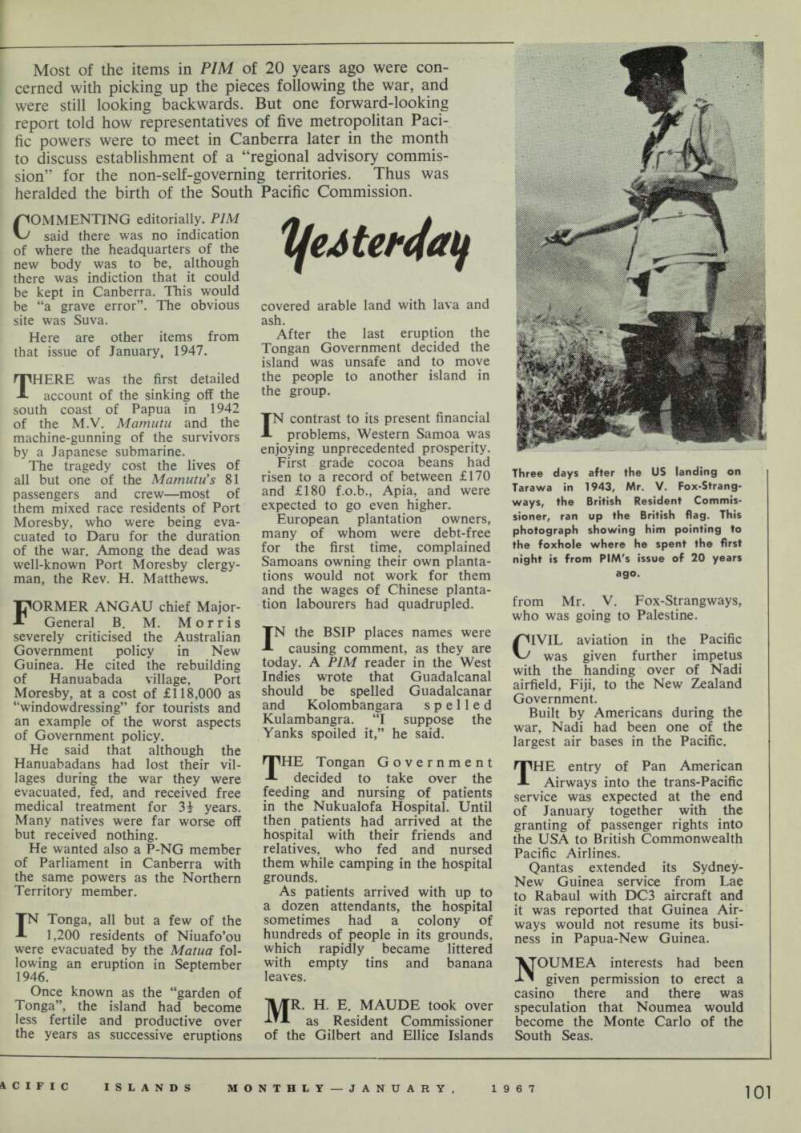
Three days after the US landing on Tarawa in 1943, Mr. V. Fox-Strang ways, the British Resident Commis sioner, ran up the British flag. This photograph showing him pointing to the foxhole where he spent the first night is from PIM's issue of 20 years ago.