Pastor Jacob Aroi: Grand
pp. 99-101 · Read in the full issue

Old Man of Nauru
From a Nauru Correspondent Here is a gentleman of Nauru whose life spans the entire period of the island’s modern history. Aroi was born in October, 1888, soon after the Germans had taken possession of Nauru, and he has experienced every event that has been worth chronicling since then.
FROM the Christianising of its people, through changes of masters in two world wars, 50 years in education, to the contemplation of prosperity and opportunity as it exists for his people today, Aroi embodies Nauru’s progress.
Meet him pottering sedately along on his NSU and you are not immedi ately aware he is nearly 78 years.
But hear his precise recollection of things that happened at the beginning of the century, and before long you feel perplexed, that the past is here in the present.
Rides Motor Cycle
Pastor Jacob Aroi takes care of himself these days. He occasionally suffers attacks of filaria, which he contracted during World War 11, so he tries to keep out of the wet, and away from the mosquitoes. Hence he has bought a little motor car re cently (but still rides his NSU if the sky is clear), and always wears long sleeves and trousers.
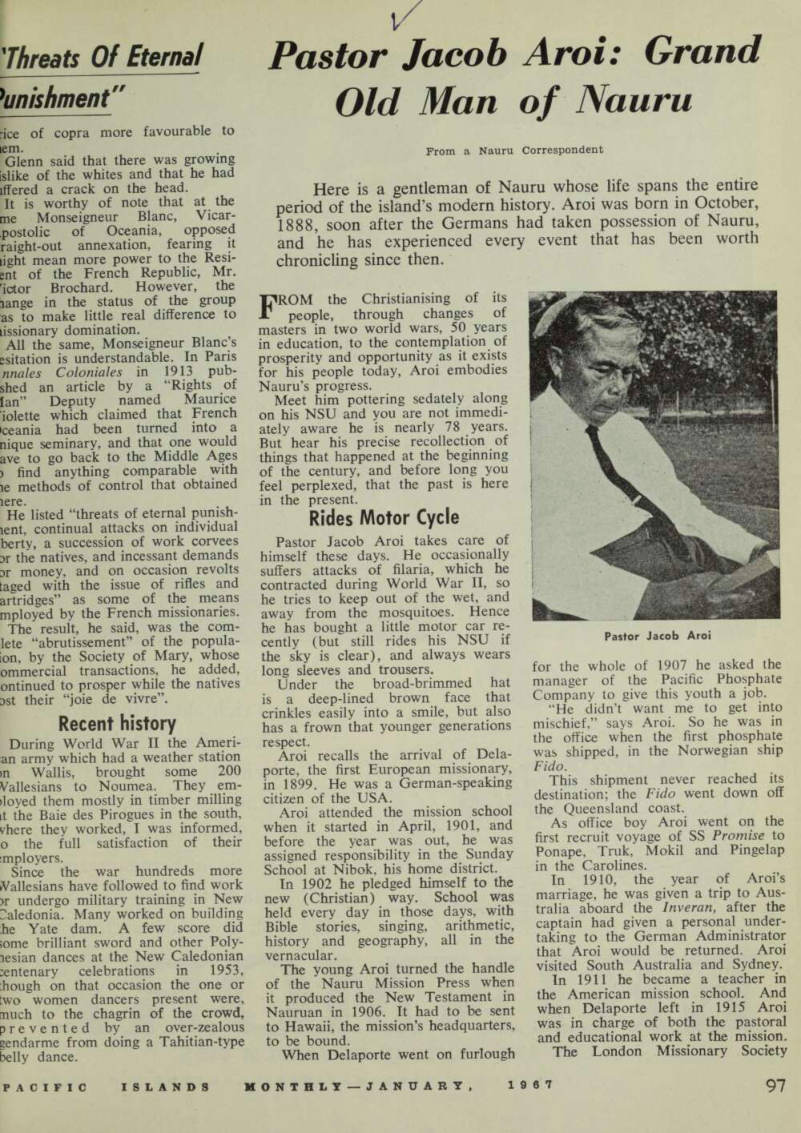
Under the broad-brimmed hat is a deep-lined brown face that crinkles easily into a smile, but also has a frown that younger generations respect.
Aroi recalls the arrival of Dela porte, the first European missionary, in 1899. He was a German-speaking citizen of the USA.
Aroi attended the mission school when it started in April, 1901, and before the year was out, he was assigned responsibility in the Sunday School at Nibok, his home district.
In 1902 he pledged himself to the new (Christian) way. School was held every day in those days, with Bible stories, singing, aritlmietic, history and geography, all in the vernacular.
The young Aroi turned the handle of the Naum Mission Press when it produced the New Testament in Nauruan in 1906. It had to be sent to Hawaii, the mission’s headquarters, to be bound.
When Delaporte went on furlough
for the whole of 1907 he asked the manager of the Pacific Phosphate Company to give this youth a job.
“He didn’t want me to get into mischief,” says Aroi. So he was in the office when the first phosphate was shipped, in the Norwegian ship Fido.
This shipment never reached its destination; the Fido went down off the Queensland coast.
As office boy Aroi went on the first recruit voyage of SS Promise to Ponape, Truk, Mokil and Pingelap in the Carolines.
In 1910, the year of Aroi’s marriage, he was given a trip to Aus tralia aboard the Inveran, after the captain had given a personal under taking to the German Administrator that Aroi would be returned. Aroi visited South Australia and Sydney.
In 1911 he became a teacher in the American mission school. And when Delaporte left in 1915 Aroi was in charge of both the pastoral and educational work at the mission.
The London Missionary Society
Pastor Jacob Aroi
sumed responsibility for Protestant issionary work in 1917, but it was >t until 1927 that a resident issionary was appointed, and in the eantime Jacob Aroi was leader of e Protestant community on Nauru.
He became an Administration adier when the Administration took /er the schools in 1923 and was ipointed Senior Teacher in 1928.
“Children were helpful and ?edient then,” he recalls, “and noking was an adult vice.” Circumances have made the job harder ►day.
D 11,. l* Kecaiis ms uerman He recalls a good deal of the erman in which he was once fluent, id also some of the early English tirases he taught when the Ausalians took over in World War I.
World War II brought its diffiallies. The school day started early, nishing at 10 a.m., “in time for le bombing”, as Aroi puts it.
Aroi went with the major conngent of Nauruans whom the ipanese moved to Truk. School as started there, the children walkig three miles to it, but it was bandoned after Allied bombing.
At the end of 1943 the Japanese )ld Aroi that there were to be no lore gatherings of any kind and lat even prayer was forbidden.
“They were very fearful and iperstitious and afraid we would ray for their defeat,” Aroi says.
Aroi was repatriated to Nauru in 946 and became superintendent of
Nauruan Education—the position he held until his retirement in 1963. In that year he was awarded the MBE for his services to the people of Nauru.
The former mission boy, and pioneer of so many innovations, re joices in the development of Nauru, but is saddened by some of the by products of rapid social change.
One of these, the decline of family iif e? Aroi attributes to a generation meagrely provided with grand-parents, So many of an older group died dur ing the war, and so many large families since have led to a shortage of the okiei . f o ik W h Q taught the mores to the young, and usually con trolled them.
He is sorry to see the Nauruan
language neglected,
“It is the only surviving part of our native culture, but soon it will be so corrupted as to be unrecogms able,” he says. ...
Pastor Aroi served on the Admim strator s Nauruan Language Com mittee before the war, and this com mittee set out standard spellings and pronunciations. A great deal of work had been done on a dictionary, which was unfortunately lost during the Japanese occupation. Aroi would hke to see this work continued, “Some people say Nauruan should gradually be forgotten, but I think we should take a pride in it, and use it correctly.”
Here speaks the man with a warm and quiet pride in Nauru, and a love for its people.
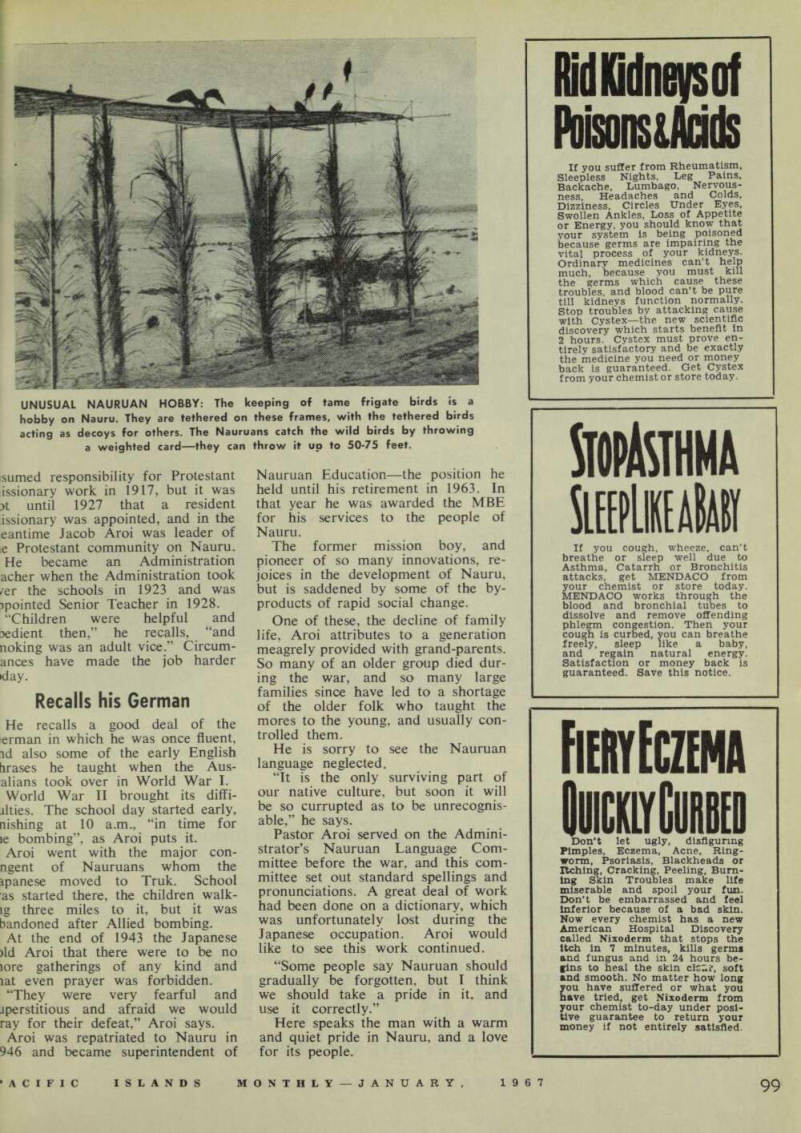
UNUSUAL NAURUAN HOBBY: The keeping of tame frigate birds is a hobby on Nauru. They are tethered on these frames, with the tethered birds acting as decoys for others. The Nauruans catch the wild birds by throwing a weighted card —they can throw it up to 50-75 feet.