How I Produced Cocoa Despite
pp. 79-81 · Read in the full issue

200 In. Of Rain A Year
By Bruce Sutherland
Despite 200 inches of rain a year and little or no sun in the harvesting season it’s possible to grow cocoa economically in the Lae coastal region.
FOR two years I managed an 800 acre copra plantation with 140 dcic tupid pidiuduuii vy iiu acres of coconuts mterplanted 1 cocoa about 20 miles east of Lae In the harvesting season which is usually from May to November, we were lucky to get a day of sunshine a week the rest of the year we received about four days sun a week.
That makes the processing of the
m.ttp^nmble^T 1011 arly drymg—
q Liir np -j c n u„ llt on tn 100 ?nl y es oTrainTvLr wi?h pTent?
IUU mcnes 01 ram a year wim piemy of sunshine in the harvesting season.
An annual fall of over 100 mches tends to be too wet and anything under 80 inches is usually too dry.
The plantation I was managing at the time was quite flat—at sea level —and getting an average of 200 inches a year—with very little sun.
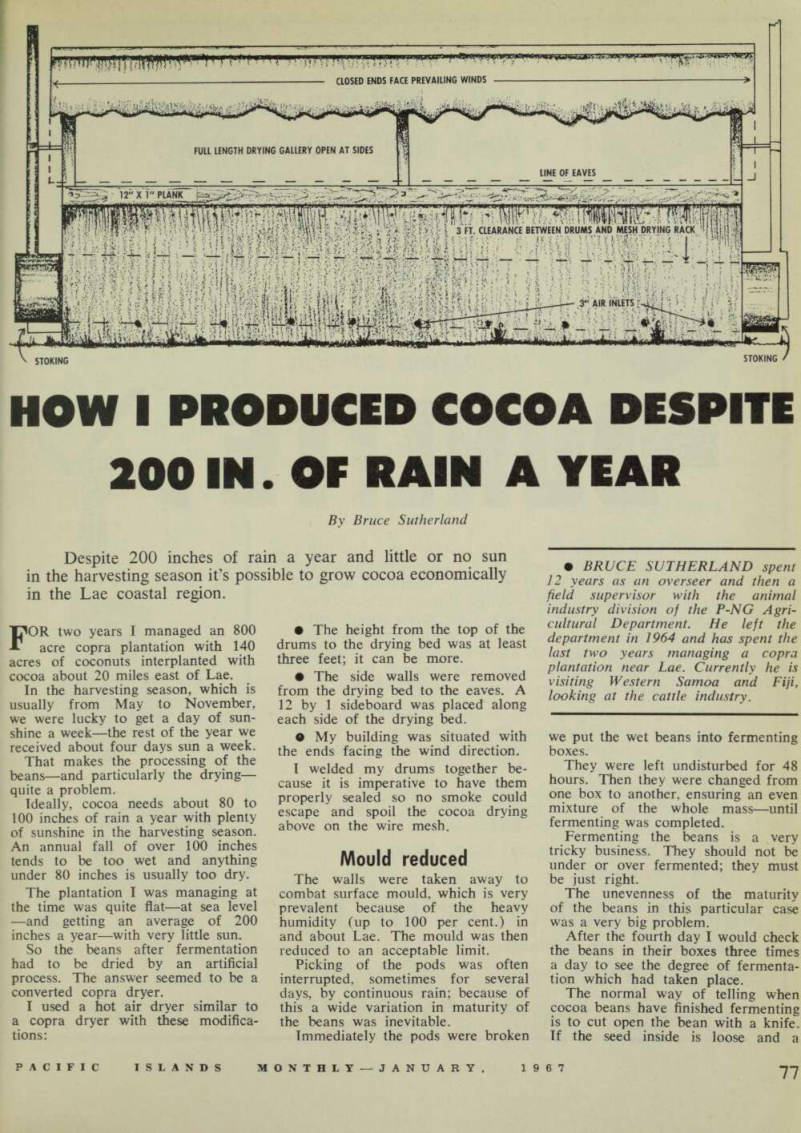
So the beans after fermentation had to be dried by an artificial process. The answer seemed to be a converted copra dryer. I used a hot air dryer similar to a copra dryer with these modifications:
0 The height from the top of the drums to the drying bed was at least f •. „fL mr>rp ’ ‘ • The side walls were removed from the drying bed to the eaves A 12 by 1 sideboard was placed along each side of the drying bed. $ My building was situated with t^e en( j s f ac j n g the wind direction. j welded mv drums together be cause it is imperative to have them properly sealed so no smoke could escape and spoil the cocoa drying b on tbe w j re mes h * 11 11 MOUld redUCGQ The walls were taken away to combat surface mould, which is very prevalent because of the heavy humidity (up to 100 per cent.) in and about Lae. The mould was then reduced to an acceptable limit.
Picking of the pods was often interrupted, sometimes for several days, by continuous rain; because of this a wide variation in maturity of the beans was inevitable.
Immediately the pods were broken
bruce Sutherland s ent 12 years as an overseer and field supervisor with the animal industry division of the P-NG Agri- De P a ) 6 department in 1964 and has spent the ' ast two years managing a copra plantation near Lae. Currently he is visM Western Samoa and Fiji, looki Qt the Cfl//fe industry^
we put the wet beans into fermenting boxes.
They were left undisturbed for 48 hours. Then they were changed from one box to another, ensuring an even mixture of the whole mass-until fermenting was completed.
Fermenting the beans is a very tricky business. They should not be under or over fermented; they must be just right.
The unevenness of the maturity of the beans in this particular case was a very big problem.
After the fourth day I would check the beans in their boxes three times a day to see the degree of fermenta tion which had taken place.
The normal way of telling when cocoa beans have finished fermenting is to cut open the bean with a knife.
If the seed inside is loose and a
brown liquid comes out, then ferment ing is finished.
This normally takes five to seven days from the time the beans first go into the boxes.
During fermentation, as the beans’ heat increases, a distinctive odour is given off and this increases to a peak —and then rapidly decreases.
I found while testing the fermenta tion that this peak in the odour corresponded with the best average fermentation of the whole batch of beans.
Working on this principle, with a little practice I found that I could judge the degree of fermentation just as accurately or even more so than by visual inspection of cut beans.
In New Guinea there are strict regulations in force on all cocoa pro duced. Inspectors from the Depart ment of Agriculture select random samples from each consignment.
These are tested for dryness, internal mould, ferment and foul odour. The permissible level is in the order of two per cent. Cocoa can also be rejected for inclusion of foreign matter, and for inadequate sowing of bags.
During the 1966 season we had five bags rejected for internal mould —due to the bags getting wet in transit.
It is still possible to export this cocoa, but it has to be exported on consignment, i.e., it is offered for sale in Europe at whatever price it fetches, whereas cocoa with an export certificate is sold in stores in Lae.
The seller of cocoa without a certificate has to wait a long time for his money; sometimes up to 12 months for a return.
There are reports of a small quantity of New Guinea cocoa going overseas below world standard, and this can only have a detrimental effect on the market for New Guinea cocoa generally.
To sell on the world markets, against the major producers, particu larly Ghana, it is essential that the standard is kept comparable to over seas cocoa.
Some growers feel that the regula tions could be more stringently enforced as there is little doubt that some sub-standard cocoa is getting out of the country.
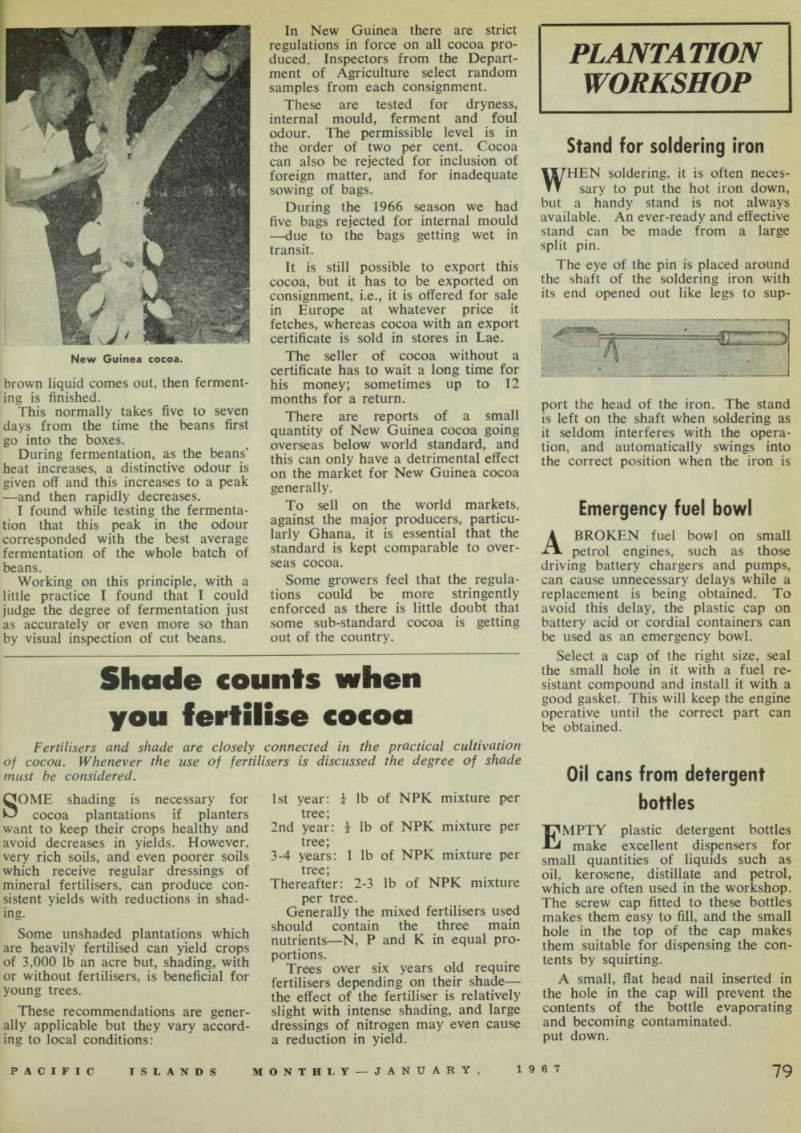
New Guinea cocoa.