The Practical Planter
pp. 75-77 · Read in the full issue

You can plant coconuts and cocoa successfully at the same time
By Don Barrett, in Rahaul
The successful interplanting of old-established coconut plantations with cocoa has been a fea ture of post-war agriculture in New Guinea. High prices and the quick return from cocoa as compared with copra influenced many persons to develop “sole” cocoa plantings. Professional agronomists have tended to discourage new joint plantings of coconuts and cocoa unless coconuts were given three to four years to become established before interplanting with cocoa took place.
BUT practical experience has shown that it is possible to successfully plant the two crops at virtually the same time. The advantages of a two crop culture are obvious, and it is certain that a number of New Guinea planters who planted cocoa alone would now dearly love a few thousand bearing coconut palms.
Even if the area to be planted is of cocoa rather than copra size, it is still an advantage to have the two crops.
Dual plantings can be carried out with a minimum waste of time, but you must be prepared to do some extra work and probably be satisfied with a smaller acreage than could be achieved with a sole cocoa planting.
A limit for one man
Probably 200-300 acres dual planted would be as much as one man could cope with, and this, in any but most abnormal times, should show a good return.
A more careful preparation of the area before planting is necessary in most South Pacific areas if coconuts are to be planted. Where rhinoceros beetle and other “dynastid” beetles are found, ideal breeding sites are provided if too much rotting vegeta tion is left. Hence it may be neces sary to burn off more carefully. This can prove tedious and rather costly, but is some form of insurance against an early infestation by the big beetles.
An added problem in some areas will be the seemingly miraculous growth of kunai grass following a big burn. This enemy of the planter appears as if by magic in closely
The Practical Planter section appears in PIM every three months. It supplements PlM’s regular monthly Planters’ Digest section, and other monthly reports of special agricul tural interest, by supplying more detailed information on specific problems en countered by planters throughout the South Seas, and shows, too, what planters are doing. The articles are written by people with practical ex perience. Questions from readers on all aspects of South Seas agriculture are welcome.
cleared and burned areas where rain forest grew before.
Some newcomers to the planting field have remarked that kunai can be used as temporary shade for cocoa. In fact, kunai roots can dam age even coconut root systems, and quickly stifle young cocoa and in hibit the growth of young coconuts.
Pulling young kunai by hand when patches first appear in the new plant ings is the safest and surest, although slowest, way of dealing with the pest. Some experiments have been made with weed killers, but to date no really effective weedicide has been found.
Continual cutting with grass knives
will in time defeat kunai but this method of control often requires more units of labour than the new planter can afford. Early control is the real answer. Once established firmly, kunai takes a great deal to eradicate.
This problem of kunai is men tioned, because if coconuts and cocoa are to be planted at virtually the same time—at any rate in the same year—it is not possible to shade as heavily as one would for sole cocoa.
Spacing and shade control become of greatest importance.
Let’s deal first with spacing of coconuts as the base crop. Most old plantings, in New Guinea at any rate, are as wide apart as 30 ft—some times on the square, sometimes on the triangle.
In most of the older plantations with this spacing, and with cocoa interplanted, it could be said that the shade cover is barely adequate.
Of course the palms are aged and therefore tall, but even so, one could not recommend 30 x 30 ft spacing of palms where interplanting of cocoa is contemplated.
Arguments have been made in favour of both 24 ft and 27 ft spac ing of palms. The weight of evidence seems to favour a 27 x 27 ft spacing —on the triangle.
The selection of seed nuts is worth mentioning, for so many planters still seem to pay insufficient attention to this—the result is seen in young palms just coming into bearing. At times it’s difficult to obtain sufficient good seed, but where time allows, a selection from the best bearing palms available will repay the effort.
If a dual crop plantation is in-
Old mistakes still being made ...
tended the actual planting of nuts is important, since the object will be to get as quick a growth as possible to balance the lighter density of shade trees that will be planted.
The old rule of a hole 2 ft 6 in. by 2 ft 6 in., and at least 2 ft deep, is a sound one. The well-loosened soil will allow the young palm’s roots to spread quickly. A possible danger is that in very friable soil in an area of high rainfall (over 150 in. per annum), the palms may tend to lean. Firm tamping of the soil at planting will obviate all but the worst of these problems.
Shade trees will need to be planted between the rows of palms, so that if your planting of palms is 27 x 27 then at 13 ft 6 in. you will have i row of shade. Leucena glauca is still the most favoured shade tree for cocoa in New Guinea, despite /ery real problems in some areas be muse of its prolific seeding.
Practical experience shows that hree rooted cuttings between each :ocoa will be sufficient for the rows vhich will have cocoa only. It may ?e necessary to plant two cuttings >etween cocoa and coconuts in the ines of palms.
No hard rules
Generally the cocoa in the lines )f palms are left until the palms are ibout one year old, whereas the cocoa n the “sole cocoa” lines may be >lan t e d as soon as shade is ufficiently advanced. It is not >ossible to lay down any hard and ast rule, as seasons, soil and other actors will affect the growth rate )f shade trees and this rate will lictate when you can plant your :ocoa. But there is no question of laving to wait three or four years.
Shade control is vital once palms md cocoa are planted. Palms must ;et maximum sunlight and to this nd judicious pruning of shade is equired quite early. Clean weeding ound young palms will not only ive them a better growth rate but vill inhibit the gathering of insect icsts.
An early enemy could well be irontispa—that evasive, flat beetle ceding in the crown of the young • aim. Penetrating insecticides, •robably in powder form, should be irought into use. Neglect of irontispa can cause ill-formed growth nd even deaths.
In the first two years, young cocoa /ill need a fair amount of shade
but thinning out should start as soon as possible while the leucena glauca is relatively young and easy to fell.
By this time, too, palms will be affording some shade.
It is often possible to cut at least one in three shade trees at this time.
It is important to replace all coconut “misses” promptly since shade density will inhibit growth later.
Thinning should continue through out the third year. By the end of that time the bulk of shade trees should have been removed. It may be necessary to preserve a few trees where palms have missed, but the object is to get the palms to provide all the shade.
The danger of falling palm fronds while the palms are still relatively small is not the great problem one might imagine, and damage to cocoa trees is slight. However it is good hygiene to remove fallen fronds from cocoa. If fronds become too numerous it is wise to remove them to a clear place and burn them—any accumula tion of rubbish attracts the beetles.
Archaic though it may seem, the best control method of dynastid beetles in the young coconut planta tion is still the “beetle gang” in the early morning. Refuse pits designed deliberately to attract breeding beetles
• Don Barrett, who wrote this re port on copra, is a leading New Guinea planter, and a former presi dent of the New Guinea Planters’
Association and member of the P-NG Copra Marketing Board. His planta tion is near Rabaul.
are useful if cleared regularly of larva e—one can imagine what happens if the clearances are not regular.
At all times a standby nursery con taining both palms and cocoa is needed. As with palms so with cocoa, and early replacement of misses is needed, for economic reasons if for no other.
Planning for roads is vital. So many plantations seem to “just grow”, evidently on the basis that it is essential to “get the trees” and that the roads can come later. This is faulty planning. Well-drained and well-situated roads begin to save time and money just as soon as they are built.
I have stressed a lot of fairly elementary things here. But one does see the old mistakes being made still.
It is impossible to have the perfect plantation but it is possible to have a fairly good one under normal con ditions. Since conditions are seldom normal, what one must look for are those things which give the best results under all conditions.
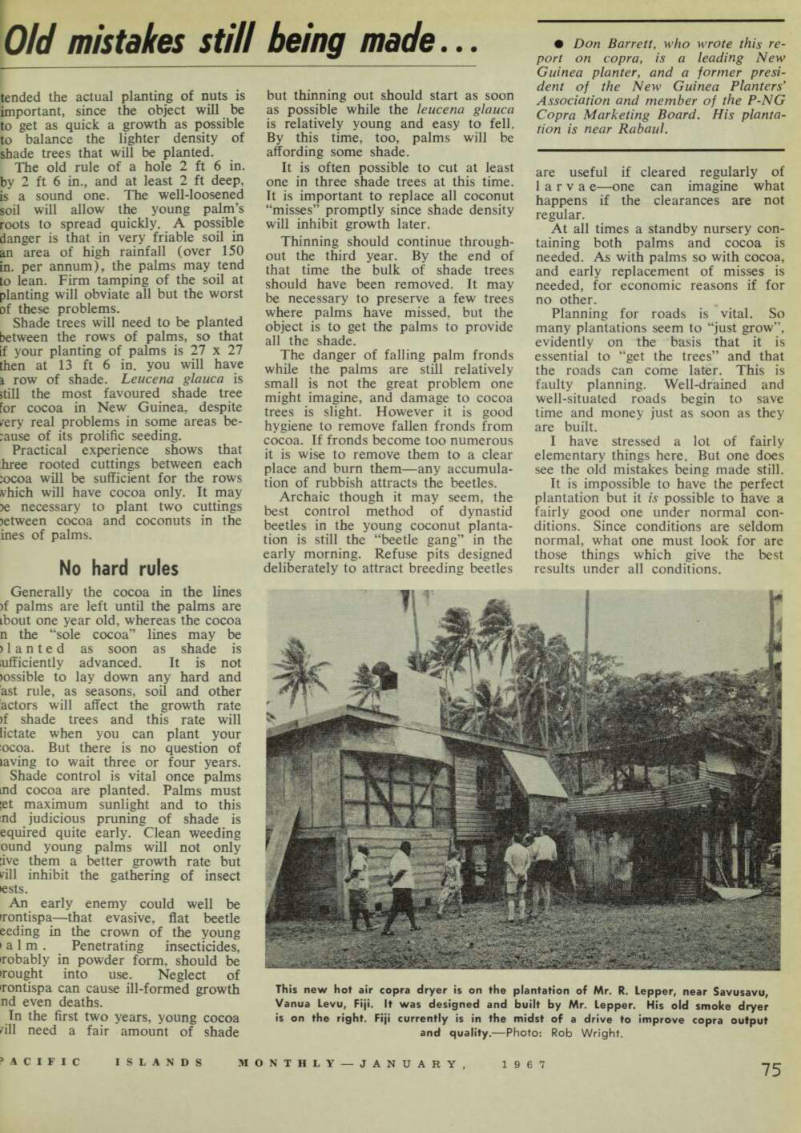
This new hot air copra dryer is on the plantation of Mr. R. Lepper, near Savusavu, Vanua Levu, Fiji. It was designed and built by Mr. Lepper. His old smoke dryer is on the right. Fiji currently is in the midst of a drive to improve copra output and quality. — Photo: Rob Wright.