Games Athletes Left Only
pp. 25-27 · Read in the full issue
Six Suva Records Intact
By breaking or equalling all but six of the 29 athletics records established in Suva in 1963, the athletes at the Second Games in Noumea in December showed that they had made good progress in the past three years.
GENERALLY speaking, the athletes J were fitter and better trained lan they were in Suva.
There is no doubt that they would ave broken even more records than ley did, and would have smashed thers more impressively, had the eather, on occasions, been kinder.
Some races were run in the teeth E a strong, warm Trade Wind; thers in almost blizzardly condi ons; and others again in a constant, »avy drizzle. The track, moreover, as somewhat heavier than many of ie athletes were accustomed to; and ime of the athletes did not perform ; their peak because of the poor id inadequate food and cramped jarters at the Games “village”.
Not surprisingly, the shorter races ere the ones where the Suva records mained unbroken. In the mien’s ack events, the Suva times still and for the 100, 200 and 400 etres sprints, and the 4 x 100 etres relay. The Suva time is also tact for the women’s 100 metres irint.
The other Suva record that stood as the men’s discus throw, where e gold medallist, Fiji’s massive esulame Rakuro, could manage ily 148 ft compared with the 161 11 in. which won him top honours 1963.
Slight edge for Fiji
Although so many of the Suva cords were broken, the standard South Seas athletics is still a ng way below Commonwealth or lympic Games standards.
Broadly speaking, the best South as times and distances are now ily on a par with those of the best jrld athletes in 1896 when the jdern Olympic Games were started.
Fiji (thanks mainly to its women) id New Caledonia (thanks mainly its men) carried off the bulk of e medals. Fiji got 11 gold, 10 silver id seven bronze (60 points); and ew Caledonia got 10 gold, eight ver and 13 bronze (59 points).
All but seven of the 36 other edals went to Nauru. Papua-New
Guinea and French Polynesia. On a percentage basis, the Nauruan athletics team of three far outstripped all others, as they won four gold and two silver medals in the six event? they entered for.
The good showing of the New Caledonians was largely due to coaching in France, or the tuition they received for over a year from six French national coaches who were specially brought from France.
The Fijians, on the other hand, excelled more through natural ability than through coaching expertise. The only notable overseas tutors they had were Ron Pickering (a British (Over)
The Second South Pacific Games — lle. Jeux du Pacifique Sud to the people of the French-speaking Pacific territories —were held in Noumea from December 8-18. On this and the next 13 pages is a full report in prose and pictures of all the Games events.
Olympic coach) and Peter Morgan (head of the track and field depart ment at Princeton University), each of whom spent three weeks in Fiji some time ago.
Papua-New Guinea’s coach, Don Barrett, was highly pleased with the showing of his team, even though its medals were few.
“We had a very young team, and we feel we gained a lot of experience for 1969,” he said afterwards.
“Bernadette Namal, for example, who won a silver medal in the women’s 800 metres event is only 14.
“We were particularly pleased with the team spirit of our people.
All of our relay teams were placed, which shows that we have depth. In the team events, New Caledonia and French Polynesia did not do as well as we did.”
Most decorated
The most decorated athletes in Noumea were Fiji’s 30-year-old Torika Varo, who has five children, and Ana Ramacake, Fiji’s only representative at the Commonwealth Games in Jamaica.
Torika won three gold medals (100 metres, 200 metres and 4 x 100 metres relay) and one bronze (long jump).
Ana won two gold (long jump and 4 x 100 metres relay) and two silver (100 metres and 200 metres). Ana’s record long jump of 18 ft 1 in. was registered only about 10 minutes after she had raced to victory in a qualifying heat for the 100 metres event.
Another woman athlete to show out was Lois Lax, of Nauru, who, as Lois Jackman, represented Australia at the 1956 Olympic Games and the 1959 Empire Games in Cardiff.
Mrs. Lax won the discus event with a throw of 138 ft 10 in. (nearly 22 ft better than the Suva figure), and she followed this up two days later with a second placing in the 80 metres hurdles.
The hurdles event was as full of incident as any on the athletics pro gramme. There were four false starts, with K. Tongi, of Tonga, being disqualified for breaking twice.
When the race finally did get going, Mrs, Lax was interfered with going over the last hurdle by Elinor Phillips, of Fiji, who got into her lane.
On Mrs. Lax’s protest, which was supported by an instant photograph which Nauru’s team manager, Buraro Detudamo, happened to be on hand to take, Phillips was disqualified, and the race was awarded to Fiji’s Shirley Hefferman.
A re-run would undoubtedly have been a fairer solution as the inter ference probably cost Mrs. Lax the race.
Hurdles record
Mrs. Lax, incidentally, established a Games record for the 80 metres hurdles with a time of 12.6 seconds in her qualifying heat. This was 0.2 seconds better than Shirley Heffer man’s time in the final.
There were three other instances of Games records being established in qualifying heats rather than in the finals:— • In the women’s 400 metres event, lona Mitchell (Fiji) registered 1 min. 1.3 sec. to win her heat, but managed only 1 min. 2.8 sec. to win the final. • In the men’s 800 metres, Osea Malamala (Fiji) streaked to victory in his heat in two minutes flat, but registered only 2 min. 2.4 sec. in the final and came in a disappointed third. • In the men’s 400 metres hurdles, Penisimani Tuipolotu, of Tonga, won his heat in a canter with a time of 53.6 sec. This was fully 1.1 sec. better than the winner’s time in the final.
Tuipolotu would almost certainly have won the final himself had it not been run on a Sunday, a day on which Tongans must neither work nor play.
Tuipolotu also missed the chance of a gold medal in the men’s 400 metres event because it was run on the Sunday.
His friends felt certain that he would have won that event after they clocked him at 47.4 sec. in the first leg of the 4 x 400 metres relay on the following day. This time was a remarkable 2.8 sec. better than the gold medallist’s time in the individual race, which, admittedly, was run in adverse conditions. It was also 2.3 sec. better than the record Suva time.
The only event in which Tuipolotu did win a gold medal was the 110 metres hurdles. In this he decisively
defeated the Suva gold medalli Charles Tetaria (French Polynesh in 15.3 sec.
The athlete who made the bigge hit with the Noumea crowds w' undoubtedly Robbie Morgan-Morr of Nauru, who won both the 5,00 and 10,000 metres events. Morgai Morris is a former Victorian an Australian steeplechase titleholder.
The longer of his two races w 1 run in a constant, heavy drizzl which made the going unusual! heavy. But Morgan-Morris finishe freshly and at a fast clip, knockin some 3i minutes off the Suva recor The race was marked by an ui pleasant incident involving the Sm gold medallist, Fiji’s V. Saulekalek: and great excitement at the end.
After Morgan-Morris had led tK field for about 20 of the 25 lap: during which he had lapped sever of his competitors, he fell in behin (but a lap ahead of) Saulekaleka.
For the next four laps, SaulekaleH kept veering or putting on a sput every time Morgan-Morris tried t pass him.
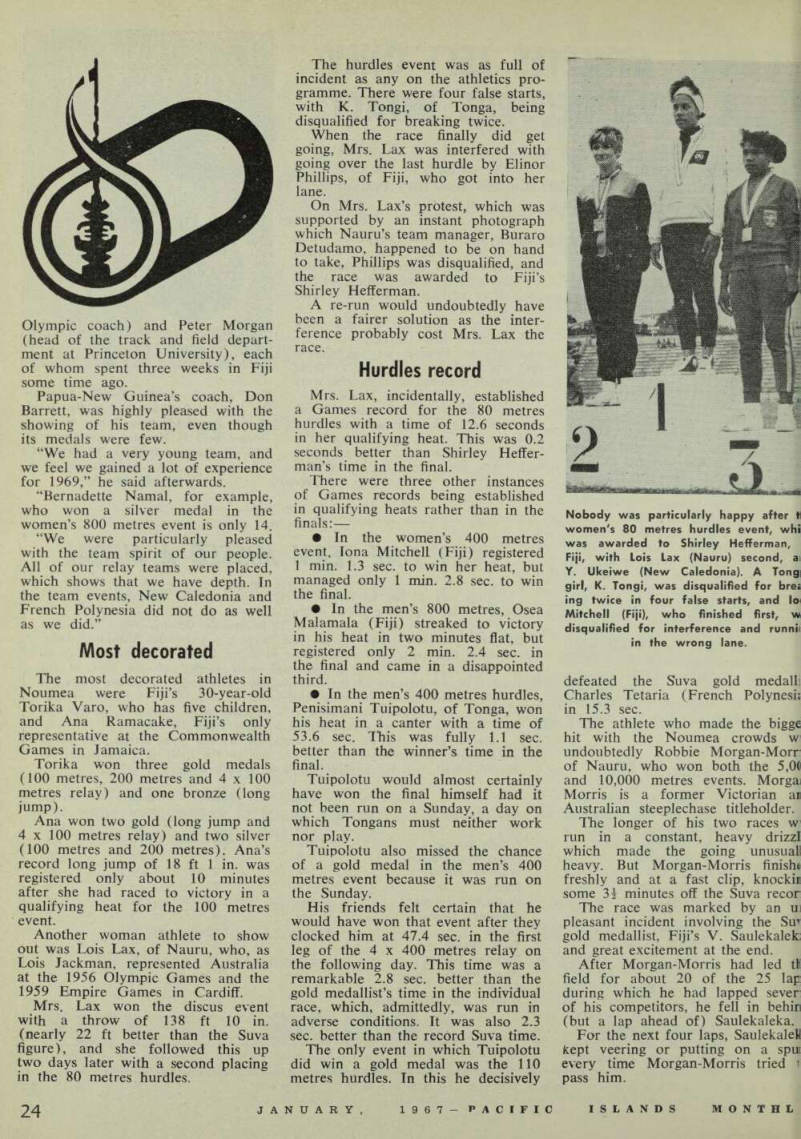
Nobody was particularly happy after t[?]
women's 80 metres hurdles event, whi[?] was awarded to Shirley Hefferman, Fiji, with Lois Lax (Nauru) second, a[?] Y. Ukeiwe (New Caledonia). A Tong,[?] girl, K. Tongi, was disqualified for bres[?] ing twice in four false starts, and lo[?] Mitchell (Fiji), who finished first, w[?] disqualified for interference and runni[?] in the wrong lane.
Finally, Fiji’s U. Sotutu, who had ;pt doggedly at Morgan-Morris’ •els throughout the race, told lulekaleka to move out of the way, id Morgan-Morris was able to get lead.
Then, with only a lap to go, Sotutu ;cidentally tripped Morgan-Morris i he (Sotutu) moved to the lead for e first time and at a fast pace; and ir the next three-quarters of the lurse, Morgan-Morris had to clap i steam to keep with him.
All seemed set for a tense, neck id-neck finish. But with only 150 irds or so to go, Sotutu’s stamina ive out, and Morgan-Morris, finish g as if he had just begun, breasted e tape, well ahead, to the thunderous ieers of the crowd.
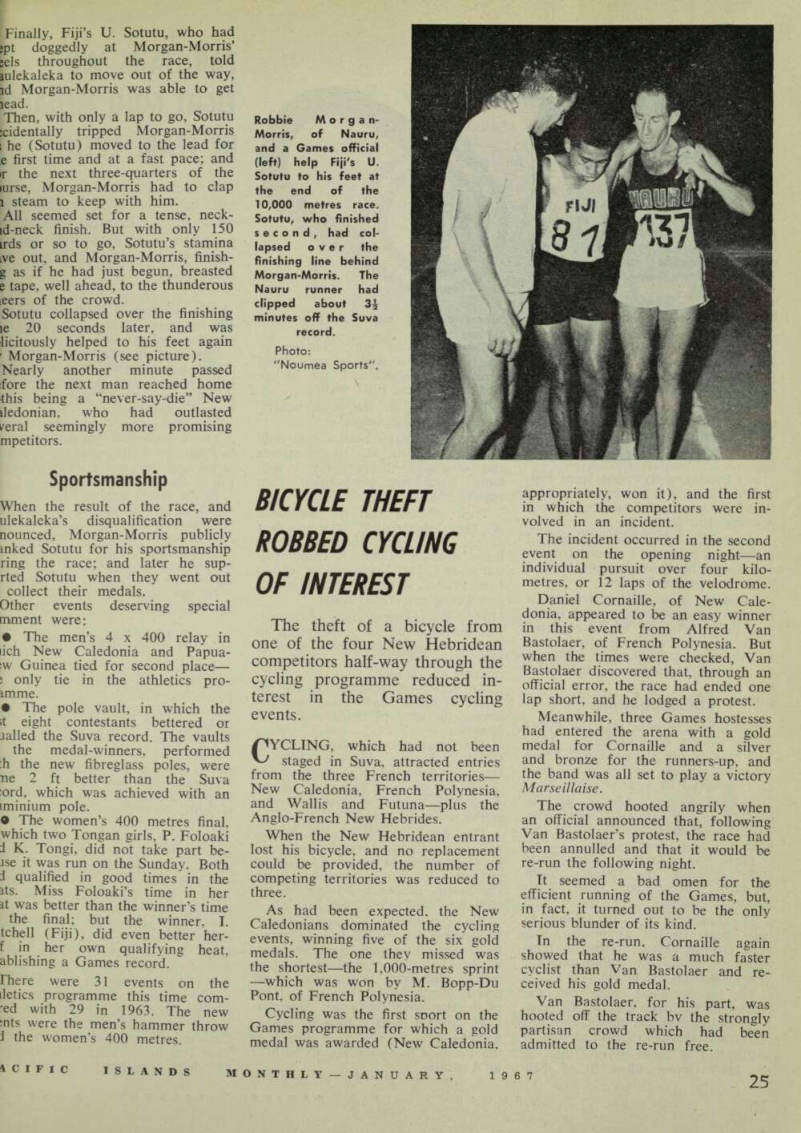
Sotutu collapsed over the finishing ic 20 seconds later, and was licitously helped to his feet again r Morgan-Morris (see picture).
Nearly another minute passed fore the next man reached home this being a “never-say-die” New iledonian, who had outlasted /eral seemingly more promising mpetitors.
Sportsmanship
When the result of the race, and ulekaleka’s disqualification were nounced, Morgan-Morris publicly mked Sotutu for his sportsmanship ring the race; and later he sup rted Sotutu when they went out collect their medals.
Other events deserving special mment were: • The men’s 4 x 400 relay in lich New Caledonia and Papua iw Guinea tied for second place— j only tie in the athletics pro imme. • The pole vault, in which the it eight contestants bettered or jailed the Suva record. The vaults the medal-winners, performed :h the new fibreglass poles, were ne 2 ft better than the Suva :ord, which was achieved with an iminium pole. 9 The women’s 400 metres final, which two Tongan girls, P. Foloaki i K. Tongi, did not take part be jse it was run on the Sunday. Both J qualified in good times in the its. Miss Foloaki’s time in her it was better than the winner’s time the final; but the winner, I. tchell (Fiji), did even better her f in her own qualifying heat, ablishing a Games record.
Fhere were 31 events on the iletics programme this time com bed with 29 in 1963. The new ;nts were the men’s hammer throw 1 the women’s 400 metres.