Tropicalities
pp. 19-21 · Read in the full issue
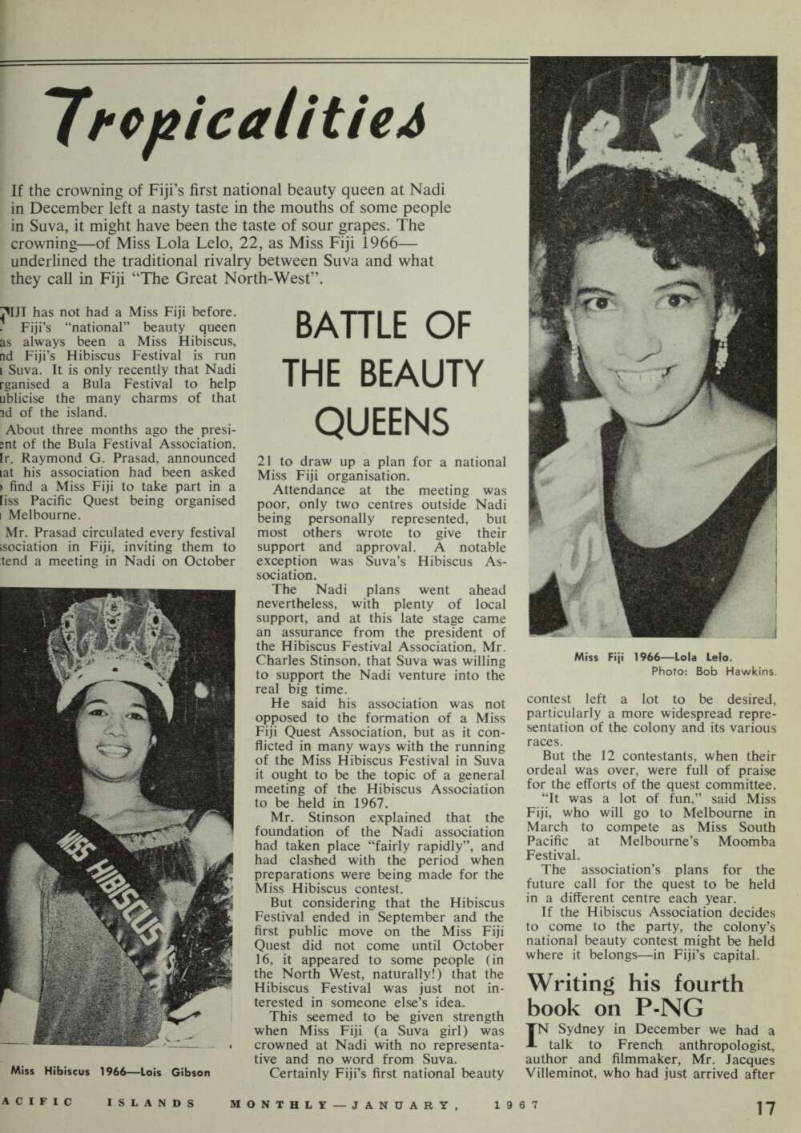
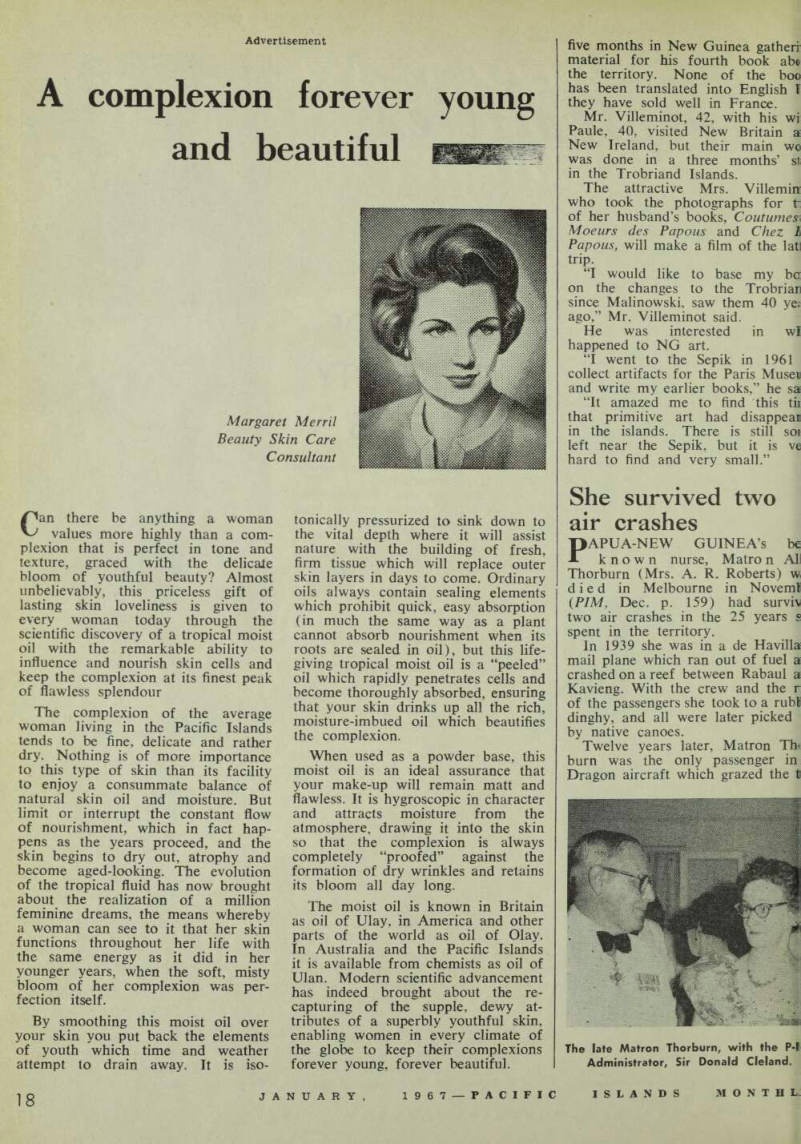
If the crowning of Fiji’s first national beauty queen at Nadi in December left a nasty taste in the mouths of some people in Suva, it might have been the taste of sour grapes. The crowning—of Miss Lola Lelo, 22, as Miss Fiji 1966 underlined the traditional rivalry between Suva and what they call in Fiji “The Great North-West”.
has not had a Miss Fiji before. . Fiji’s “national” beauty queen as always been a Miss Hibiscus, nd Fiji’s Hibiscus Festival is run i Suva. It is only recently that Nadi rganised a Bula Festival to help üblicise the many charms of that id of the island.
About three months ago the presi ;nt of the Bula Festival Association.
Ir. Raymond G. Prasad, announced lat his association had been asked > find a Miss Fiji to take part in a liss Pacific Quest being organised i Melbourne.
Mr. Prasad circulated every festival isociation in Fiji, inviting them to tend a meeting in Nadi on October
Battle Of
The Beauty
Queens
21 to draw up a plan for a national Miss Fiji organisation.
Attendance at the meeting was poor, only two centres outside Nadi being personally represented, but most others wrote to give their support and approval. A notable exception was Suva’s Hibiscus As sociation.
The Nadi plans went ahead nevertheless, with plenty of local support, and at this late stage came an assurance from the president of the Hibiscus Festival Association, Mr.
Charles Stinson, that Suva was willing to support the Nadi venture into the real big time.
He said his association was not opposed to the formation of a Miss Fiji Quest Association, but as it con flicted in many ways with the running of the Miss Hibiscus Festival in Suva it ought to be the topic of a general meeting of the Hibiscus Association to be held in 1967.
Mr. Stinson explained that the foundation of the Nadi association had taken place “fairly rapidly”, and had clashed with the period when preparations were being made for the Miss Hibiscus contest.
But considering that the Hibiscus Festival ended in September and the first public move on the Miss Fiji Quest did not come until October 16, it appeared to some people (in the North West, naturally!) that the Hibiscus Festival was just not in terested in someone else’s idea.
This seemed to be given strength when Miss Fiji (a Suva girl) was crowned at Nadi with no representa tive and no word from Suva.
Certainly Fiji’s first national beauty
contest left a lot to be desired, particularly a more widespread repre sentation of the colony and its various races.
But the 12 contestants, when their ordeal was over, were full of praise for the efforts of the quest committee.
“It was a lot of fun,” said Miss Fiji, who will go to Melbourne in March to compete as Miss South Pacific at Melbourne’s Moomba Festival.
The association’s plans for the future call for the quest to be held in a different centre each year.
If the Hibiscus Association decides to come to the party, the colony’s national beauty contest might be held where it belongs—in Fiji’s capital.
Writing his fourth
book on P-NG
F Sydney in December we had a talk to French anthropologist, author and filmmaker, Mr. Jacques Villeminot, who had just arrived after
Miss Hibiscus 1966—Lois Gibson
Miss Fiji 1966—Lola Lelo.
Photo: Bob Hawkins
five months in New Guinea gatheif material for his fourth book abo the territory. None of the boo has been translated into English 1 they have sold well in France.
Mr. Villeminot, 42, with his wi Paule, 40, visited New Britain a New Ireland, but their main wo was done in a three months’ si; in the Trobriand Islands.
The attractive Mrs. Villeminr who took the photographs for t; of her husband’s books, Coutumes\ Moeurs des Papous and Chez L Papous, will make a film of the latl
trip.
“I would like to base my ba on the changes to the Trobrian since Malinowski, saw them 40 ye;; ago,” Mr. Villeminot said.
He was interested in wi happened to NG art.
“I went to the Sepik in 1961 collect artifacts for the Paris Museu and write my earlier books,” he sa “It amazed me to find this til that primitive art had disappean in the islands. There is still soi left near the Sepik, but it is ve hard to find and very small.”
She survived two
air crashes
Papua-new guinea’s be known nurse, Matro n All Thorburn (Mrs. A. R. Roberts) w. died in Melbourne in NovemK ( PIM, Dec. p. 159) had surviv two air crashes in the 25 years s spent in the territory.
In 1939 she was in a de Havilla mail plane which ran out of fuel a crashed on a reef between Rabaul a Kavieng. With the crew and the r of the passengers she took to a rubV dinghy, and all were later picked by native canoes.
Twelve years later, Matron Thii burn was the only passenger in Dragon aircraft which grazed the ti
The fate Matron Thorburn, with the P-I Administrator, Sir Donald Cleland.
\ a mountain and crashed near ate Creek. The plane was a com ete write-off but the pilot and issenger were unhurt, Matron iorburn walking into Slate Creek ith the rescue party.
Matron Thorburn went to the rritory in 1935 to begin nursing ? Salamaua. In 1938 she became atron of Rabaul Hospital, escap g just ahead of the Japanese, [ter the war she became Senior NG Matron, and in 1958 she was ren the OBE. She married Allan >berts in 1961.
'hey own the
rst bookshop
IHE Maropa Bookshop, the first shop in the New Hebrides de led solely to the sale of books, ened in Vila on November 18 under t management of Mr. Geoff Rice, Sydney.
The interesting point is that the op, which is non-profitmaking, is ned by the Presbyterian Church the New Hebrides, and is con ►lled by the local people through 5 church assembly.
“Our aim is to get books to the ople,” Mr, Rice told us in De nber. “We hope, eventually, to ve agencies on all mission stations the New Hebrides, not only of r own denomination.”
forfolk Island
i the motor age
rORFOLK ISLAND, oldest British I settlement in the South Sea mds, has brought its traffic laws -to-date. Maximum speed is now mph, with 25 mph through the opping centre at Burnt Pine. And )tor scooters may now be ridden schoolchildren, who are entitled apply for conditional licences at (and many have).
Norfolk has had traffic laws of a t since 1858, when Governor nison approved the following: ‘All persons convicted of racing furious driving through the streets d upon any of the public roads out the Settlement, Longridge and scade, shall be fined one pound.” \ year later another traffic law s written into the code: “No per i shall be allowed to gallop a rse on the grass on which is aated Samuel M’Coy’s house and ; long row of buildings, excepting ; case of driving cattle into the LUghter-house. Any person or per is so offending shall be fined the n of twenty shillings.”
Horses were practically the only -ans of transport until 1928 when
the first motor car arrived. Many people protested against the innova tion, their protests being based on the belief that the horses would panic causing a large number of accidents.
Today Norfolk has about 600 motor vehicles and upwards of a hundred motor cycles and scooters.
And every boat brings more.
End of another
no-man’s-land
ANNEXING the last remaining lumps of unclaimed real estate in the South Pacific has become quite fashionable among Islands govern ments in the past two years.
First, Fiji annexed Conway Reef (. PIM , March, 1965, p. 61). Next, New Caledonia annexed Matthew and Hunter Islands, south-east of the New Hebrides chain (PIM, Jan., 1966, p. 76). Now Tonga has annexed South Minerva Reef, scene of an epic story of courage among 16 castaways after the Tongan vessel Tuaikaepau was wrecked there in 1962.
The annexation ceremony at Minerva Reef was performed on
November 24 by David Fifita, captain of the ill-fated Tuaikaepau, who was widely acclaimed for his part in the 1962 shipwreck story.
Captain Fifita is now skipper of the 97 ft Auckland trawler Loch Lein, which sailed for South Minerva Reef on November 19 to explore the possibility of crayfishing there (see also p. 115).
Before setting out, plans had been made for the re-burial at the reef of Fatai Efiafi, who died during the 14 weeks the Tongan castaways were stranded there.
On arrival, the crew dismantled the temporary grave and the remains were placed in a specially constructed concrete casket, together with letters that Fatai Efiafi had written before his death and a copy of Olaf Ruben’s book on the castaways, Minerva Reef.
For the annexation ceremony, a cross and the aftermast of a wrecked Japanese ship, which sheltered the castaways in 1962, were erected on one of the highest points of the island (3 ft above high water), some coco nuts were planted, the Tongan flag was raised, and the Tongans sang their national anthem.
Gowns Of
The Year
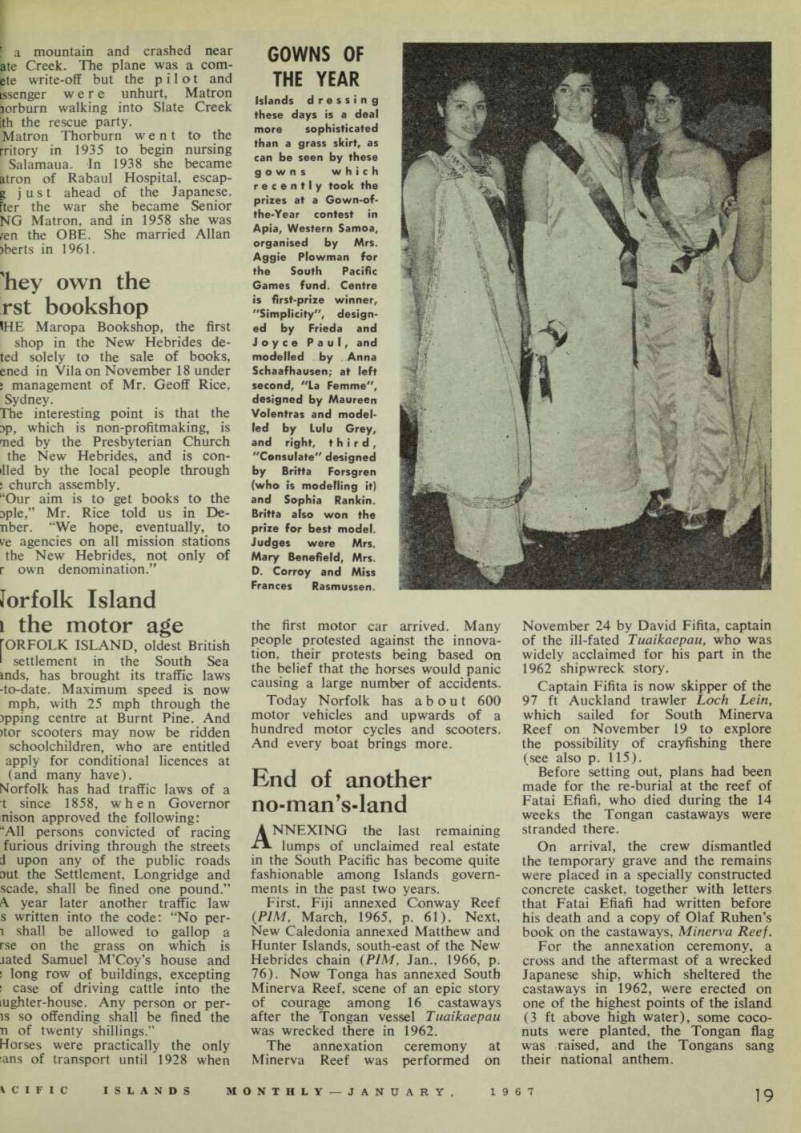
Islands dressing these days is a deal more sophisticated than a grass skirt, as can be seen by these gowns which recently took the prizes at a Gown-of the-Year contest in Apia, Western Samoa, organised by Mrs.
Aggie Plowman for the South Pacific Games fund. Centre is first-prize winner, "Simplicity", design ed by Frieda and Joyce Paul, and modelled by Anna Schaafhausen; at left second, "La Femme", designed by Maureen Volentras and model led by Lulu Grey, and right, third, "Consulate" designed by Britta Forsgren (who is modelling it) and Sophia Rankin.
Britta also won the prize for best model.
Judges were Mrs.
Mary Benefield, Mrs.
D. Corroy and Miss Frances Rasmussen.