And independence is just
pp. 13-14 · Read in the full issue
what the Nauruans want
By Stuart Inder
The recommendation by the United Nations in December that the Nauruans be granted independence by January 31, 1968, and that ownership of the phosphate industry be trans ferred to them, will be discussed at talks in Canberra soon —
possibly in February.
IHE talks will be attended by the three trusteeship partners —Ausilia, NZ and Britain—and by mruan leaders and their Sydney onomic advisers.
The meeting has not been arranged a result of the UN recommenda >ns. It is a continuation of talks Id in Canberra in June last year, dependence and control of the osphate have always been vital ues on the agenda, but the new UN cision will give added urgency the renewed talk s—for the mruans plan to press the points.
In late December there was doubt out the exact date of the talks be nse Australian officials wanted ire time to consult with their rtners as result of the UN moves.
What they want
The Nauruans have made it clear at they want both independence and ntrol of the phosphate. How to t them has been the problem.
They have said that: • The phosphate industry is >ally theirs and that they want to ke full possession of it. • The BPC will get a fat fee managing agents to continue to 'Crate the industry. • They want to see Nauru re bilitated, the trusteeship powers ying one-third of the cost of re bilitation (as the phosphate has stroyed one-third of Nauru) or, ternatively, they want resettlement i another island. • They want independence by nuary, 1968.
They have in the last year or two it detailed submissions in support these requests—long legal and dinical arguments on ownership >hts and rehabilitation costs.
These submissions have been the ark of their advisers, Philip Shrapnel id Co., of Sydney, who have pplied economic and even political vice. The Australian firm of public lations counsellors, Eric White and ssociates, have also been advising
the Nauruans on various aspects of their approach, and at times the Nauruans have had top legal advice.
All of it has been expensive, but as a result of this professional help the Nauruans have in the last two or three years more than made up for their lack of progress during the previous five years, when they were virtually given the run-around by the Australian Government, which considered there were more important problems in the Pacific.
Their greatest success—which has been almost entirely achieved through their advisers—has been in getting phosphate royalties increased sub stantially.
The economic advisers have done such a thorough job in preparing and presenting economic papers that sometimes the main issue has been relegated to the background.
The main issue in Nauruan eyes is independence.
There is a deep nationalism on Nauru, and the independence issue is not seen by Head Chief Hammer De Roburt and his colleagues as merely a means of gaining complete control of the phosphate; they consider achievement of independence as a matter of national honour.
Independence, above all
They are aware that the phosphate economy is an important prerequisite of independence, but such is their determination to achieve independ ence that it is doubtful if they would take any other stand even if no phosphate existed.
Hammer Deßoburt also sees, in independence, security in an insecure world. Fear of insecurity troubles the Nauruan leaders greatly; they believe they need an island—their own island or another one—more than they need phosphate.
It is this fear of insecurity which has made the Nauruans difficult negotiators—as difficult to their friends as to the governments they have to approach.
Government and BPC officials say they have frequently been frustrated almost to screaming point by the Nauruan habit in the conference room of changing their stand on small matters, of fretting about minor compromises, of being reluctant to give a straight yes or no, of their seeming inability to weigh alter natives.
But all the difficulties are not with the Nauruans. The Nauruans often feel they are being pushed into decisions by more experienced negotiators who are not really sympathetic to the Polynesian/Micro nesian way of doing things, Nauruans do not regard themselves as embryo- Australians.
They need reassurance
Their difficulty in negotiation sometimes stems from their sense of responsibility to the people back home. They know what result they want but they are continually appre hensive of taking a wrong step on the intricate path of negotiation, which later generations of Nauruans might hate them for.
Sometimes they go too far, and distrust everybody. On these occasions their friends, too, become frustrated and ask themselves why the Nauruans can’t see a little sense, “give a little”.
It’s a good way of losing friends.
What the Nauruans need most of all from the Australian Government is reassurance reassurance that, come what may, they will be given independence at some date.
Until they are reassured the Nauruan situation is likely to develop from a minor pin prick to a large scale international rumpus. The Nauruans are going to keep on ask ing for independence whether any body likes it or not; whether anybody thinks they can survive as
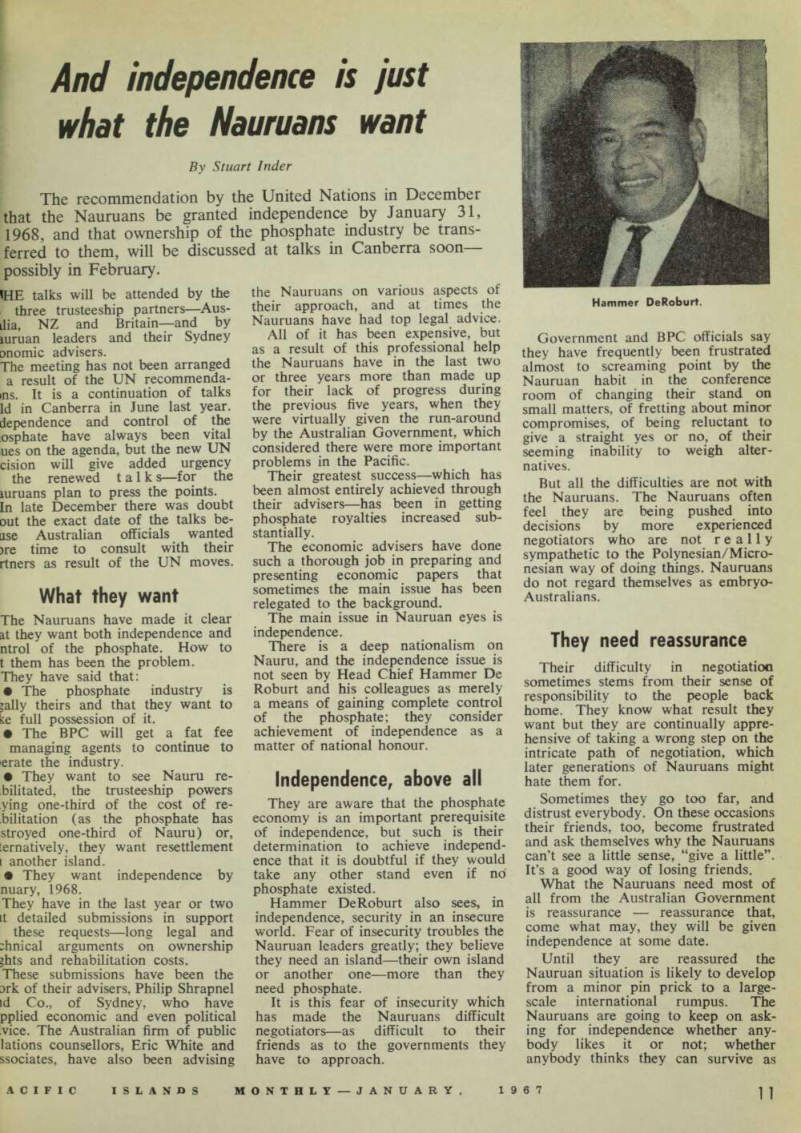
Hammer DeRoburt
an independent nation or not. This fact is certain.
The partner governments are aware that a viable economy for Nauru is feasible provided phosphate money is available—an economy based on several industries, including a tuna industry. There does not appear to be any dispute on this score.
From my own personal observa tions it could be that Australia at least is getting weary of the pro tracted negotations and demands for independence, and has come around to the view that the Nauruans perhaps ought to have independence—just to prove to them how tough life can be in a cold world!
The forthcoming talks, one way or another, should be of vital impor tance on the whole Nauruan issue.
Mr. Wootten said the territ; would continue to need outs financial aid for development. II could not even run its basic servi without outside aid, it would h, no meaningful choice of its politi future. The territory’s economic s financial problems must be looked as its own and not those of Austrai In the absence of another moc New Guineans in transition to urf life had assumed as their ideal way of life of the Europeans.
Standards different
Mr. Wootten said that otl developing countries had accepted i fact that the standard of the met politan country was not the only c to be followed, and so should P-N There were differences in resourc development, education and skill.
If all the Public Service was pj on the Australian rate there woi be an unbalanced community, w the people the public servants set living at a lower standard—c related to New Guinea’s deveh ment.
The Australian wage standai were merely a “temporary aber tion” on the New Guinea scei dictated by the necessity to attrs qualified Australians to do the jc New Guineans were not yet rea to do.
Mr. Wootten submitted that t problem of race relations w temporary and would disappear the more highly paid Australians we replaced by qualified New Guinea] Within the foreseeable future, N< Guineans would replace all but t most highly qualified, specialis Australians.
It was already some years sin a permanent appointment had be* made at overseas rates. It was on those prepared to accept local rat who had a permanent future, he sai It was the group of emergir educated New Guineans who had t] “difficult and painful task” developing a new mode of livin more modest and inexpensive th; the Australian, but no less tasteft graceful or dignified. A style ai standard appropriate to New Guin< must be developed.
During the hearing, Mr. Wooth produced the report of a triparti mission which visited the territory : September-October, 1960, on laboi matters.
Mr. Wootten said the report, ; effect, had castigated the Governme] for not having done what the Goven ment had now done—related salarii throughout the public service to tl capacity of the territory’s economy