says UN (whether they
p. 12 · Read in the full issue
Independence for all, says UN (whether they want it or not)
The UN General Assembly in December called for independence for Fiji, P-NG and Nauru.
It called on those responsible to fix “an early date” for independence in Fiji and P-NG, and asked Australia to give Nauru independence not later than January 31, 1968, and to pass over the phosphate industry to the Nauruans.
ONLY on Nauru were the UN declarations received with special interest. The P-NG House of Assembly has already said it is not ready for inde pendence, and the Fiji Legislative Council has said it doesn’t want it. Both legislatures have a majority of local members.
The Nauru Legislative Council, which also has a local majority, asked during 1966 that Nauru be granted independence by January, 1968, and has been pressing the demand. Further talks are expected to be held in Canberra soon (see opposite), but meanwhile Australia has said it wants the Nauru Legislative Council to gain further experience before “any further steps are made”.
In its resolution on Fiji the General Assembly asked that Britain hold general elections for a constituent assembly to draft a constitution and form a govern ment. It wanted a sub-committee to be sent to Fiji to study the political situation.
Britain retorted that the resolution ignored the political progress made in Fiji in the last 12 months, as a result of a constitutional conference followed by new elections. And no mission was necessary, as all the facts about Fiji were freely available.
Although only six nations voted against the resoluth in its entirety several African states said they thoug independence for Fiji at this stage would do more har than good.
The UN resolution on New Guinea asked, in additic to early independence, that elections be held on tl basis of universal adult suffrage, that discriminate: electoral rolls and other forms of discrimination 1 abolished, and that Australia refrain from using tl territory for military activities “imcompatible with tl charter of the UN”.
In Canberra on December 21 the Australian Minish for Territories, Mr. C. E. Barnes, replied that Austral had no obligation to follow resolutions passed by tl UN “in disregard of the situation in the territory an everything that is known about the wishes of the va majority of its inhabitants”.
He said there were no discriminatory electoral roll but one common roll. Discrimination had been remove from all laws and discriminatory practices in busines had been made illegal, but “the action of ever individual could not be controlled by a government”.
He pointed out that the current House of Assembl had been elected in 1964 on the basis of universal adul suffrage, and that Australia’s policy for P-NG was sell determination—with the New Guineans themselve deciding when.
He added that there were no military activities in th territory incompatible with the UN charter, and las June the Assembly had passed a motion welcoming th presence of Australian defence installations and force “as a guarantee that the country would come to ou aid in time of need in the future”.
On the resolutions affecting Nauru Mr. Barnes saic the matters referred to were the subject of incomplett discussions with the Nauruans. Australia, Britain anc NZ had rights to the phosphate deposits, and phosphate ownership and independence ought to be worked ou with the Nauruans, “rather than being determined bj declarations adopted without informed discussions aboui the consequences”.
In formal attire at the ceremonial opening of the Fiji Legis lative Council's Budget session in December are the Governor, Sir Derek Jakeway (left), and the new Speaker of the Legis lative Council, Mr. R. G. Kermode. Like his predecessor, Sir Maurice Scott, Mr. Kermode is a solicitor. — Photo: Rob Wright.
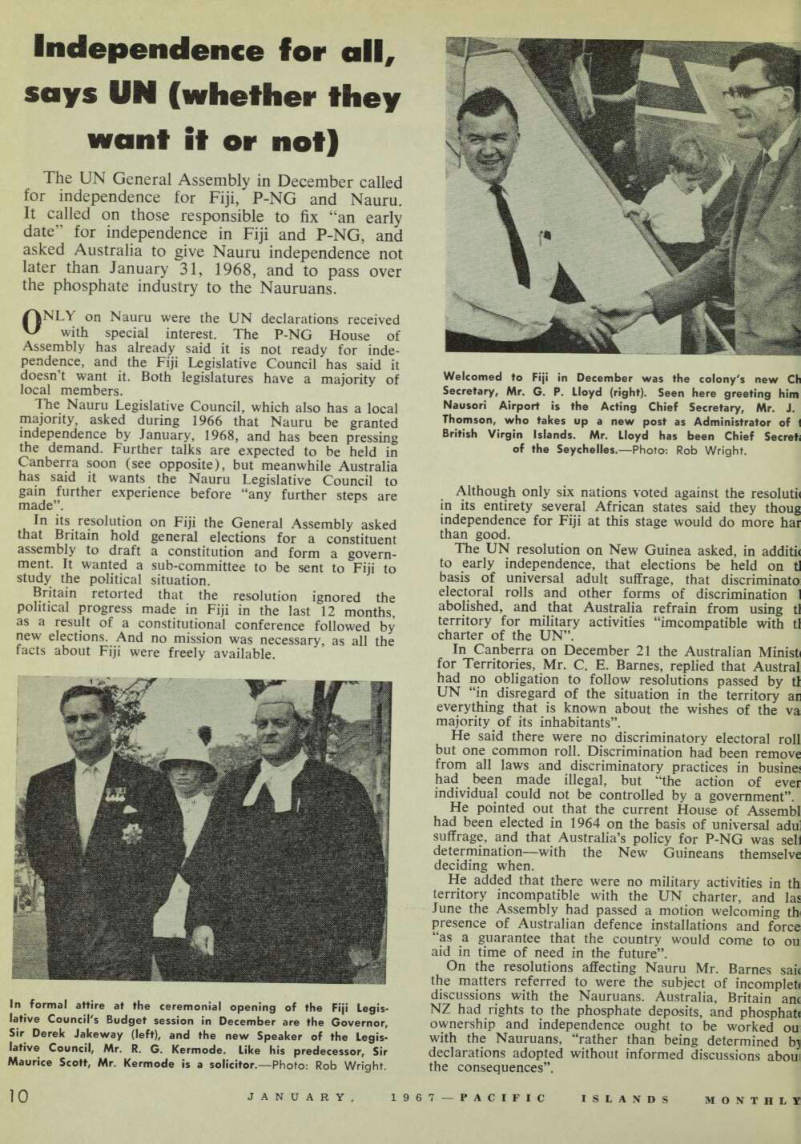
Welcomed to Fiji in December was the colony's new Ch[?] Secretary, Mr. G. P. Lloyd (right). Seen here greeting him Nausori Airport is the Acting Chief Secretary, Mr. J.
Thomson, who takes up a new post as Administrator of [?] British Virgin Islands. Mr. Lloyd has been Chief Secret[?] of the Seychelles.— Photo: Rob Wright.