travel
pp. 123-127 · Read in the full issue
The Man Who Put The Yasawas On The Map
By R. W. Robson
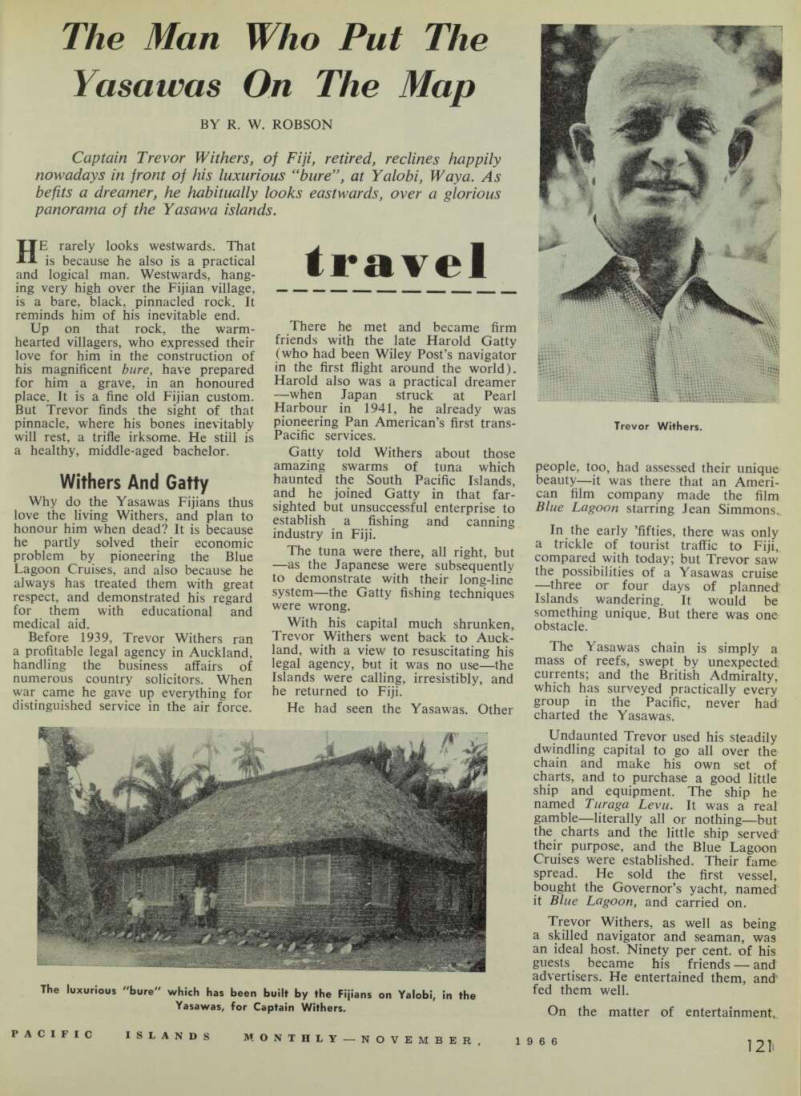
Captain Trevor Withers, of Fiji, retired, reclines happily nowadays in front of his luxurious “bure”, at Yalobi, Way a. As befits a dreamer, he habitually looks eastwards, over a glorious panorama of the Yasawa islands.
HE rarely looks westwards. That is because he also is a practical and logical man. Westwards, hang ing very high over the Fijian village, is a bare, black, pinnacled rock. It reminds him of his inevitable end.
Up on that rock, the warm hearted villagers, who expressed their love for him in the construction of his magnificent bare, have prepared for him a grave, in an honoured place. It is a fine old Fijian custom.
But Trevor finds the sight of that pinnacle, where his bones inevitably will rest, a trifle irksome. He still is a healthy, middle-aged bachelor.
Withers And Gatty
Why do the Yasawas Fijians thus love the living Withers, and plan to honour him when dead? It is because he partly solved their economic problem by pioneering the Blue Lagoon Cruises, and also because he always has treated them with great respect, and demonstrated his regard for them with educational and medical aid.
Before 1939, Trevor Withers ran a profitable legal agency in Auckland, handling the business affairs of numerous country solicitors. When war came he gave up everything for distinguished service in the air force.
travel
There he met and became firm friends with the late Harold Gatty (who had been Wiley Post’s navigator in the first flight around the world).
Harold also was a practical dreamer —when Japan struck at Pearl Harbour in 1941, he already was pioneering Pan American’s first trans pacific services.
Gatty told Withers about those amazing swarms of tuna which haunted the South Pacific Islands, and he joined Gatty in that far sighted but unsuccessful enterprise to establish a fishing and canning industry in Fiji.
The tuna were there, all right, but —as the Japanese were subsequently to demonstrate with their long-line system—the Gatty fishing techniques were wrong.
With his capital much shrunken, Trevor Withers went back to Auck land, with a view to resuscitating his legal agency, but it was no use—the Islands were calling, irresistibly, and he returned to Fiji.
He had seen the Yasawas. Other
people, too, had assessed their unique beauty—it was there that an Ameri can film company made the film Blue Lagoon starring Jean Simmons., In the early ’fifties, there was only a trickle of tourist traffic to Fiji,, compared with today; but Trevor saw the possibilities of a Yasawas cruise —three or four days of planned' Islands wandering. It would be something unique. But there was one obstacle.
The Yasawas chain is simply a mass of reefs, swept by unexpected currents; and the British Admiralty, which has surveyed practically every group in the Pacific, never had charted the Yasawas.
Undaunted Trevor used his steadily dwindling capital to go all over the chain and make his own set of charts, and to purchase a good little ship and equipment. The ship he named Turaga Leva. It was a real gamble—literally all or nothing—but the charts and the little ship served their purpose, and the Blue Lagoon Cruises were established. Their fame spread. He sold the first vessel, bought the Governor’s yacht, named it Blue Lagoon, and carried on.
Trevor Withers, as well as being a skilled navigator and seaman, was an ideal host. Ninety per cent, of his guests became his friends and advertisers. He entertained them, and fed them well.
On the matter of entertainment,
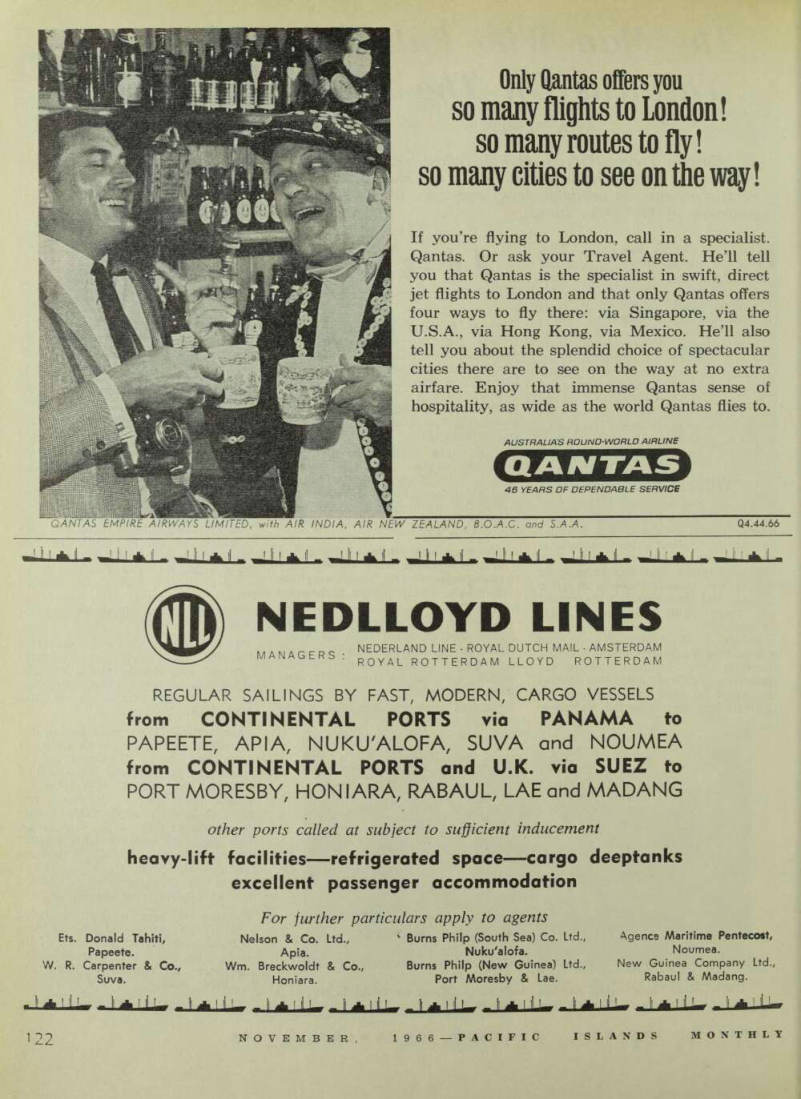
The luxurious "bure" which has been built by the Fijians on Yalobi, in the Yasawas, for Captain Withers.
Trevor Withers.
it is worth remembering that Withers is an incorrigible practical joker. I hope that he and his former pas sengers will forgive me if I tell of one priceless feature that he intro duced into his cruises.
At one place in the chain a high, rocky cape overhangs the cruise route —a steep drop directly into sea.
Withers named this The Virgins' Leap. As his vessel approached, he told the story.
In the old days, he said, a Tongan war expedition approached the island.
There was a large Fijian population.
The Fijians, fearing the Tongans, sent their women and children, in cluding a large number of rare virgins, back into the hills. The Tongans overwhelmed the Fijian defenders, and set off after the women. The women retreated up the hill at the end of the island. The Tongans followed. Finally the virgins, faced with a fate worse than death, lined the cape and, as the Tongans came on, they all jumped over into the sea.
Shillings And Sophistication
As told dramatically by the solemn Captain Withers, it was a moving story.
“Here,” he said “we pay honour to their courage and to their memory”. He slowed speed, let off a mournful sound on the ship’s siren and, as they passed The Virgins’
Leap, he and his crew stood to at tenion. Invariably, the passengers followed suit.
It was a highlight of a memorable cruise—but a gorgeous spoof. The new owners don’t do it any more... probably only a Withers could get away with it.
Captain Withers and his Blue Lagoon Cruise opened up some delightful places—the caves with their mysterious carvings, at Sawa i-Lau (actually, beside the beautiful lagoon where the film was made); the native market under the palms, along the beach, at Nacula; the lovely beach and unspoiled village at Yalobi, where the head men direct an old-time kava ceremony and primitive dancing, to welcome the visitors.
The cruise ship lies overnight in
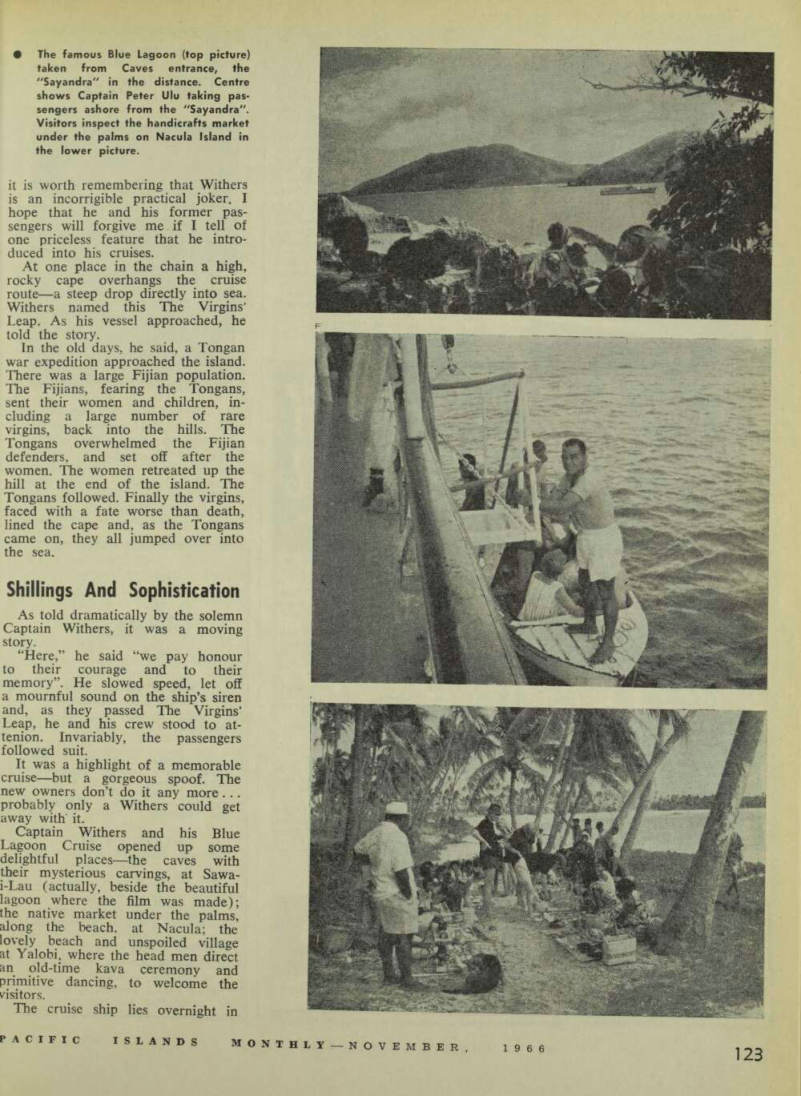
The famous Blue Lagoon (top picture) taken from Caves entrance, the "Sayandra" in the distance. Centre shows Captain Peter Ulu taking pas sengers ashore from the "Sayandra".
Visitors inspect the handicrafts market under the palms on Nacula Island in the lower picture.
quiet, landlocked places like Cunu and Matacawa, where villagers put on fire-lit local entertainments—all fruits of Withers’ enterprise.
Before Withers, the Yasawas had only a fish and coconuts economy, and the people were poor. Now, they get a substantial number of shillings each trip from the tourists; but they still are poor, and happy, if a little more sophisticated.
At the Blue Lagoon (Sawai-i-Lau) I wandered around a clump of rocks, seeking a picture. There 1 found a couple of comely Fijian girls, looking for shellfish along the beach. They greeted me with cautious smiles.
I asked them to come back around the corner, where ardent photo graphers were gathered. They re treated, quickly. I urged them to come along.
Then the older one, with inbred courtesy, came up to me and whispered the only English phrase she knew, probably taught her by the local Methodist missionary: “Master, I am not free”. The smaller one said nothing, scrabbled shyly with her toes in the sand. Perhaps she was free.
Anyway, I got them around to the waiting cameras, and all was well— they earned their shillings legiti mately.
Goodwill
In his 14 years, pioneering and running the Blue Lagoon cruises, Withers gained not only the goodwill but also the love of the Fiijans along the chain. That goodwill was worth something as tourism grew, and other entrepreneurs got their eyes on the Yasawas.
One experienced lad decided to run cruises also. The Fijians, at first, did not quite get it. Then they showed their teeth. The new arrivals were told, with frankness backed with ferocity, that the islands belong ed to the Fijians; that Withers was there with their permission; and if any other gentlemen came in with cruise ships not directed by Withers, there would be acute unpleasantness.
The competitor, naturally, was indignant. Why should Withers have a monopoly? On his next trip, he was accompanied by the District Officer. What happened is not quite clear; but the officer somehow held the scales of justice nicely balanced, the Fijians were placated, and Captain Withers was left alone in
the area he had developed, and charted.
Last year, Captain Withers sold out to New Zealand interests, re presented by Captain Claude Miller.
Captain Miller brought in his young son, lan and introduced the cruise ship Romanda, another nicely-equip ped converted Fairmile from Auck land, and Captain A. P. Tonkin and his wife; and now they are running the two vessels (Sayandra and Romanda ) in an expanded tourist service out of Lautoka, through the Yasawas chain.
Captain Withers’ right-hand man and deputy was a Fijian, Captain Peter B. Ulu, who can take the
Sayandra through that maze of islands and reefs (on one 4-hours’ run they make 38 changes of course!) almost on memory alone.
Peter, also, is highly popular among the Fijians. At the end of May, Peter was not happy about the changes, and had informed the new owners that he was going to another job.
Trevor Withers has now removed his home from Lautoka to Yalobi, in Waya, in the Yasawas; and from there, among his Fijian friends, he benevolently observes the operations of his busy successors, operating the service he pioneered, and still based on his goodwill and his charts.