Yesterday
p. 95 · Read in the full issue
As the November issue of PIM went to press 20 years ago, the Pacific was still emerging from its post-World War II reconstruction blues. In New Guinea, copra planters were still sore because of the low price they were receiving from the Production Control Board, while their op posite numbers in Fiji were celebrating a rise of £F2/18/6 per ton for all grades of copra pro duced in the Colony.
But if the price of copra was a bone of contention, the Pacific was booming in other spheres. Two trans-Pacific air services had been put into full operation, although few people were using them. PIM commented that the fare of £A2I4 from Sydney to San Francisco was far too high; and it was probably right, as the fare is now only about SA6OO (£300), while prices generally have increased threefold.
OTHER items from PIM for November, 1946, were: THE “blundering bureaucrats and politicians” of Australia’s socialist government had driven the United States from the huge fortified base at Manus, in New Guinea, where the US had spent $156 million on construction and had planned to occupy it per manently. After a lot of fuss the Australian Government announced that it would not give the United States rights to the base but would share it—under certain conditions.
The Americans eventually ceased negotiations and started dis mantling the base.
BUNDLES for Britain were still fashionable. In Fiji, the Gov ernor’s wife, Lady Grantham, headed a committee that organised an appeal for gifts for still rationed Britain. She was pictured beside a lorry loaded with cases of Fiji soap and Fiji canned pine apple—all headed for London for war-battered Britishers.
MORE than 1,000 Chinese were preparing to leave Tahiti for China, The Chinese consul-general was negotiating with a steamship company for their transportation.
Nearly 200 Europeans had left Tahiti by the Sagittaire and an other 60-odd were due to depart in November. PlM’s corres pondent could give no reason for the exodus.
ERIC FELDT’S famous book The Coast Watchers had just been published. The book told the story of the part played by the Coast Watchers in the Pacific War.
FOLLOWING a volcanic erup tion on Niuafoou (Tin Can Island) in September, 1946, the Tongan Government decided that its 1,800 inhabitants should be evacuated. Most of the Govern
ment buildings, trade stores, houses and installations on the island were destroyed when the centre of the island blew up.
P-NG was being invaded by a steady stream of war-surplus buyers from Australia, who were flown to the territory at the Gov ernment’s expense and taken on conducted tours of the acres of “car parks” where ex-service vehicles and aircraft had been assembled and abandoned. Local residents claimed that while these buyers had received the red carpet treatment, they had to locate any thing they wanted in the jungle and were otherwise frustrated by red tape and shilly-shallying from the Commonwealth Disposals Commission.
A PROPOSAL to resettle 100 people from the overpopu lated Gilbert and Ellice Islands Colony in Tonga was passed unanimously by Tonga’s Parlia ment and approved by Queen Salote and the Privy Council. (However, the proposal was never taken up. The Gilbertese went eventually to the BSIP, and Tonga now has population problems of its own.) MR. HENRI SAUTOT, the first French Colonial Governor to declare for General de Gaulle and Fighting France in 1940, had arrived in Sydney en route to New Caledonia from France. Accom panied by his wife, Sautot stated that he was returning to become “a gentleman farmer”. Sautot was deported from Noumea in 1942 following his clash with Rear- Admiral d’Argenlieu, and was subsequently appointed Governor of a French African colony by de Gaulle.
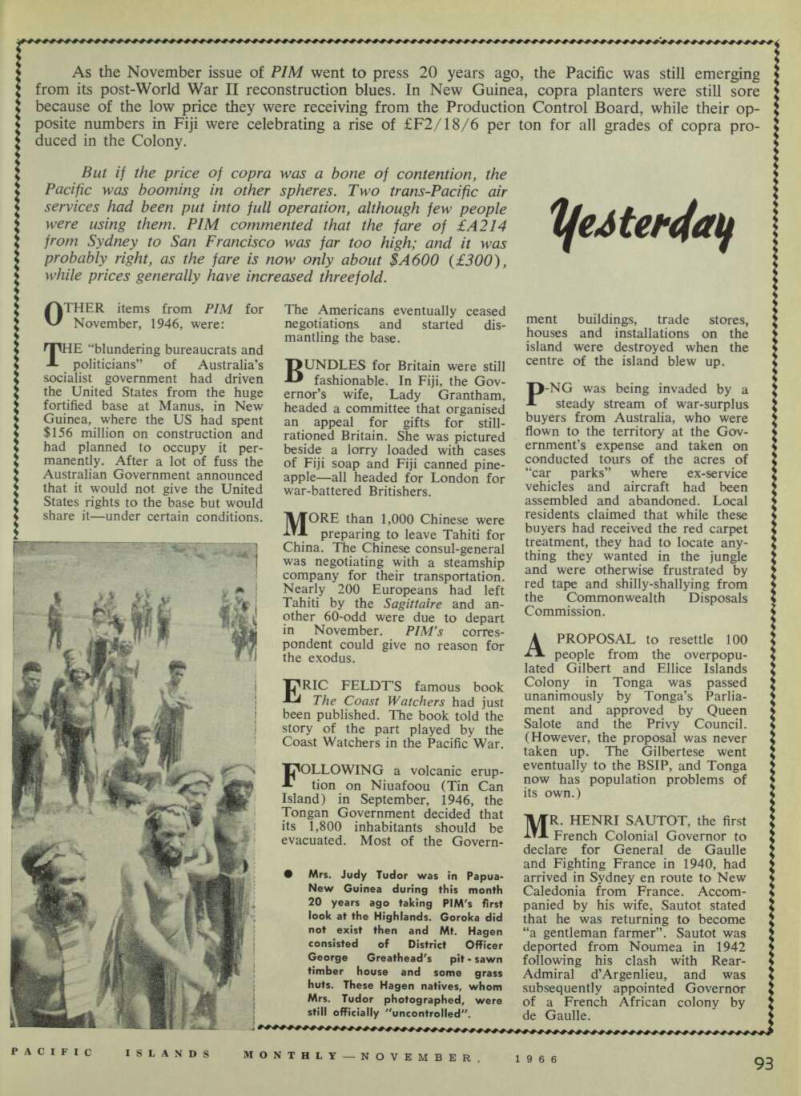
Mrs. Judy Tudor was in Papua- New Guinea during this month 20 years ago taking PIM's first look at the Highlands. Goroka did not exist then and Mt. Hagen consisted of District Officer George Greathead's pit-sawn timber house and some grass huts. These Hagen natives, whom Mrs. Tudor photographed, were still officially "uncontrolled".