Breeding Sheep In Fiji
p. 93 · Read in the full issue
There’s Nothing New About Breeding Sheep In Fiji
From John Carter in Suva When mutton bred in Fiji was served to the Queen Mother at Government House, Suva, earlier this year, it was regarded by some people as an interesting novelty.
BUT it was rather an old novelty, for the first breeding sheep brought into Fiji were well estab lished in the country by the time it was ceded to Britain. And it is on record that wool from Wakaya Island was sent to the London Exhibition in 1862.
The first sheep were brought in by Dr. I. M. Brower, who was US Consul from 1860 to 1876, and extensive runs were opened up on the northern shores of Viti Levu and on Vanua Levu, particularly on the Bua coast. Several good flocks were also on Makogai.
In 1864 it was estimated that upwards of 1,000 sheep were brought to Fiji from Australia, making a total of 3,000 sheep in the country.
Despite all dire prophecies about footrot and other diseases which would affect sheep in the tropics, they did well. The sheep fattened, the wool grew rapidly, and the ewes bred politically.
In a comprehensive survey of the sheep industry in the early days, Charles R. Turbet, a former chief veterinary officer in the Department of Agriculture, recorded that David Wilkinson, of Bua, one time in
terpreter to King Cakobau, brought in sheep in 1879.
In 1901, H. H. Darcy brought that flock up to 2,000 with fresh importations. Edwards and Hall carried on in 1912, and just recently, a descendant of that Edwards (Mr.
A. Edwards, of Bua), brought in new blood from overseas.
On Viti Levu in the nineties J.
Tyler ran sheep at Tavua, bringing in fresh sheep from Australia in 1908. The remnants of that flock were taken over by Messrs. Foulis and Marsh under the management of the late Mr. G. C. Foulis at Wainivoci, and ran successfully for several years.
Mr. Tyler was not the only person to bring in sheep in 1908.
Pig, Dog Menace
In that year K. P. Wright, Rasikula Estate, Nadroga, in the Western zone of Viti Levu, brought 1,436 sheep from the west of New South Wales.
He lost only 19 on a protracted sea trip, and only six on the long drive from Lautoka to the Sigatoka River.
“There is little doubt that if land can be obtained, the next few years will see sheep farming rank as one
of the principal industries in the colony,” The Fiji Times commented.
The veterinarians and early planters agreed that the sheep did well in rolling, hilly country, with short grass and small patches of bush, and that the stony hillsides prevented footrot.
However, native-owned dogs, wild dogs and wild pigs proved to be a menace, and within a year or two most planters had given up their interest in sheep.
“Shooting wild pigs and wild dogs became monotonous,” one planter said.
Another said: “If wild dogs were exterminated, sheep production would be an easy and profitable proposition.”
The original sheep-breeding Edwards’ view was that “sheep in Fiji would long ago have been a big industry if it had not been for the dog question”.
The mutton that the Queen Mother ate at Government House this year came from a flock that is considerably smaller than some of those that were in the colony years ago.
But the present-day flock could well grow to be much bigger than those of the old days.
The Department of Agriculture is experimenting with this flock to determine how many sheep the small Fijian and Indian farmers can run economically, producing both wool and mutton.
Wool sold well on the overseas markets, and today there is a large population of Indian people who, for religious reasons, cannot eat beef, and who have developed a strong liking for mutton curry.
The fact-finding has been done and the industry proved. And, with imports of fresh, chilled or frozen sheep and lambs amounting to £196,573 in 1965, and, with mutton in airtight containers bringing the total to £253,275, it can certainly be regarded as an industry with a bright future.
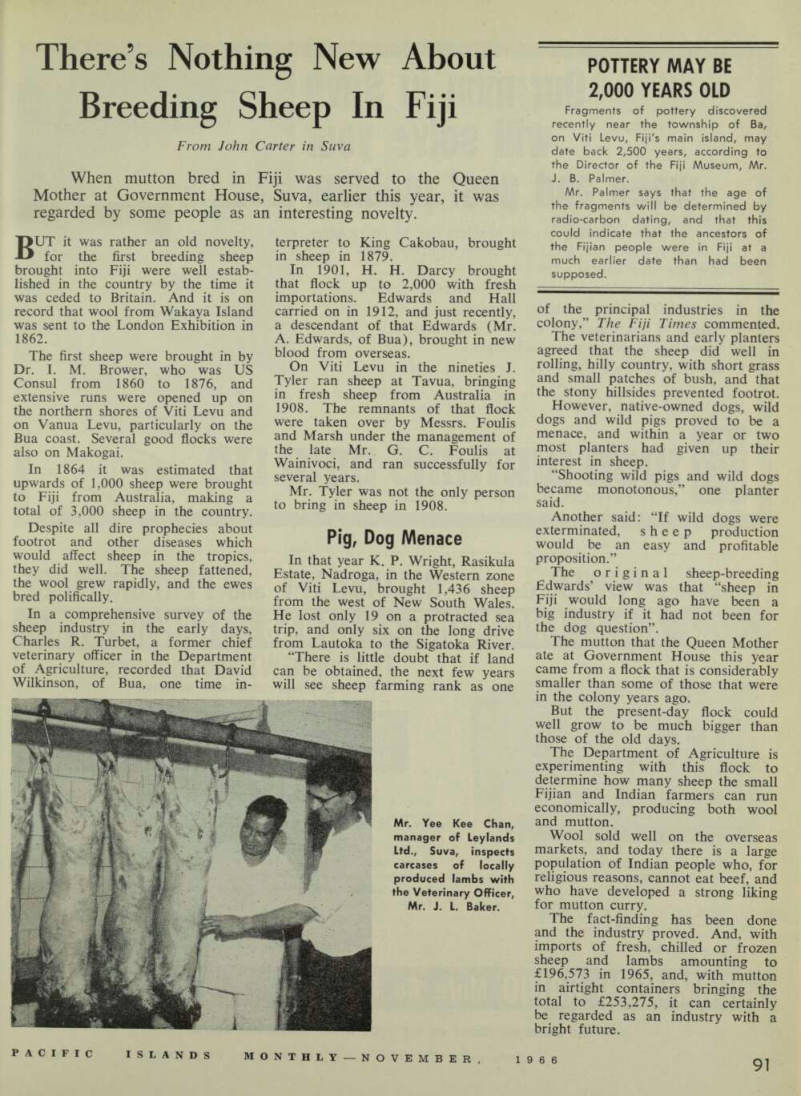
Mr. Yee Kee Chan, manager of Leylands Ltd., Suva, inspects carcases of locally produced lambs with the Veterinary Officer, Mr. J. L. Baker.