Aviation Played
pp. 49-51 · Read in the full issue
Big Part In
Morobe Goldfields
The fabulous Morobe gold fields rocketed to fame when gold was discovered in 1921 by
the legendary “Sharkeye” Park,
at the junction of Koranga Creek and the Bulolo River, just be low the present site of the town of Wau.
KORANGA Creek proved to be amazingly rich. Word of the new find spread, and other famous pro spectors made the hard and dangerous walk to the Koranga.
By the end of 1925 there were over 50 prospectors with their teams scattered over the Koranga, Watut and Bulolo country. In 1926 the extraordinary field at Edie Creek, 7,000 ft up the mist-shrouded slopes of Mount Kaindi, was discovered by W. G. Royal. There was a real gold rush. Men poured into New Guinea, eager to make their fortunes at the new Eldorado. Few did so.
Edie Creek, whilst enriching the discoverers, proved to be limited in extent. The physical hardships of working the new field were appalling.
The newcomers, mostly inexperienced, faced heartbreaking conditions in the sodden, icy heights of Edie Creek.
Every pound of food, every piece of equipment had to be carried in on
the backs of carriers from the coast at Salamaua, a tough journey for the experienced man but almost impos sible for the newchum.
There were no roads, no stores, no amenities. Life was as primitive as it could well be, and warmed only by the bright lure of gold.
The harshest of the conditions vanished when the aeroplane came to the goldfields. The man most responsible was C. J. Levien, who was District Officer at Morobe when Park found gold at Koranga. Levien was a man of vision.
He resigned from the Administra tion and went into the new field. He became convinced that the future of the field lay in large-scale com pany operations and he realised that the key to development was aerial transport, a completely new concept on the scale that Levien envisaged.
He dreamed and planned and toiled and when he died in 1932 he had laid the foundations for the future prosperity of the goldfields.
Air Age Begins
The first aircraft landed at the raw new strip at Wau in April, 1927, a fragile wartime biplane piloted by Captain A. E. “Pard” Mustar. So commenced the air age on the gold fields.
A company was formed to exploit the alluvial flats of the Bulolo Valley. Plans were made to fly in the component parts of gold dredges, in huge aircraft that were not even flying when the first plans were made.
The township at Bulolo sprang into existence and as, one after another, the great gold dredges were brought
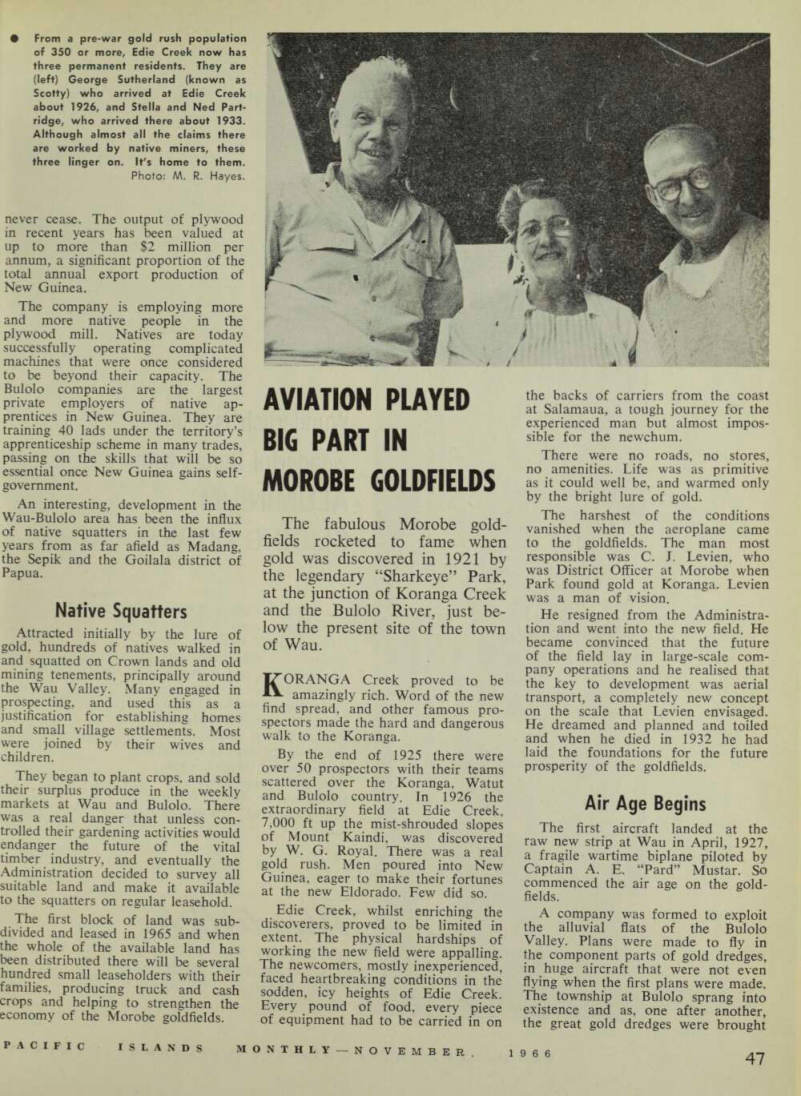
From a pre-war gold rush population of 350 or more, Edie Creek now has three permanent residents. They are (left) George Sutherland (known as Scotty) who arrived at Edie Creek about 1926, and Stella and Ned Part ridge, who arrived there about 1933.
Although almost all the claims there are worked by native miners, these three linger on. It's home to them.
Photo: M. R. Hayes.
The Gave The Goldfields Life
into operation, the new town began to overshadow Wau.
Other companies were formed: New Guinea Goldfields Ltd., Koranga Gold Sluicing Ltd.. Day Dawn Ltd. and others. The day of the individual prospector had come to a close.
Giant Junkers aircraft came into use, and broke world records for the carriage of freight.
Wau and Bulolo grew. Life was good on the Morobe Goldfields.
Other settlements were established; the Watut, Black Cat, Bulwa, Baiune, Sunshine. Hotels and stores were built, a racecourse developed, roads constructed, electricity installed, pic ture theatres erected. Everything was carried in by air. Without the aeroplane, the goldfields would have died before their time.
There were over 3,000 whites on the field when World War II came, and the energies of almost all of them were directed towards the production of gold.
Battered During War
Both Wau and Bulolo suffered heavily during the war. The Japanese attempted to capture Wau with its vital airstrip, and they fought their way from the coast to the edge of the strip before being turned back and destroyed. The town was repeat edly bombed and strafed and few buildings or facilities survived.
The Japanese never reached Bulolo, but it was feared that they would capture the town with its superb engineering facilities. In 1942 the eight dredges were scuttled and the three hydro-electric power plants and the fine engineering workshops were largely destroyed.
With war’s end Australians return ed to the goldfields. An immense task of rehabilitation awaited the big companies, and gold production in 1947 amounted to only $560,000.
But that year saw the eight dredges of BGD Ltd. again in full operation.
New Guinea Goldfields Ltd. and Koranga Gold Sluicing Ltd. went back into production. Gold output exceeded $2 million in 1950 and continued to increase until 1953, from which time it has continued to decline.
Now not one dredge remains in operation.