Morobe's Colourful Days Are Past - But
pp. 45-49 · Read in the full issue

There's A New Life Ahead
By a Special Writer
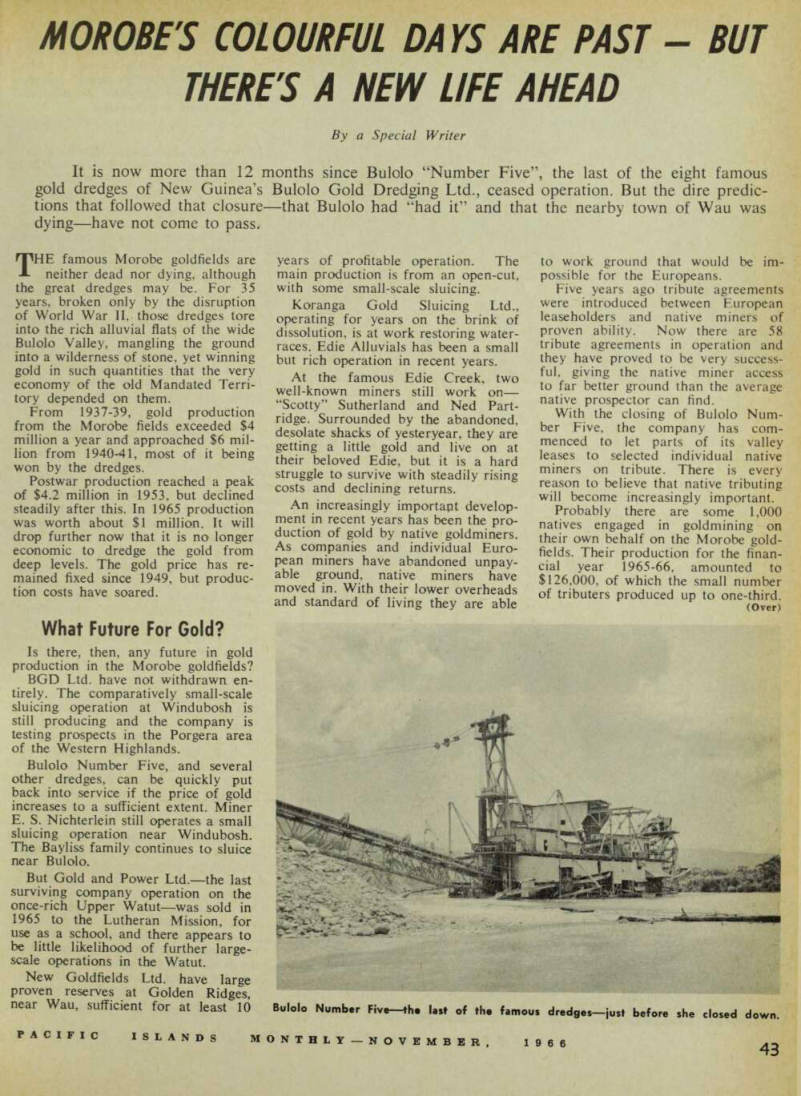
It is now more than 12 months since Bulolo “Number Five”, the last of the eight famous gold dredges of New Guinea’s Bulolo Gold Dredging Ltd., ceased operation. But the dire predic tions that followed that closure—that Bulolo had “had it” and that the nearby town of Wau was dying—have not come to pass.
THE famous Morobe goldfields are neither dead nor dying, although the great dredges may be. For 35 years, broken only by the disruption of World War 11. those dredges tore into the rich alluvial flats of the wide Bulolo Valley, mangling the ground into a wilderness of stone, yet winning gold in such quantities that the very economy of the old Mandated Terri tory depended on them.
From 1937-39, gold production from the Morobe fields exceeded S 4 million a year and approached $6 mil lion from 1940-41, most of it being won by the dredges.
Postwar production reached a peak of $4.2 million in 1953, but declined steadily after this. In 1965 production was worth about $1 million. It will drop further now that it is no longer economic to dredge the gold from deep levels. The gold price has re mained fixed since 1949, but produc tion costs have soared.
What Future For Gold?
Is there, then, any future in gold production in the Morobe goldfields?
BGD Ltd. have not withdrawn en tirely. The comparatively small-scale sluicing operation at Windubosh is still producing and the company is testing prospects in the Porgera area of the Western Highlands.
Bulolo Number Five, and several other dredges, can be quickly put back into service if the price of gold increases to a sufficient extent. Miner E. S. Nichterlein still operates a small sluicing operation near Windubosh.
The Bayliss family continues to sluice near Bulolo.
But Gold and Power Ltd.—the last surviving company operation on the once-rich Upper Watut—was sold in 1965 to the Lutheran Mission, for use as a school, and there appears to be little likelihood of further large scale operations in the Watut.
New Goldfields Ltd. have large proven reserves at Golden Ridges, near Wau, sufficient for at least 10
years of profitable operation. The main production is from an open-cut, with some small-scale sluicing.
Koranga Gold Sluicing Ltd., operating for years on the brink of dissolution, is at work restoring water races. Edie Alluvials has been a small but rich operation in recent years.
At the famous Edie Creek, two well-known miners still work on— “Scotty” Sutherland and Ned Part ridge. Surrounded by the abandoned, desolate shacks of yesteryear, they are getting a little gold and live on at their beloved Edie, but it is a hard struggle to survive with steadily rising costs and declining returns.
An increasingly importapt develop ment in recent years has been the pro duction of gold by native goldminers.
As companies and individual Euro pean miners have abandoned unpay able ground, native miners have moved in. With their lower overheads and standard of living they are able
to work ground that would be im possible for the Europeans, Five years ago tribute agreements wer e introduced between European leaseholders and native miners of proven ability. Now there are 58 tribute agreements in operation and they have proved to be very successf u 'v S™"* the na ! iv f mi " er access ° ar ground than the average na !iy < ; P™ sp « ,or ca " fi " d - , KI , osin 8 °f Bulolo Num er ve ’ com P an y as C( 7 m " , menced ><> P arts J . of J '•? val ! e V le ? ses to selei r ted individual native miners °n tribute. There is every reaso ? to belleve that natl Y e ‘"buting will become increasingly important.
Probably there are some 1,000 natives engaged in goldmining on their own behalf on th ® Morobe K gold . fie , ds . Their production for the finan , cial year 1965 66 amoU nted to $126,000, of which the small number of tributers produced up to one-third, (Over)
Bulolo Number Five—the last of the famous dredges—just before she closed down.
Native gold production is levelling out and it seems unlikely that it will in crease by any significant amount.
Although the yield per head is small, the native miner develops habits of self-reliance and prefers to s’cratch for gold—in all corners of the goldfields—rather than engage in paid employment for Europeans. The Administration provides much practi cal assistance to native miners through the Mines Office at Wau.
So much for the mines and the miners.
But the towns of Wau and Bulolo are emphatically not dying, for no longer is gold the only product. The towns are well stabilised.
Population Stable
The white population of Wau to day is approximately 260, and of Bulolo and district 550. Approxi mately 5,000 native people are in employment. These figures have re mained reasonably stable for some years past.
Certainly the white population has fallen sharply from the old days, when gold was king, but it is un likely that the numbers will fall be low present levels. From time to time one reads in the local papers of well known oldtimers leaving the gold fields for good; mention is 1 seldom made of the newcomers who are re placing them.
The economy of Wau is today based on the various operations of New Guinea Goldfields Ltd. and on the coffee plantations and mixed farms. For many years NGG Ltd. was an unprofitable enterprise, but in recent years the company has branched out into timber operations, general trading, shipping management and coffee farming.
The company operates a modern and efficient sawmill, processing the fine-quality pine growing around the slopes of the Wau Valley. The under ground gold workings at Golden Ridges—expensive to operate and barely profitable have been abandoned and the company is con centrating on low-yield open cut min ing which has the advantage of con siderably lower production costs. The company has made steadily increasing profits over the past five years, ex-
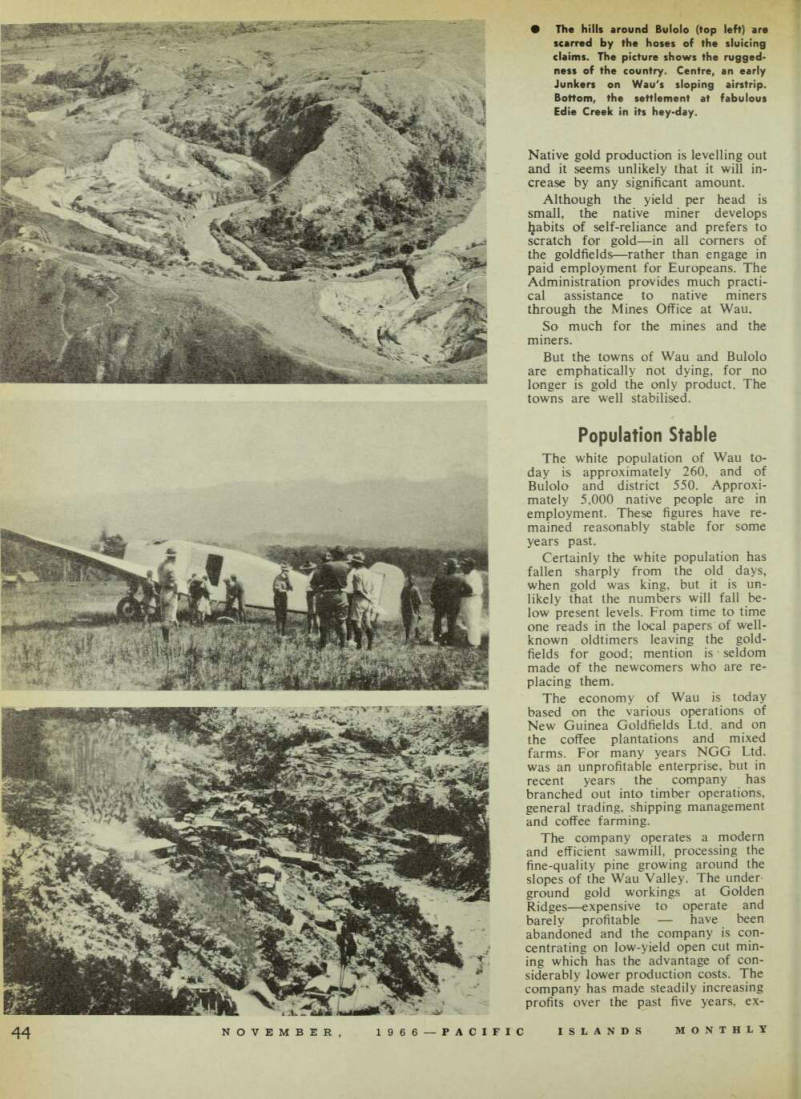
The hills around Bulolo (top left) are scarred by the hoses of the sluicing claims. The picture shows the rugged ness of the country. Centre, an early Junkers on Wau's sloping airstrip.
Bottom, the settlement at fabulous Edie Creek in its hey-day.
Wau Has Had Coffee Since The 1920's
ceeding $300,000 for the first time in 1965.
NGG is the biggest employer in the Wau Valley, and the present healthy condition of the company is good for the whole valley.
It is not generally realised that high-quality arabica coffee was first grown at Wau in the late 1920’5.
The Department of Agriculture planted a five-acre block with Blue Mountain coffee from Jamaica, which was later taken over by C. L. B.
Wilde. Wilde greatly extended the experimental plantings and when war came he was operating a fine planta tion, producing coffee of world class.
The Wilde plantation was brought back into production after the war.
There was great interest in coffee as a cash crop.
By the end of 1950 much of the available land in the valley—un fortunately very restricted in extent — had been leased to European farmers and planted with arabica coffee, which has become increasingly impor tant to the economy of the valley.
The output will continue to improve as new plantings come into bearing.
Fine Climate
The Department of Agriculture has attempted to interest the village people in outlying areas in coffee production, but the response has been disappointing. The only important native coffee-producing area in the Wau sub-district is the Upper Watut, where a flourishing rural progress society had been established.
Other significant industries in the Wau Valley are mixed businesses, mixed farms, a dairy farm and com mercial vegetable farms although these last are of decreasing impor tance.
Wau today, enjoying one of the finest climates in New Guinea, will clearly maintain its present economic position.
Undoubtedly, the saviour of Bulolo has been the pine tree. Far-sighted men long ago realised that one day the gold would come to an end. The slopes of the Bulolo Valley were covered with a dense growth of first quality native pine—klinkii and hoop.
Many trees exceeded 200 feet in height.
Before the war the goldfields depended for its existence on the
aeroplane—there was no road access to the coast, although this was under consideration when war came. Timber was cut for local use only, for it could not be economically trans ported by air.
Ironically it was the war—the war which caused so much devastation— that provided the key to the future of Wau and Bulolo. A good road was constructed by Australian army engineers to the coast at Labu, at the mouth of the Markham.
The long-term value of this road was to far outweigh the material losses caused by the war, for the road was to become the lifeline of the gold fields, just as the aeroplane had been in the early years. Almost everything consumed and produced at Wau and Bulolo today is transported in heavy vehicles along the road that the army built.
Plywood Starts
Even as BGD Ltd. worked to get the gold dredges and hydro-electric plants back into operation, the possibilities of large-scale exploitation of the enormous pine-stands of the Bulolo Valley were being studied. The essential requirements were now avail able: road transport, cheap hydro electric power and fine workshop facilities.
The Commonwealth Government and BGD Ltd. formed a joint com pany, to manufacture high-grade plywood at Bulolo. The controlling interest in the new company—
Commonwealth-New Guinea Timbers Ltd.—is held by the Commonwealth.
The Department of Forests set up an experimental station at Bulolo and began the study of nursery culture of the two pine species found in the valley. Production of plywood began in January, 1954, and over the next 10 years as the dredges, one by one, ceased operation, many of the staff of BGD Ltd. were absorbed into CNGT Ltd. and trained in their new role.
A Pulp Mill Next
Inevitably the total number of European staff that could be employed at Bulolo fell, year by year, but it is unlikely that there will be any further significant decline. It is planned to install a pulp mill within the next few years, when the volume of thinnings from the newly-planted forests justifies it. This could lead to further employment.
As the natural forest is cut by CNGT Ltd., the Forestry Depart ment team plants pine seedlings, 640 to the acre, The end result will be at least 40,000 acres of new pine forest, denser and of better quality for plywood manufacture than the natural forest. The annual harvest of natural pine is planned to ensure that it will last until the first of the replanted trees are ready for cutting.
A cycle will thus be established, and provided the balance between cutting and replanting is not dis turbed, the supply of timber should
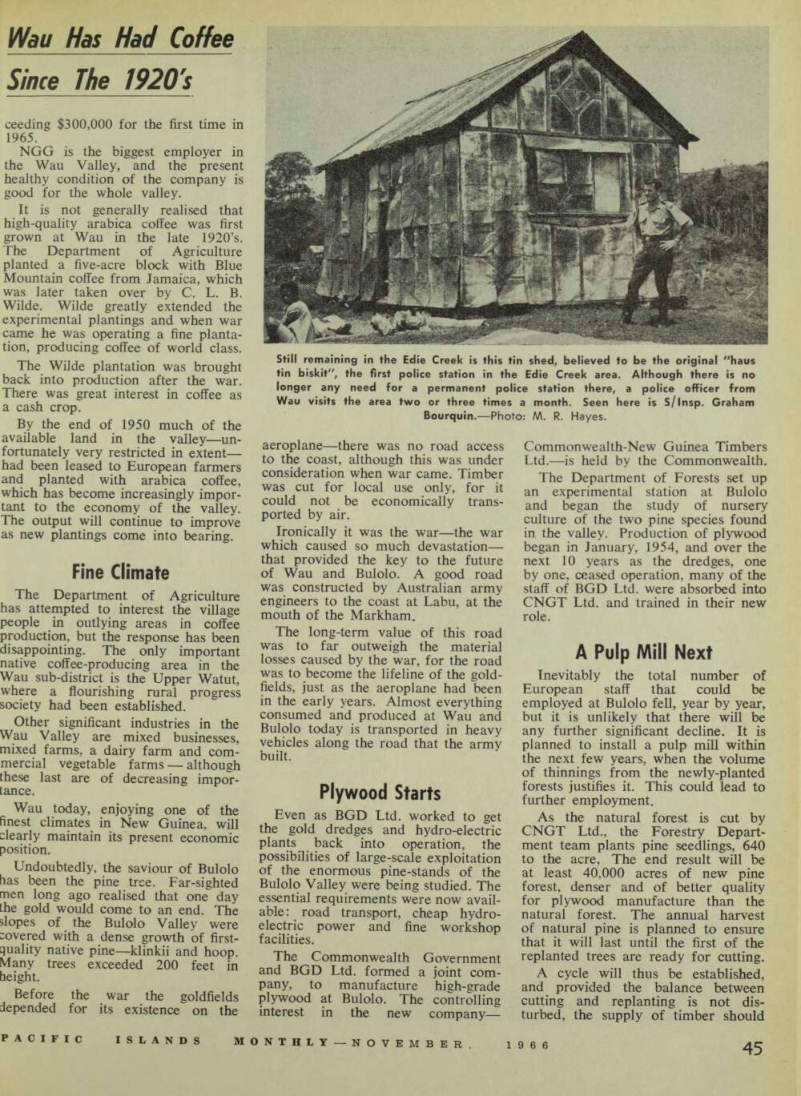
Still remaining in the Edie Creek is this tin shed, believed to be the original "haus tin biskit", the first police station in the Edie Creek area. Although there is no longer any need for a permanent police station there, a police officer from Wau visits the area two or three times a month. Seen here is S/Insp. Graham Bourquin.— Photo: M. R. Hayes.
never cease. The output of plywood in recent years has been valued at up to more than $2 million per annum, a significant proportion of the total annual export production of New Guinea.
The company is employing more and more native people in the plywood mill. Natives are today successfully operating complicated machines that were once considered to be beyond their capacity. The Bulolo companies are the largest private employers of native ap prentices in New Guinea. They are training 40 lads under the territory’s apprenticeship scheme in many trades, passing on the skills that will be so essential once New Guinea gains self government.
An interesting, development in the Wau-Bulolo area has been the influx of native squatters in the last few years from as far afield as Madang, the Sepik and the Goilala district of Papua.
Native Squatters
Attracted initially by the lure of gold, hundreds of natives walked in and squatted on Crown lands and old mining tenements, principally around the Wau Valley. Many engaged in prospecting, and used this as a justification for establishing homes and small village settlements. Most were joined by their wives and children.
They began to plant crops, and sold their surplus produce in the weekly markets at Wau and Bulolo. There was a real danger that unless con trolled their gardening activities would endanger the future of the vital timber industry, and eventually the Administration decided to survey all suitable land and make it available to the squatters on regular leasehold.
The first block of land was sub divided and leased in 1965 and when the whole of the available land has been distributed there will be several hundred small leaseholders with their families, producing truck and cash crops and helping to strengthen the economy of the Morobe goldfields.