—But That’s On The Way
pp. 13-156 · Read in the full issue
It’s Not Self-Government —But That’s On The Way
A Survey by R. W. Robson.
As a result of the Fiji elections in October, Fiji may not have achieved independent self-government, or anything like it —but it is on the way. The 92 years of paternalistic adminis tration through the British Colonial Office ended just as the elections began, with the promulgation of Fiji’s new constitution.
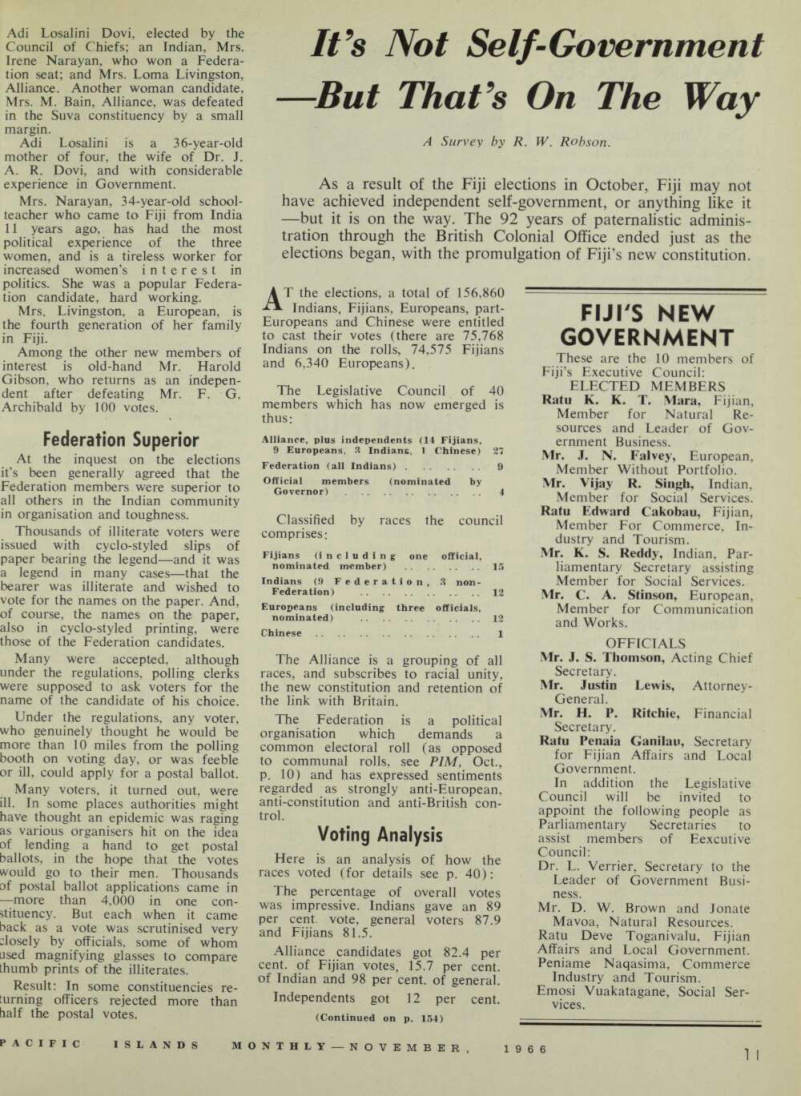
AT the elections, a total of 156,860 Indians, Fijians, Europeans, part- Europeans and Chinese were entitled to cast their votes (there are 75,768 Indians on the rolls, 74,575 Fijians and 6,340 Europeans), The Legislative Council of 40 members which has now emerged is thus: Alliance, plus independents (14 Fijians, 9 Europeans. 3 Indiana, 1 Chinese) 27 Federation (all Indians) 9 Official members (nominated by Governor) 4 Classified by races the council comprises: Fijians (including one official, nominated member) 15 Indians (9 Federation, 3 non- Federation) 12 Europeans (including three officials, nominated) 12 Chinese 1 The Alliance is a grouping of all races, and subscribes to racial unity, the new constitution and retention of the link with Britain.
The Federation is a political organisation which demands a common electoral roll (as opposed to communal rolls, see PIM, Oct., p. 10) and has expressed sentiments regarded as strongly anti-European, anti-constitution and anti-British con trol.
Voting Analysis
Here is an analysis of how the races voted (for details see p. 40): The percentage of overall votes was impressive, Indians gave an 89 per cent, vote, general voters 87.9 and Fijians 81.5.
Alliance candidates got 82.4 per cent, of Fijian votes, 15.7 per cent, of Indian and 98 per cent, of general.
Independents got 12 per cent.
(Continued on p. 154)
Fijian votes, 19 per cent. Indian and 1.7 general.
About 66,000 Indians voted of the 75,768 on the Indian roll. Of the votes, Federation got about 43,500, or 65.2 per cent., and captured all nine of the Indian com munal seats. The remainder voted for mostly Alliance candidates.
Neither the Fijian nor general roll had Federation candidates and the three Indians elected on the cross voting roll were non-Federation. The cross-voting roll is Fijian, Indian and general rolls treated as one.
Many Indian voters, under Federa tion instructions, would not use the ballot papers handed to them in the cross-voting constituencies. In two districts, informal votes totalled more than 20,000.
Under Fiji’s new constitution, the Governor retains control of external affairs, defence, internal security, (including the police) and of major Public Service appointments. He has an influential voice in finance.
To assist him with the Public Service the Governor now has a Public Service Board, the chairman being Mr. P. D. Macdonald who has just retired from the old post of Colonial Secretary. The title of Colonial Secretary has been changed to that of Chief Secretary.
All other administration will be shaped by the Legislative Council, subject to the Governor’s veto.
Except that the legislature is elected mostly on communal rolls instead of a common roll, Fiji’s new political system is generally similar to that under which Australian and New Zealand crown colonies in the last hundred years moved from London’s paternalistic care to full self-government.
Because of wide racial differences, a common roll is not at present practicable in Fiji. It inevitably would lead to civil disorder. The common roll will come, but only when Fijians, Asians and Europeans have learned to live in harmony.
The common roll might have been given serious consideration in Fiji in 1964-65 but fear about its adoption was aroused years ago by the per formance of the Nadi-Lautoka groups of Indians who caused so much industrial and political dis turbance. That fear was confirmed by the non co-operation shown by the same groups when Sir Derek Jake way was trying to get racial unity on constitutional issues in 1964-65, and by the tactics of the
Federation leaders in the recent elections.
The new Executive Council has two significant features—namely, that the Governor announced that before he set it up he had had a formal consultation with Ratu Mara; and that the members do not include any Federation men.
Ratu Mara, Oxford educated, is leader of Government Business not because of any desire to flatter the Fijian race but because of his out standing quality and the merit of public service already rendered.
The Federation leaders, Messrs, Patel and I. Madhavan, were in the old Executive Council. There could be two reasons for them not being in this new Government.
Either they were invited, and declined; or the Governor and Ratu Mara, in choosing the Cabinet, decided that inclusion of a Federa tion man could lead to disruption.
Probably the latter.
Whatever the case, it is likely the nine Federation members will form themselves into an Opposition, anti government, anti-constitution, anti- European and perhaps even anti- Fijian.
In any event they surely will broad cast abroad the facts that, although half Fiji’s population is Indian and two-thirds of the Indian voters supported the Federation, there are two Indians in the new Government of 10—and neither is a Federation man.
But another obvious fact is that at least one-third of the Indian popula tion, plus all the Fijians, Europeans, part-Europeans and Chinese, totalling 320,000 (as compared with 160,000 pro-Federation Indians), support the broad programme of racial unity and progressive development on which the Alliance members were elected.
Sir Derek Jakeway and Ratu Mara have ahead of them a difficult job of re-organisation and development.
They need, above all, a group of Executive Councillors who will work in a spirit of co-operation and trust.
They seem to have got such a team.
Situation To Be Deplored
Fiji’s situation is greatly to be deplored.
The Indians are a numerous, strongly established community.
Despite handicaps imposed by an un fortunate segmentation in creeds, culture and political thinking, there
are men of outstanding ability in the professions, trades and commerce.
But a sine qua non of develop ment is that the Indians work in harmony with the Fijians, who need the help of the older immigrant races in their now impressive adaptation to the ways of the modern world; and with the Europeans, who are on their way out.
Instead of that, the Indians have for years allowed their wild men to run loose in political and industrial affairs, poisoning the socio-political structure.
It will take time, for example, to break down the suspicion of Indians created among the Fijians by the Federation’s pre-election dis plays.
It is a good Legislative Council and an impressive Executive Council, and they will tackle the formidable tasks in workmanlike style. But the Government must keep in the fore front of its planning the paramount need to break down the racial barriers.
In this curiously constituted little nation there cannot be real achieve ment without racial harmony.
One of the Government’s first tasks is to get the majority of the Indian community as a full working partner.