Ratu Mara Heads Fiji’S
pp. 12-13 · Read in the full issue
New Government
From a Suva Correspondent
Prominent Fijian Ratu K. K. T. Mara takes the newly created post of “Leader of Government Business” in Fiji, fol lowing the success of his Alliance group in the Fiji general elections in October. He heads an Executive Council, or “Cabinet”, of 10.
THE Executive Council does not include any members of the opposition Federation group, which was the big surprise of the elections by securing an impressive vote.
Led by Indian lawyer Mr. A.
D. Patel, the Federation won all nine of the Indian communal seats which it sought, and missed out only on three cross-voting seats which it con tested. Thus it won nine out of a possible 12 seats. A PIM corres pondent had predicted (Oct., p. 10) that possibly from only three to six Federation men would get in.
The Federation collected about 65 per cent, of the total Indian votes.
But Alliance candidates got 82 per cent, of the Fijian votes, and thus are in power, with Mr. Patel and his members forming the opposition.
The new Legislative Council in November will be invited to recognise the position of the Leader of the Opposition.
But meanwhile, the poll results and the failure to include any Federation
members in the new Executive Council have aroused speculation in the colony as to what will happen next.
Some say the Federation may boycott the Legislative Council and that Mr. Patel, on the poll result, will feel he is strong enough to force a showdown and launch something like a civil disobedience campaign.
But opportunities for civil dis obedience in India are greater than those in Fiji with its widely differing communities, and Mr. Patel’s Party will no doubt continue to talk inside and outside the council.
Executive Council
There is also a view that the Federation might stage a grandstand walkout from the first meeting of the council, but if this were done it would be a nine days’ wonder and Mr. Patel would merely have lost a pulpit. He has promised his sup porters another London constitutional conference in two years and he may be content to wait.
Looking at Fiji’s new Executive Council, it was wise to allow Ratu Mara to keep his former portfolio of Natural Resources in view of his interest in the five-year development plan.
The reasoning behind the appoint ment of Mr. Vijay R. Singh as Member for Social Services (formerly held by Mr. Patel) probably was that Mr. Singh should be elevated to prove that support of the Alliance brings more satisfying results than support of the Federation. And of course Mr. Singh deserves the honour.
A lawyer, former civil servant, and the candidate with the biggest majority of the election (18,000), Mr. Singh is astute, ambitious, and a good organiser. With the other Indian member of the Executive Council, Mr. K. S. Reddy, to help him, as Parliamentary under-secretary, he should make a good minister.
A new portfolio, of Commerce In dustry and Tourism, goes to Ratu Edward Cakobau, who was elected unopposed. Ratu Edward, Ratu Mara, and Ratu Penaia Ganilau (Sec retary for Fijian Affairs) make an impressive panel of Fijians. Ratu George Cakobau, elected to the Legislative Council by the Council of Chiefs, is not in this Cabinet.
Although it might have been expected that Mr. C. A. Stinson, former Suva Mayor and in the Legislative Council for the first time, might have got the tourism port folio, he will still be involved with tourism as Member for Communica tions and Works. But he’ll be too busy pushing the new Nadi-Suva road to have spare time for other facets of the tourist industry.
Three Women
Mr. John Falvey had the Works portfolio previously, but he accepted it only because there was difficulty at that time in finding a man. He is in the new Executive Council without portfolio, and will certainly be one of the elder brethren and advisers. He is a busy lawyer.
Farmer Douglas Brown, who won a cross-voting seat with a 15,000 majority, will probably get a parlia mentary secretaryship, and if round pegs are to be fitted into round holes he ought to become righthand man to Ratu Mara in his Natural Resources job.
For the first time there will be three women in the council—a Fijian,
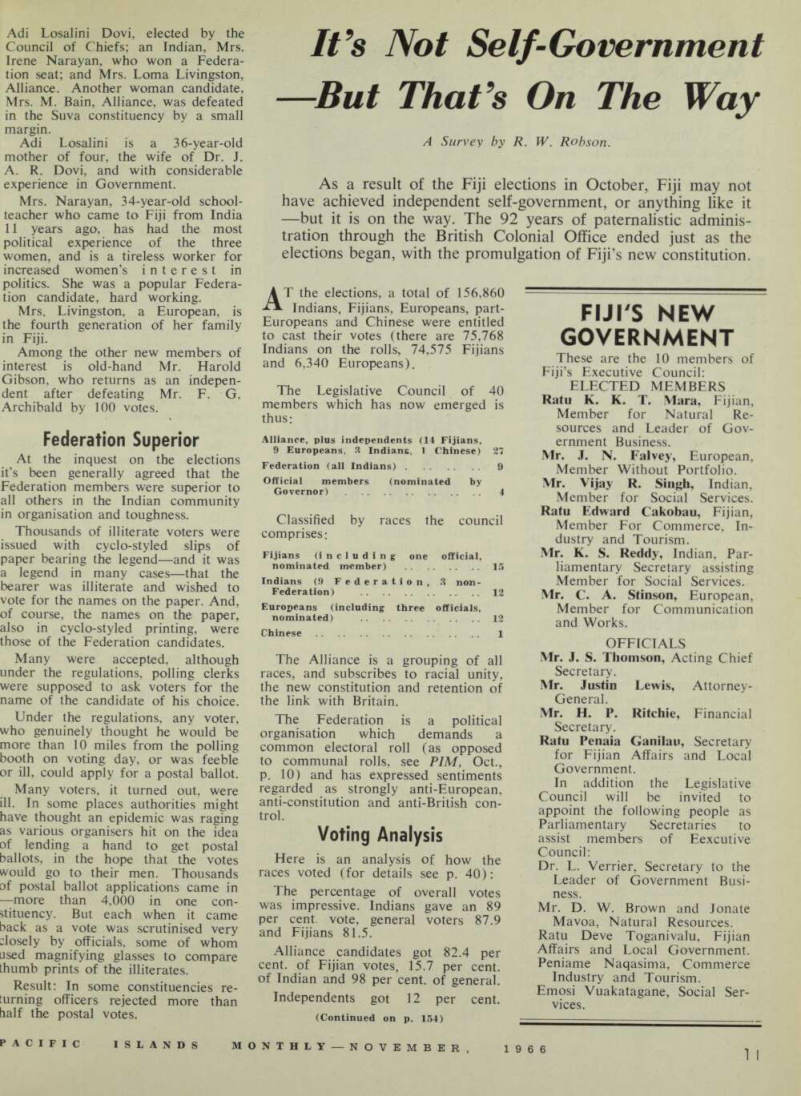
Mr. A. D. Patel.
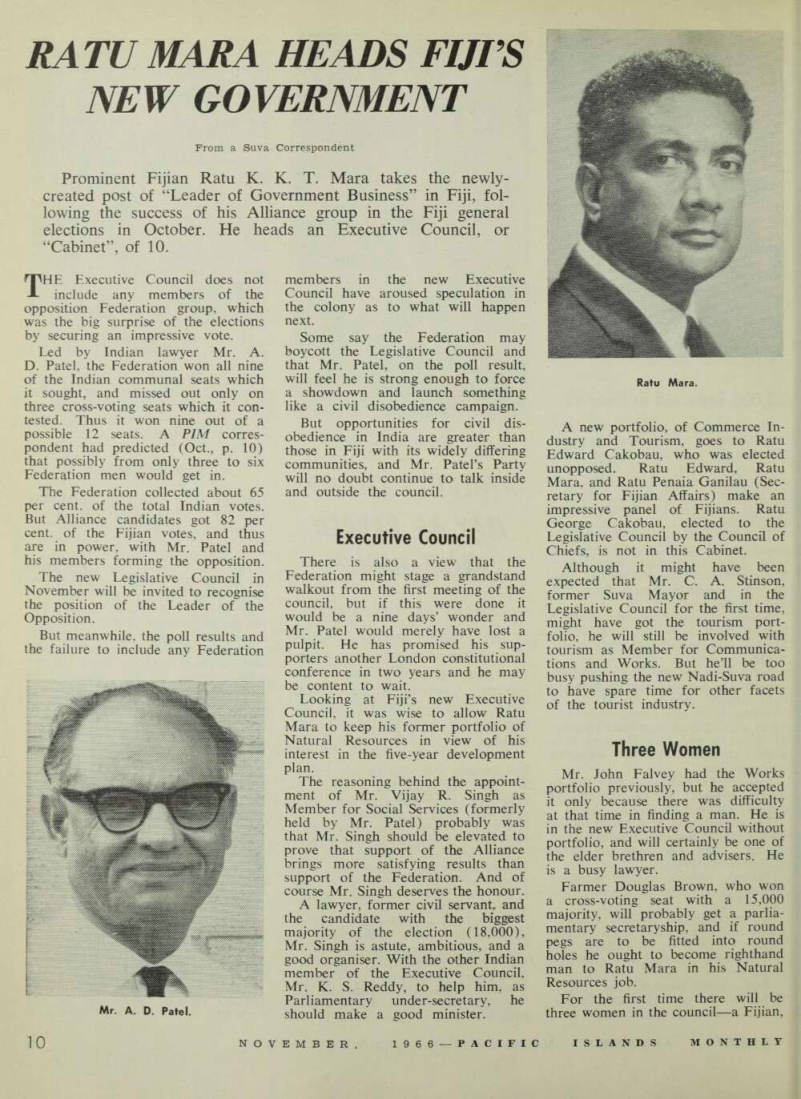
Ratu Mara.
Adi Losalini Dovi, elected by the Council of Chiefs; an Indian, Mrs, Irene Narayan, who won a Federa tion seat; and Mrs. Loma Livingston, Alliance. Another woman candidate, Mrs. M. Bain, Alliance, was defeated in the Suva constituency by a small margin.
Adi Losalini is a 36-year-old mother of four, the wife of Dr. J.
A. R. Dovi, and with considerable experience in Government.
Mrs, Narayan, 34-year-old school teacher who came to Fiji from India 11 years ago, has had the most political experience of the three women, and is a tireless worker for increased women’s interest in politics. She was a popular Federa tion candidate, hard working.
Mrs. Livingston, a European, is the fourth generation of her family in Fiji.
Among the other new members of interest is old-hand Mr. Harold Gibson, who returns as an indepen dent after defeating Mr. F. G.
Archibald by 100 votes.
Federation Superior
At the inquest on the elections it’s been generally agreed that the Federation members were superior to all others in the Indian community in organisation and toughness.
Thousands of illiterate voters were issued with cyclo-styled slips of paper bearing the legend—and it was a legend in many cases—that the bearer was illiterate and wished to vote for the names on the paper. And, of course, the names on the paper, also in cyclo-styled printing, were those of the Federation candidates.
Many were accepted, although under the regulations, polling clerks were supposed to ask voters for the name of the candidate of his choice.
Under the regulations, any voter, who genuinely thought he would be more than 10 miles from the polling booth on voting day, or was feeble or ill, could apply for a postal ballot.
Many voters, it turned out, were ill. In some places authorities might have thought an epidemic was raging as various organisers hit on the idea of lending a hand to get postal ballots, in the hope that the votes would go to their men. Thousands of postal ballot applications came in —more than 4,000 in one con stituency. But each when it came back as a vote was scrutinised very closely by officials, some of whom used magnifying glasses to compare thumb prints of the illiterates.
Result: In some constituencies re turning officers rejected more than half the postal votes.