New Names,
pp. 127-130 · Read in the full issue

New Ideas
Motels of Australia ltd. plan to take advantage of an expected boom in the tourist industry in the South Pacific in the next decade with a programme of expan sion extending to Fiji from its present base in Australia. NZ will also be included.
For its Fiji project, a multi-storeyed motel with possibly 200 rooms, on reclaimed land near the Grand Pacific Hotel in Suva, it has formed a part nership with Trust Houses Ltd., of London.
At this stage a final decision has not been made because negotiations over the project are still going on be tween the partners and the Fiji Gov ernment. In Sydney in August Motels of Australia told PIM it had very little to add.
A recent survey of the Australian tourist potential by Harris, Kerr, Forster and Co. and Stanton Robbins and Co. Inc., of New York, indicated that Australia will need another 46,000 beds for tourists in the next nine years.
With many of the tourists arriving in Australia via Tahiti, Fiji and New Zealand, it is logical to expect that those countries will share in the boom.
This has prompted Motels of Aus tralia to get into the accommodation, etc., field in Fiji at a comparatively early date.
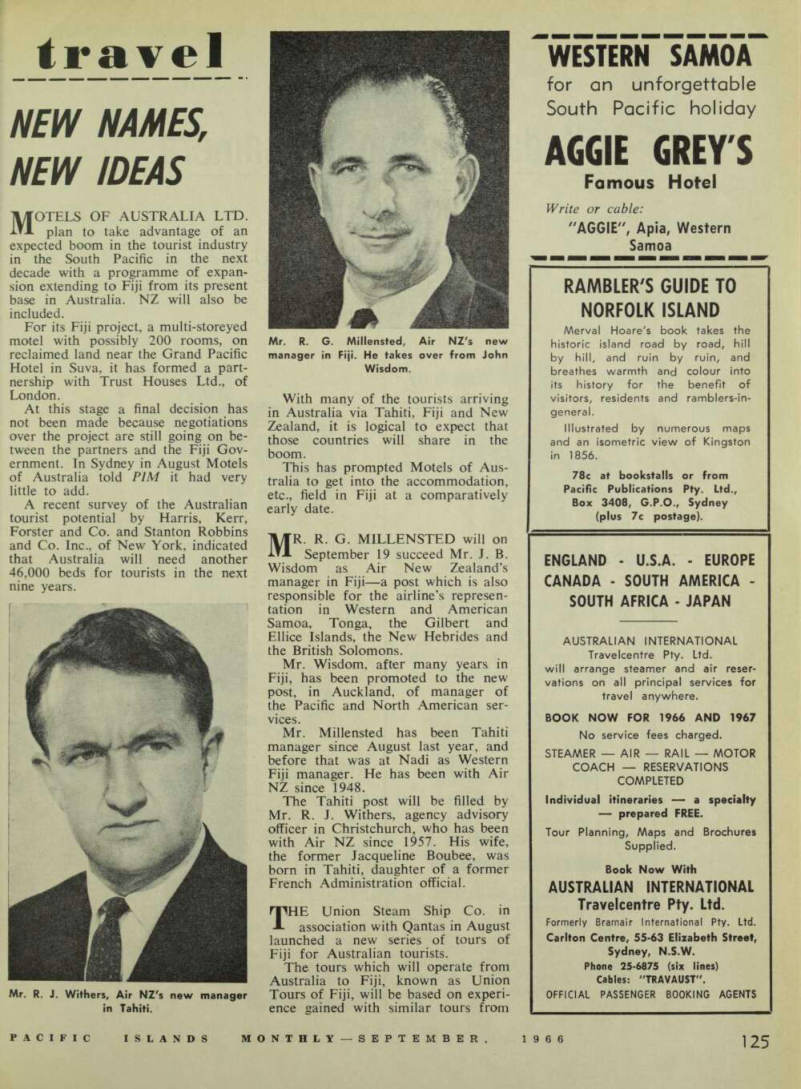
Mr. R. G. Millensted Will On
September 19 succeed Mr. J. B.
Wisdom as Air New Zealand’s manager in Fiji—a post which is also responsible for the airline’s represen tation in Western and American Samoa, Tonga, the Gilbert and Ellice Islands, the New Hebrides and the British Solomons.
Mr. Wisdom, after many years in Fiji, has been promoted to the new post, in Auckland, of manager of the Pacific and North American ser vices.
Mr. Millensted has been Tahiti manager since August last year, and before that was at Nadi as Western Fiji manager. He has been with Air NZ since 1948.
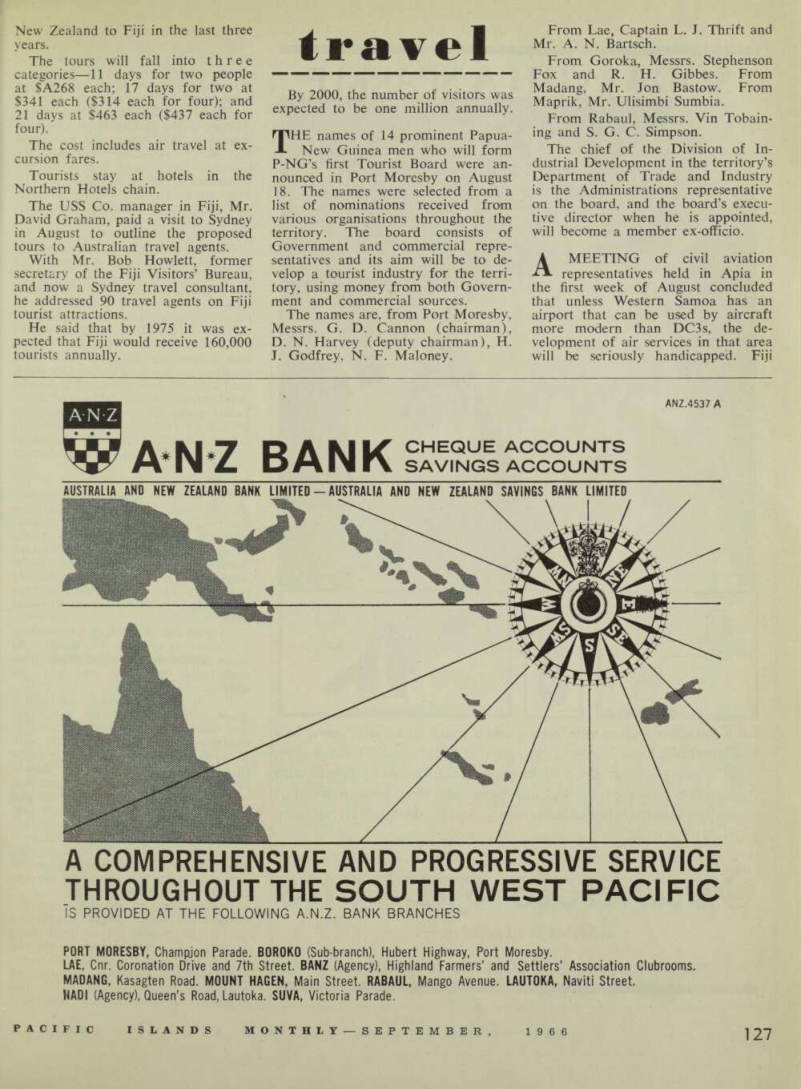
The Tahiti post will be filled by Mr. R. J. Withers, agency advisory officer in Christchurch, who has been with Air NZ since 1957. His wife, the former Jacqueline Boubee, was born in Tahiti, daughter of a former French Administration official.
THE Union Steam Ship Co. in association with Qantas in August launched a new series of tours of Fiji for Australian tourists.
The tours which will operate from Australia to Fiji, known as Union Tours of Fiji, will be based on experi ence gained with similar tours from
Mr. R. G. Millensted, Air NZ's new manager in Fiji. He takes over from John Wisdom.
Mr. R. J. Withers, Air NZ's new manager in Tahiti.
New Zealand to Fiji in the last three years.
The tours will fall into three categories—ll days for two people at SA26B each; 17 days for two at $341 each ($314 each for four); and 21 days at $463 each ($437 each for four).
The cost includes air travel at ex cursion fares.
Tourists stay at hotels in the Northern Hotels chain.
The USS Co. manager in Fiji, Mr.
David Graham, paid a visit to Sydney in August to outline the proposed tours to Australian travel agents.
With Mr. Bob Hewlett, former secretary of the Fiji Visitors’ Bureau, and now a Sydney travel consultant, he addressed 90 travel agents on Fiji tourist attractions.
He said that by 1975 it was ex pected that Fiji would receive 160,000 tourists annually.
By 2000, the number of visitors was expected to be one million annually.
THE names of 14 prominent Papua- New Guinea men who will form P-NG’s first Tourist Board were an nounced in Port Moresby on August 18. The names were selected from a list of nominations received from various organisations throughout the territory. The board consists of Government and commercial repre sentatives and its aim will be to de velop a tourist industry for the terri tory, using money from both Govern ment and commercial sources.
The names are, from Port Moresby, Messrs. G. D. Cannon (chairman), D. N. Harvey (deputy chairman), H.
I. Godfrey, N. F. Maloney.
From Lae, Captain L. J. Thrift and Mr, A. N. Bartsch.
From Goroka, Messrs. Stephenson Fox and R. H. Gibbes. From Madang, Mr. Jon Bastow. From Maprik, Mr. Ulisimbi Sumbia.
From Rabaul, Messrs. Vin Tobain ing and S. G. C. Simpson.
The chief of the Division of In dustrial Development in the territory’s Department of Trade and Industry is the Administrations representative on the board, and the board’s execu tive director when he is appointed, will become a member ex-officio.
A MEETING of civil aviation representatives held in Apia in the first week of August concluded that unless Western Samoa has an airport that can be used by aircraft more modern than DC3s, the de velopment of air services in that area will be seriously handicapped. Fiji
Airways is already planning to use Pago Pago when it gets a bigger air craft next year, because Western Samoa couldn’t handle the type.
In addition to Western Samoan representatives the meeting was at tended by Mr. T. Paris, Civil Aviation Adviser to the British High Commis sioners in Wellington and Canberra; Mr. R. N. Atkinson, Secretary for Communications and Works for the Government of Fiji; and M. U.
Tupouniua, Tonga’s Deputy Premier and Minister of Finance. The meet ing discussed the general development of air services in the area.
Plans for the future development of Apia include the reclaiming of Vaiusu Bay for an airport. This is not popular with Samoan Parliamen tarians for it would probably mean planes zooming over the Parliament building every time they took off or landed. It has also, reportedly, now fallen into disfavour with town planners as it would utilise too much land valuable for urban and industrial development on the fringes of Apia.
Latest proposals envisage putting the airport on reclaimed land inside the lagoon five-10 miles from town, rather like Papeete’s Faaa Airport and Pago Pago’s.
THE Samoan Handicrafts Corpora tion opened early in August for the purchase, sale, and later produc tion of Samoan handicrafts. Like many another project in Western Samoa, the corporation got under way almost a year later than officially predicted. The corporation has been established under Samoa’s five-year plan.
Its purpose, according to manager I. Hunter, is to foster the handicrafts industry; set standards of production; and build up sales, especially for export.
It will also, obviously, establish a price pattern for village producers and because of this, and because it is operating in direct competition with individuals and firms already engaged in selling village-produced handi crafts, there has been some predict able criticism of the government for having entered the field of private enterprise.
But of course private enterprise is not blameless. One Samoan woman who was paid 8/- for a set of baskets saw the set for sale in a shop window the next day priced at 42/-.
Before the end of the year, the corporation hopes to be employing up to 50 people in a handicrafts factory, to be established in the old wharf shed near the middle of town.
Mr. Hunter is currently preparing an illustrated catalogue listing all the items available to overseas buyers.