Air Services Key To Urgent Tourist
pp. 119-125 · Read in the full issue


Needs Of The Solomons
By a Special Correspondent
The inadequacy of air services to the Solomons has emerged as a decisive barrier to the government’s plans for developing the protectorate.
ABOUT 50 per cent, of the gov ernment’s funds are derived from the United Kingdom in the form of grant-in-aid and other allocations.
Now, however, Britain’s efforts to reduce overseas financial commit ments is putting pressure on the gov ernment to speed up its plans for mak ing the protectorate’s economy self supporting.
The government has recognised that its chief hope of reversing the chronic unfavourable balance of pay ments lies in attracting overseas de velopment capital and tourist traffic.
As a result there is a growing awareness, shared also by the Euro pean business community and the educated islanders, that the present in ternational air services are inadequate.
Few seats of government in similar small territories in the world nowa days have such limited air links with other countries as Honiara has.
The present services provide for only a maximum of 56 people to enter the protectorate by air each
week—36 on the TAA Friendship which flies in once a fortnight from Sydney via P-NG and 20 at the most on the twice-weekly flights of Fijian
Airways’ Heron services from Suva via the New Hebrides.
This maximum declines every second week when a DC-3 with a lower passenger capacity than the Friend ship is used on the TAA service.
Moreover, the infrequency of the services, the need for passengers from Australia to make connections with
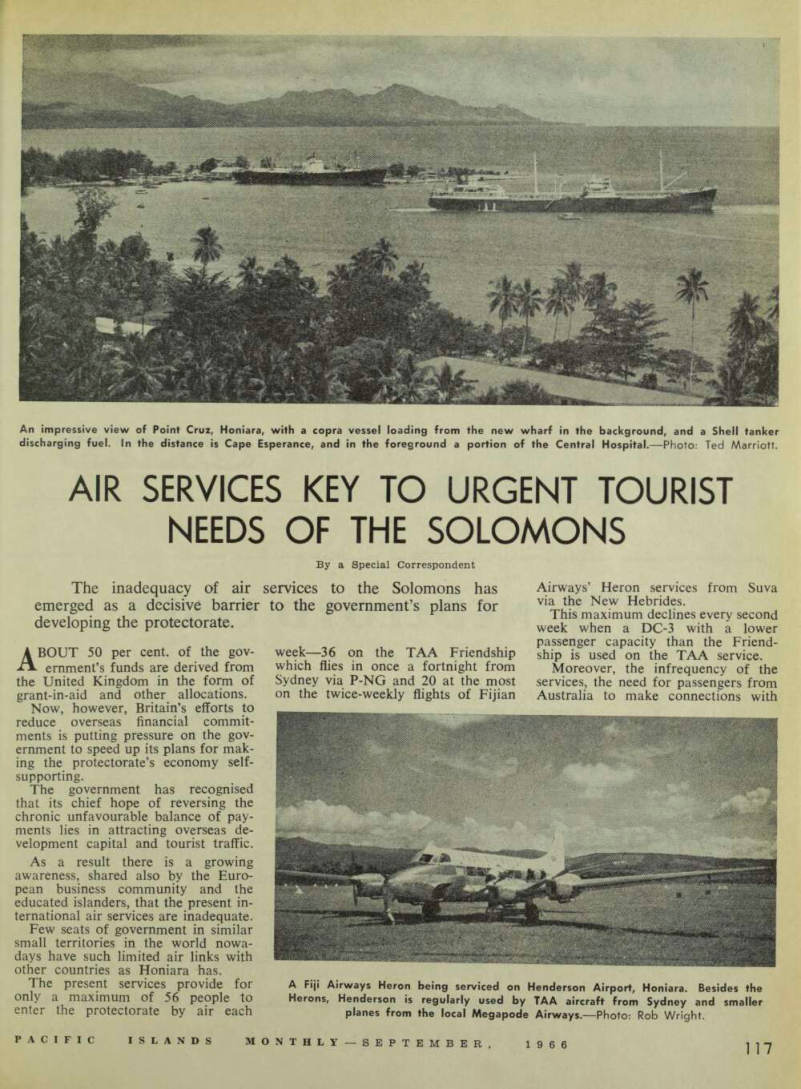
An impressive view of Point Cruz, Honiara, with a copra vessel loading from the new wharf in the background, and a Shell tanker discharging fuel. In the distance is Cape Esperance, and in the foreground a portion of the Central Hospital.— Photo: Ted Marriott.
A Fiji Airways Heron being serviced on Henderson Airport, Honiara. Besides the Herons, Henderson is regularly used by TAA aircraft from Sydney and smaller planes from the local Megapode Airways.— Photo: Rob Wright.
New Guinea-mainland services, and the long hours of flying this involves, combine to deter the most determined businessman and the most enthusi astic tourist.
Honiara is only 1,200 miles from Brisbane, as close as the increasingly well-served Port Moresby, but most visitors from the great metropolitan centres of Sydney or Melbourne must make a long looping trip up through New Guinea and New Britain amounting to 3,000 to 3,500 miles.
One of the most serious setbacks to the Solomons’ progress occurred earlier this year when the protect orate inadvertantly became a victim of Australia’s two-airline policy.
Air Services Inadequate
TAA, which operates the Lae- Rabaul-Honiara service under charter to Qantas because of its international rating, had been providing a weekly Friendship service until March when a successful protest was made by Ansett-Mandated Airlines.
The subsidiary of Ansett-ANA, which operates DC-3s between Lae and Rabaul, objected to TAA’s air craft superiority with its Friendship on this route.
A compromise resulted in the Friendship service being reduced to a fortnightly frequency.
The BSIP Superintendent of Civil Aviation, Mr. E. Nielsen, concedes that the air services are not adequate to cope with the demand and there is room for improvement.
“Traffic has kept pace with the services as they have been provided,” he told me.
International air traffic, though tiny by New Guinea standards, has been steadily increasing. In 1964, passengers totalled 3,454 —an increase of 1,019 over 1963, and cargo in creased to 46,412 lb from 29,498 lb.
The potential demand, however,
appears to be rising at a faster rate within the protectorate, largely be cause of the expansion of Honiara’s population, which at nearly 7,000 has doubled in six years.
Strong hopes are now held in Honiara that the international ser vices will be considerably improved by this time next year.
Fiji Airways has ordered a twin engined turbo-prop Hawker Siddeley 748, and is expected to introduce it into the Nadi-Honiara service next August.
The 748, which has a cruising speed of 274 miles an hour and can carry between 40 and 60 passengers, prob ably will be operated once a week.
This will meet mainly the needs of tourists and of civil servants go ing to Europe on leave, but will do little to accelerate the development of trade and other links between Aus tralia and the Solomons.
More Friendships?
The cost of travelling between Syd ney and Honiara via Fiji by air rules out the possibility of a growth of heavy volume traffic on this route.
The fare is 5634 return, by com parison with $360 on the TAA ser vices through New Guinea.
There are sound grounds for hop ing, however, that the weekly Friend
A section of Honiara's Chinatown, where tourists may buy anything from Jade to liquor.— Photo: Rob Wright,
Typical of the new generation of youth in the Solomons is this healthy school girl, educated at the Melanesian Mission school of St. Helda's, on Florida Island. She comes from Gela Island.— Photo: Rob Wright.
ship service will be restored early next year.
Ansett-ANA this year is taking de livery of seven Friendships which will be progressively fed into its subsidiary airlines and its feeder routes.
The expected replacement of DC-3s on the Lae-Rabaul route with Friendships should remove any barrier to TAA resuming its former services to Honiara.
Growing dissatisfaction with the air services has brought to the sur face a variance of opinion on the future needs of the Solomons.
The consensus of opinion in Honiara is that a direct Brisbane- Honiara service, preferably by jet, is needed, and a precedent has already been set for this in the special DC-4 flights that have been operated in recent years by TAA during school holidays.
Mr. K. Dalrymple-Hay, one of Honiara’s leading businessmen, be lieves efforts should be made to bring Honiara into the world jet pattern by establishing a service from Sydney to Hong Kong via Honiara and Manila.
Captain Lionel Thrift, TAA man ager for Papua-New Guinea, says that, although traffic between New Guinea and Honiara is growing steadily, it is not enough to warrant more fre quencies or a Brisbane-Honiara ser vice.
“I can’t see more services coming for a long time,” he says.
The protectorate government, in planning for the future, faces a nroblem compounded of great dif ficulties in projecting likely demand, lack of decisive influence over the outside-managed airlines, and limited financial resources.
Development Plan
In its three-year $l2 million de velopment plan announced last January, it is providing $570,000 for the re-surfacing of Henderson Airport at Honiara and the provision of air fields at Santa Cruz and the Reef Islands.
The re-surfacing at present planned for Henderson—black topping of the runway after grass-cropping—will enable DC-6Bs to land.
Already, however, the government is having second thoughts about this project.
Mr. Nielsen explained: “Planning for DC-6Bs is a waste of time be cause they are on their way out. ‘The next aircraft should be an Electra, and we are examining the
problem of finding sufficient finance to lengthen and improve the runway to take it.
“We cannot afford better development.”
The final decision on Henderson Airport improvements will be influenced by the forthcoming radical reorganisation of the Australian domestic airline fleets.
Each airline will take delivery of a fourth Boeing 727 and three twinengined DC-9 aircraft later this year and a further three DC-9s over the next three years.
With the spread of jet travel to all the main centres in Australia— and to New Guinea next year—older aircraft will be disposed of or re deployed to routes now served by smaller aircraft.
Ansett-ANA already has its DC-6Bs up for sale and TAA is expected to follow shortly.
Both airlines also are known to be considering the sale of their Electras —each has three—over the next few years because of the cost of main taining them when jets have taken over the trunk routes. (Over)
Aviation observers in Australia, in any case, are predicting that the country’s feeder routes by the early 1970’s will be served by a third type of jet with a carrying capacity of 50 to 60 passengers.
These trends strongly suggest that long-term planning for Honiara needs to take account of the possibility that a jet service should be provided for.
In contrast with the external aviation picture, fortunately, the in ternal air services of the BSIP are steadily improving with the in crease in Megapode Airways’ activ ities and the development of more airstrips by the government and local councils.
Megapode Objects
Megapode is now operating scheduled services almost every week day, involving nine island centres— Honiara, Yandina, Munda, Bara koma. Auki, Kira Kira, Mono, Sege, and Avu Avu.
Its two twin-engined aircraft—a seven-seater De Havilland Dove and a five seater Piper Apache—can also be chartered.
Megapode began operations in De cember, 1963, as a pioneer service.
The government is understood to have guaranteed the airline five years free of competition.
The continuance of the service was briefly threatened last March when a dispute arose between Megapode Airways and the government over an application by the Mission Aviation Fellowship for a licence to operate in the Solomons.
The Fellowship planned to offer limited commercial services in addi tion to transporting missionaries and supplies to and from mission stations.
Megapode’s manager, Captain L.
Crowley, of Lae, objected strongly to the application.
It is understood that Mr. Nielsen did in fact grant the application after a hearing but withdrew it with in 24 hours when Captain Crowley threatened to withdraw his airline’s services. Nobody will admit to the facts, as it suits both sides to draw a veil over just what did happen.
Certainly the BSIP was without an internal air service for 24 hours.
Ten airstrips are now in use in the islands following the completion of one at Sege Point in the New Georgia group.
The recent building of a strip at Avu Avu on the weather coast of Guadalcanal has reduced travelling time from Honiara from 16 hours (by sea) to 20 minutes.
The government’s air development plan calls for a main domestic aero drome in each of the main island groups and provides for the construc tion of two strips in the eastern outer islands—Santa Cruz and the Reef Islands.
Mr. Nielsen says the government will build strips on Santa Ysabel, Choiseul, and the Shortland Islands, and local councils, assisted by gov ernment finance, also will put in more strips.
Mr. E. V. Lawson, the member for Honiara in the Legislative Council, has been battling—so far without suc cess—to persuade the government to build an airfield on Gizo, the second biggest centre in the group and the main town of the Western Solomons.
“I have been well and truly beaten in trying to get a strip there,” he ad mits.
He is now advocating shifting the centre of operations in the Western Solomons to Hathorne Sound, on the tip of New Georgia near Munda airfield.
These huts of the coastal Malaita people are built on a man-made island of coral rock in Langa Langa Lagoon, Malaita. —Photo: Rob Wright.