But Remember, New Guinea
pp. 57-59 · Read in the full issue
Is Everybody’s Business
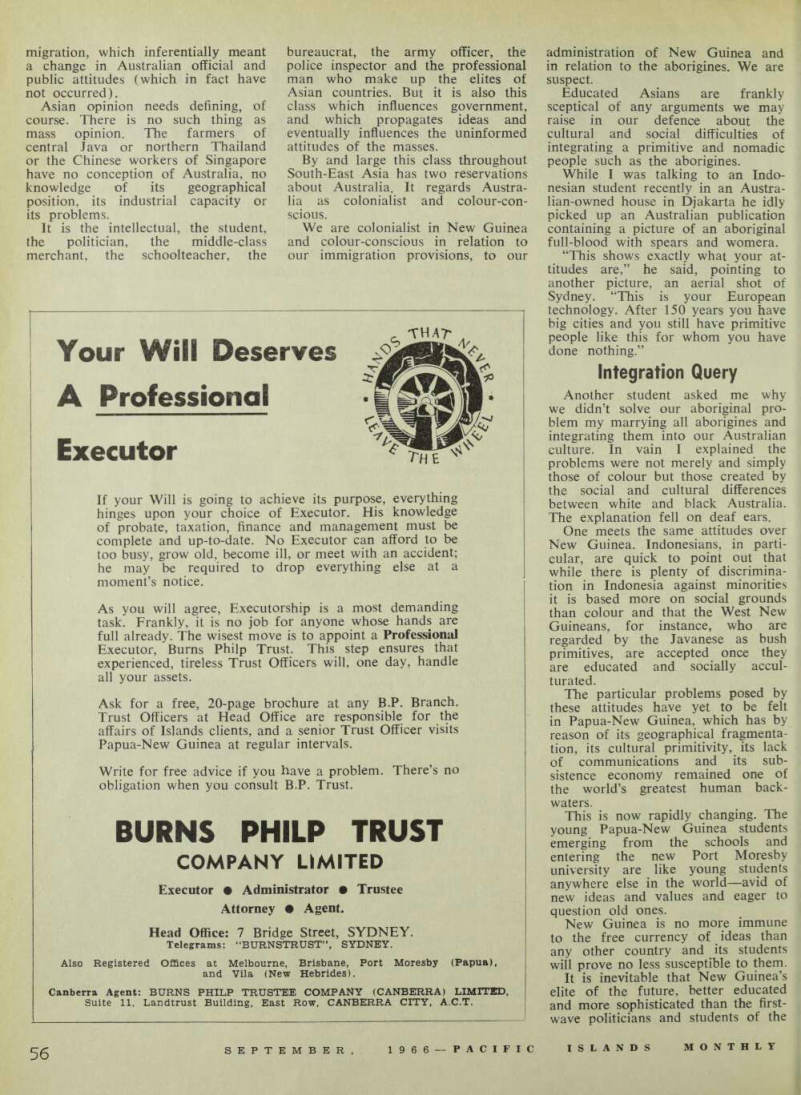
Says PETER HASTINGS, Editor of the "New Guinea Quarterly"
One of the greater problems with New Guinea has been the tendency for Australians both on the mainland and within the territory to regard New Guinea as primarily an Australian domestic affair.
1T is an expectable attitude deriving from our own isolationism, the self-congratulatory government pro paganda manufactured in past years and, reasonably enough, from the fact that it was Australian money, skills and capacity which developed New Guinea.
Even the UN debates and visiting missions of the past few years haven’t significantly impinged on the consciousness of mainland Austra lians.
There is a sense of vague menace (“The UN will drive us out of New Guinea one day”), of irritation (“Why don’t they mind their own business?”) and even of resignation (“Well let them see if they can do the job any better!”).
While reactions of this sort are understandable, they obscure realities.
New Guinea not only faces us with a long, intractable, expensive, pro bably thankless and certainly un avoidable task, it is going to involve us with our near Asian neighbors as well as the Afro-Asian world at large.
Race Relations
Despite encouraging changes in Indonesian attitudes, despite our alliance with Malaysia, our relations with the Philippines and our emerg ing links with Thailand, all of these countries will inevitably take notice in the future of the emerging politics of New Guinea, especially where these politics involve race relations.
It won’t necessarily be an un friendly interest, but it will be critically responsive to the experiences of their own colonialist past, to their own hyper-sensitivity on the colour question and, for that reason, to our restrictive immigration provisions.
White Australia is significant news in South-East Asia and no less so in countries like Malaysia, where we have official support for our im migration problems deriving not so much from approval of White Aus tralia as such, but from the fact that Malaysia has its own multiracial problems.
Nevertheless, any incidents con cerning immigration are given con siderable play in all Peninsular newspapers. The Straits Times, for instance, gave a whole broadsheet column on page one to the recent resolution of the NSW annual Country Party conference that New Guinea be incorporated as Austra lia’s seventh state.
The story carried no comment but the point of interest was obvious— immigration. It was assumed, justi fiably, that seventh statehood for New Guinea meant unfettered im-
Mr. Peter Hastings
migration, which inferentially meant a change in Australian official and public attitudes (which in fact have not occurred).
Asian opinion needs defining, of course. There is no such thing as mass opinion. The farmers of central Java or northern Thailand or the Chinese workers of Singapore have no conception of Australia, no knowledge of its geographical position, its industrial capacity or its problems.
It is the intellectual, the student, the politician, the middle-class merchant, the schoolteacher, the
bureaucrat, the army officer, the police inspector and the professional man who make up the elites of Asian countries. But it is also this class which influences government, and which propagates ideas and eventually influences the uninformed attitudes of the masses, By and large this class throughout South-East Asia has two reservations about Australia. It regards Austra lia as colonialist and colour-con scious.
We are colonialist in New Guinea and colour-conscious in relation to our immigration provisions, to our
administration of New Guinea and in relation to the aborigines. We are suspect.
Educated Asians are frankly sceptical of any arguments we may raise in our defence about the cultural and social difficulties of integrating a primitive and nomadic people such as the aborigines.
While I was talking to an Indo nesian student recently in an Austra lian-owned house in Djakarta he idly picked up an Australian publication containing a picture of an aboriginal full-blood with spears and womera.
“This shows exactly what your at titudes are,” he said, pointing to another picture, an aerial shot of Sydney. “This is your European technology. After 150 years you have big cities and you still have primitive people like this for whom you have done nothing.”
Integration Query
Another student asked me why we didn’t solve our aboriginal pro blem my marrying all aborigines and integrating them into our Australian culture. In vain I explained the problems were not merely and simply those of colour but those created by the social and cultural differences between white and black Australia.
The explanation fell on deaf ears.
One meets the same attitudes over New Guinea. Indonesians, in parti cular, are quick to point out that while there is plenty of discrimina tion in Indonesia against minorities it is based more on social grounds than colour and that the West New Guineans, for instance, who are regarded by the Javanese as bush primitives, are accepted once they are educated and socially accul turated.
The particular problems posed by these attitudes have yet to be felt in Papua-New Guinea, which has by reason of its geographical fragmenta tion, its cultural primitivity, its lack of communications and its sub sistence economy remained one of the world’s greatest human back waters.
This is now rapidly changing. The young Papua-New Guinea students emerging from the schools and entering the new Port Moresby university are like young students anywhere else in the world—avid of new ideas and values and eager to question old ones.
New Guinea is no more immune to the free currency of ideas than any other country and its students will prove no less susceptible to them.
It is inevitable that New Guinea’s elite of the future, better educated and more sophisticated than the first wave politicians and students of the
last few years, will look not only to Australia but to surrounding countries for political inspiration.
It is inevitable that sooner or later, perhaps sooner, students from Port Moresby will make contact with students in Sukarnapura and later with those in Djakarta, Singapore, Manila and Bangkok. Why not?
What will be crucial in those contacts is the attitude of New Guineans to Australia and to Aus tralians and that attitude in the final event will be determined by the sum of race relations in the territory.
It is idle to deny that territory race relations on the whole are bad and are deteriorating. The reasons are many. Substantially they are bad because the majority of the Aus tralians in the territory, not always with deliberate ill will, have deli berately avoided meaningful social contact. The Australian attitude has been one of conscious racial super iority.
This in itself has, perhaps, been unavoidable. It is easy to preach racial equality and acceptance. It is another to practise it in a country where the realities of the cultural gap between white and black are enormous and determine the course of everyone’s daily life.
Have-Nots
Nevertheless it remains sadly true that with the emergence of ever in creasing numbers of New Guineans who are culturally at least approx imate in skills and capacities with the European there has been on the part of the Australian not acceptance but a further withdrawal.
There is a sad and now familiar inexorability about it all.
Perhaps, in the long run, despite conscience or effort, a primitive, backward race of brown “have nots” can only look with despair and envy on the white representatives of a technologically advanced civilisation.
For these reasons, with the passage of time the emerging New Guineans will inevitably come into contact with Asian civilisations which are not only old in themselves, but politically dynamic and which have long, and usually resentful, memories of the white man.
In the end New Guinean attitudes towards Australians will have con siderable influence on South-East Asian attitudes to us. This need not be calamitous, but it will involve us in new problems and in new considerations.
Far from being a domestic Aus tralian problem, New Guinea is more likely to prove an eventual and uncertain catalyst of our relations with our near-Asian neighbours.