Australia And Nz Must Look
pp. 56-57 · Read in the full issue
Two Angles on Pacific Responsibility
Inwards - To The New World
Says OLAF RUHEN, author of "Minerva Reef", "Harpoon in My Hand", etc.
The lack of any official recognition doesn’t detract from Sydney’s status as a functioning metropolis and social capital of the South Pacific. Perhaps this was more obvious a few years ago; it has been true since the first whaler slipped round Cape Horn, since the first Europeans found profit in the products of the area. But it is still valid.
FROM one boundary of this ocean to the other, a variety of like minded people, domiciled under several different flags, look affec tionately to Sydney.
It’s sad that Canberra feels no sympathetic vibration with the city’s romantic pride in her Pacific ties; such a sentiment might have halted or slowed the official urge to count Australia as a South-East Asian country.
The urge is puzzling, but not in comprehensible. The bureaucrats now look like gaining their objective of having Australia counted one of the smallest potatoes in the South-East Asian bag.
If they do, the new assessment may mask or even seem to justify our hasty flight from responsibility in the Pacific area, where Australian strength could bolster a lot of friendly developing nations and be repaid with the practical reward of toughened fibre in the network of Pacific trade.
Not Part Of Asia
The scramble for a minority status in the company of nations seems both illiberal and time-serving. There is no geographical, commercial, ethnic or mutually-beneficial reason for count ing Australia a part of Asia.
Indeed, with the exception of South America, the Australian continent is further than any other from Asia, the Asian mainland, the Asian com plex, or Asian attitudes.
It is possible, indeed, to walk from Asia to North America, and some aborigines of both regions came from the same stock. The same applies to Africa; the Semitic nations near the juncture are much more closely related to each other than to the peoples of either hinterland; their trade is co-related, and their frontier easily negotiated.
Even more spectacularly this is true of the Europe-Asia relationship,
In August, Malaysia and Indonesia officially ended “confrontation”. With Soe karno now in the back ground, Indonesia has pledged herself to devoting her energies to improving her economy. Thus the Pacific picture is again changing. How does Aus tralia fit herself into the scene? On these pages two well-known writers on Paci fic affairs give forthright views on two aspects of what they say are Austra lia’s responsibilities.
to the degree that today it is im possible to maintain that a true political boundary separating the continents does not lie west of Berlin.
In this matter the political Aus tralian mind seems to be influenced or inhibited by memories of school room maps in which the presentation and projection give a false picture of natural relationships. If it were not, Australia might well find reward ing alliances in the Pacific.
It is easy to see that Australia and New Zealand have a need of each other; and we have long been callous of the need of the newly-independent island groups for a strengthening of fraternal ties.
Fiji and the British Solomons have looked this way in vain; New Guinea has had scant assurance as to its future prospects. We are beginning to accept the desirability of increased commerce with Japan and con sequently improving relationships; and I feel that it is at this point that we should evaluate the direction and meaning of the movements that
intensify our relationships with the rest of the world as the ancient alliances weaken.
For it is only a convention that rates Japan an Asian nation. Japan and the Philippines are Pacific nations, and a new assessment of values should establish this. Only the labels need changing; and “Asia” is too large and unwieldy a label to do justice to all the territories it is supposed to cover.
Taking this matter a step further, the Pacific complex itself is part of the New World. The Old World con sists of the continents grouped about the Mediterranean: Asia, Africa and Europe; the New World is reckoned to be the continents of the Americas plus the Caribbean complex to which the name was first applied.
It seems against all reason that Australia should swamp its emer gent national personality in the line up of the Old World; and for this and other reasons a larger view of the New World would see it inclusive of Australia, New Guinea, New Zealand and the independent island power groups of the Philippines and Japan.
This is a “co-prosperity sphere” that makes sense.
Trade Frontier
Japan long ago forged links with the western coasts of both Americas; and the Pacific provides her natural trade frontier. Her increasing de pendence on Australia, for example, is matched by a compensating move ment here. Recently Japan proposed providing direct shipping between Mexico and Australia, a prime example of the sort of development that would increase with official encouragement. Shipping of ore and coal from Australia has been step ped up, and Australia is increasingly looking to Japan rather than tradi-
tional sources for certain imports of manufactures.
Closer Japanese-Australian relations promise a number of rewards, not least in the field of oceanic ex ploitation—whaling, fishing, and the provision of new basic materials.
Our relations with the Philippines could be gratifying too, given a little less bureaucracy at our end. And it may well be that other islands, particularly those of Indonesia, may later see their destiny in an ocean alliance.
This New World concept deals with an entity, a cohesive hemisphere, and that not merely in the physical sense. For in general the Pacific nations have interrelated needs and pressures; the defence problems of sea-based territories differ in many essentials from those of countries whose boundaries are held in com mon with neighbouring aliens. Simi larly the transport systems and problems of sea-based territories are interdependent. There is much practical basis for closer under standing.
Friendships and alliances are, in general, good; but they will last the longer and establish a higher degree of security if they are friendships and alliances between like-minded people.
Conversely a friend who responds to other pressures can draw you into trouble not of your own seeking. In all her foreign dealings Australia has commanded the most respect and been most at home within the boundaries of the Pacific Ocean.
It is within this area too that she can do the most good to less fortunate people, and in this area that such efforts will be best-known, understood and appreciated.
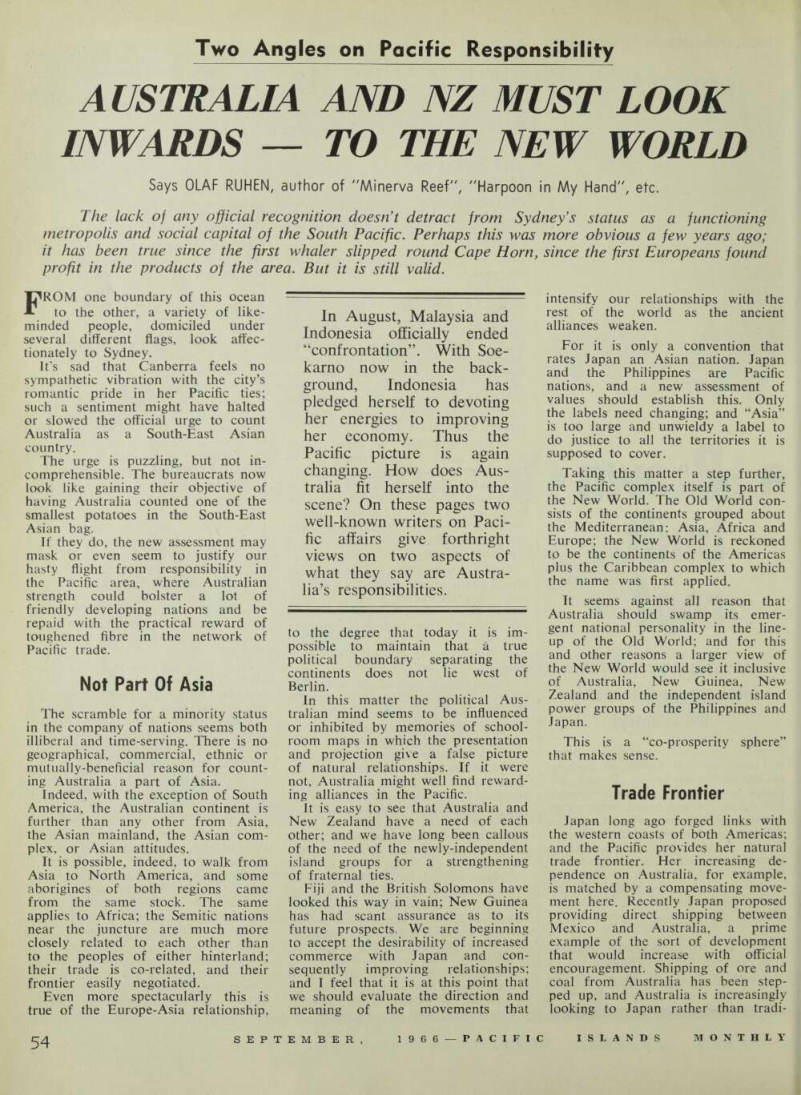
Mr. Olaf Ruhen