Ttopicalities
pp. 20-22 · Read in the full issue
The way we see and hear things , General de Gaulle will need to turn on all his Gallic charm when he visits Tahiti in September—to persuade the Tahitians that they are as happy and as well-off in the bosom oj Mother France as they used to be.
FOR the Tahitians, the history of their country is now divided into two periods—before and after the establishment of the atomic testing centre; and many of them are of the opinion that the centre has made their island “un terre maudite” (a cursed place).
The decision to build the centre three years ago took up the slack in a failing economy in both the agri cultural and industrial fields. But if there has been an expansion in the
A Testing Time
For General
de Gaulle
economy since then, it has been almost entirely artificial.
In 1962, for example, the port of Papeete was visited by 146 com mercial ships and 24 warships. In 1965, the figures were 202 com mercial ships and 194 warships.
The new port, which was recently opened by the Minister for Overseas Territories, General Billotte, cost 52 million francs, of which one-third was from the Armed Forces budget.
Between February, 1965, and 1966, the cost of living rose officially by 16 per cent. There was an adverse balance of trade of 478 million francs last year against 55 million in 1962.
The advent of the testing centre has wrecked the agricultural industry in Tahiti and surrounding islands, for the men deserted the plantations in droves to work for higher wages on the various building projects as sociated with it.
Meanwhile, the phosphate industry at Makatea, 120 miles from Tahiti, which has helped to prop up French Polynesia’s economy for the past 50 years, has been on its last legs; and it was officially announced recently that it would close down completely in September.
The loss of revenue from the phosphate industry is being made all the harder to bear by a decline in Tahiti’s tourist industry, which, in recent times, has been worth 56 per cent, of the value of the country’s “exports”.
There was a fall of 8 per cent, in tourist business in 1964 compared with the previous year; and although there was a slight rise in 1965, busi ness has since declined again (see p. 129).
As the Tahitians have found it harder and harder to cope with circumstances, there has been rising discontent among them and increasing anti-French sentiment.
This seems scarcely likely to lessen for the time being. In fact, the position has now been reached when the slightest incident could be made a cause by those who feel that Tahiti ought to be for the Tahitians.
General de Gaulle, it seems, will need to tread warily to ensure that he does not become the centre of an incident himself.
General de Gaulle will arrive in Tahiti on September 6 after brief visits to New Caledonia and the New Hebrides, He is due to witness the explosion of a “hotted up” atomic bomb at Mururoa Atoll about September 10.
Road Casualty:
Samoan Politeness
A FRIEND of ours who, for a great number of years has known and respected the Samoans, came away from Apia on his most recent trip, wondering what had happened to the traditional Samoan politeness.
An old lady of more than 70, just off the boat for the day, caught her heel while crossing the road and fell on some jagged stones, blacken ing her eye and badly cutting her face and knee.
Streaming with blood, she looked up to see herself surrounded by Samoan taxidrivers, shouting “Two
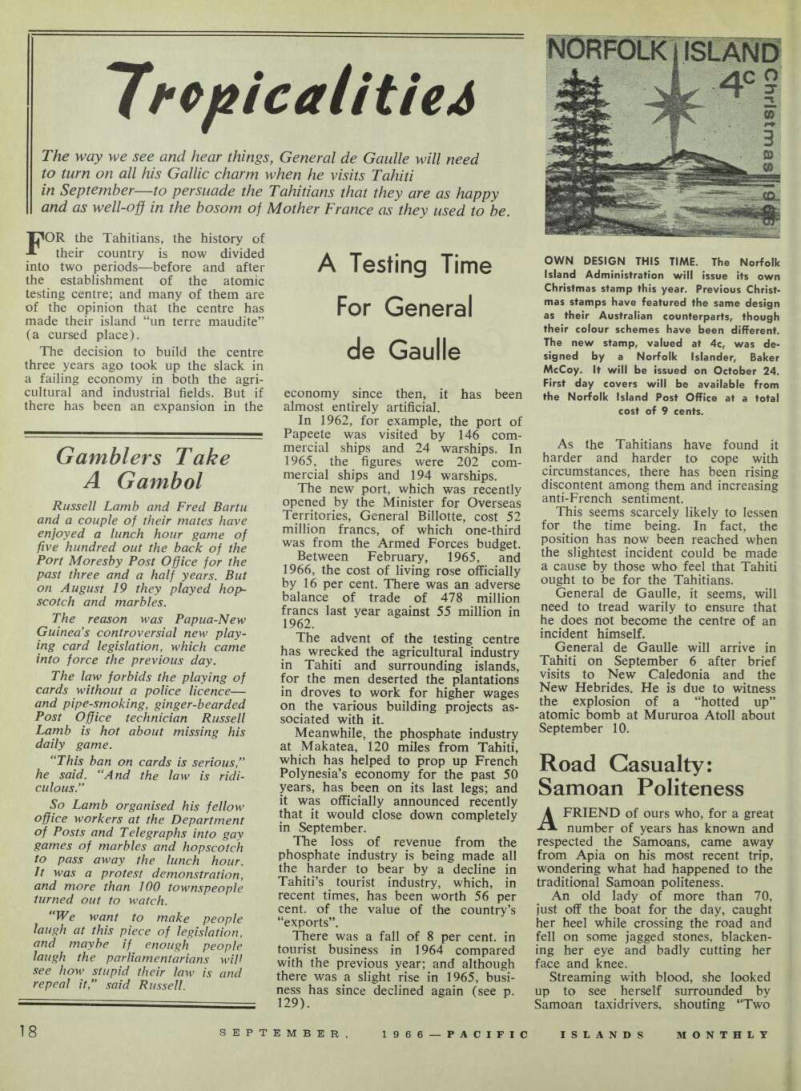
Own Design This Time. The Norfolk
Island Administration will issue its own Christmas stamp this year. Previous Christ mas stamps have featured the same design as their Australian counterparts, though their colour schemes have been different.
The new stamp, valued at 4c, was de signed by a Norfolk Islander, Baker McCoy. It will be issued on October 24.
First day covers will be available from the Norfolk Island Post Office at a total cost of 9 cents.
shillings taxi to hospital!” This per sisted until a policeman finally drove them away and helped her up.
She was so terrified that all she wanted to do was to get back to the boat in case she missed it. Apart from the policeman, nobody offered any assistance.
In recounting the incident later she said that she was having nightmares night after night, and in her dreams she could see faces leaning over her, calling out, “Two shillings to the hospital!”
Tracking A Link
With Subnormality
A MAJOR cause of mental sub normality in young children may be wiped out if experiments due to start in September among villagers in the Jimi River area of New Guinea’s Western Highlands prove successful.
The experiments will start as a result of work by an Anglican Mis sion nurse—Olive Robin, sister-in charge at Koinambe in the Western Highlands, and wife of Canon Peter Robin, priest-in-charge there.
The tests will be carried out by a joint research team from Adelaide University and the territory’s Public Health Department.
“When I first started doing baby clinics in the area last October,”
Mrs. Robin told us, “I was struck by the fact that there were few children under five years old and by the enormous number of mentally subnormal children around.”
The report Mrs. Robin made interested Dr. lan Buttfield, research fellow in medicine at Adelaide University, who was visiting the ter ritory in June.
He discovered that 18 per cent, of the people in the villages of Koinambe and Yimbugema were mentally sub normal, and all of those affected were under five years old.
The subnormality is probably due to iodine deficiency in pregnant mothers, which affects the unborn babies, for this has been noticed among children in mountainous areas all over the world. But while iodine deficiency has long been suspected, there has never been the opportunity to prove it definitely by controlled experiments.
Now the researchers hope to prove their case in the short period of about two years. Pregnant mothers will be given iodised oil injections to see if this has any effect on the number of mentally subnormal children born in the villages.
Mrs. Robin says the subnormality is something which has been going
on in that area for a long time.
Medical aspects apart, she is worried about the future of those mentally subnormal children growing up or being born now.
“In the past, perhaps, their strange ness didn’t matter very much in their communities,” she says. “But now, with the pressures of civilisation growing steadily, these children need special schooling.”
How The Games
Got Started
OUR story in these pages in July (p. 27) on the origin of the South Pacific Games did not exactly amuse Dr. A. H. Sahu Khan, a Fiji-Indian, who now has a practice in Sydney, and we’re not surprised.
Our story stated that, although Dr. Sahu Khan had always pre viously been acclaimed as the “father” of the Games, a newsletter put out recently by the organising committee of the Second Games, to be held in Noumea in December, claimed that the first man to put forward the idea of a South Pacific sports tournament was a New Caledonian, Mr. Pierre Issamatro.
The newsletter said that Mr.
Issamatro had suggested the Games at the 4th South Pacific Conference in Rabaul in 1959—which is where Dr. Sahu Khan is always stated to have originated them.
As we pointed out in July, the records of the Rabaul conference do actually indicate that Mr. Issamatro got in first.
However, Dr. Sahu Khan has told us most emphatically that the records are not a true mirror of what actually took place—and he feels sure that if Mr. Issamatro were asked, he would immediately acknowledge that he (Dr. Sahu Khan) was the real and only begetter.
Dr. Sahu Khan told us that he proposed the holding of a triennial South Pacific sports tournament during discussions which followed the delivery of a paper by the Fiji delegation (of which he was a
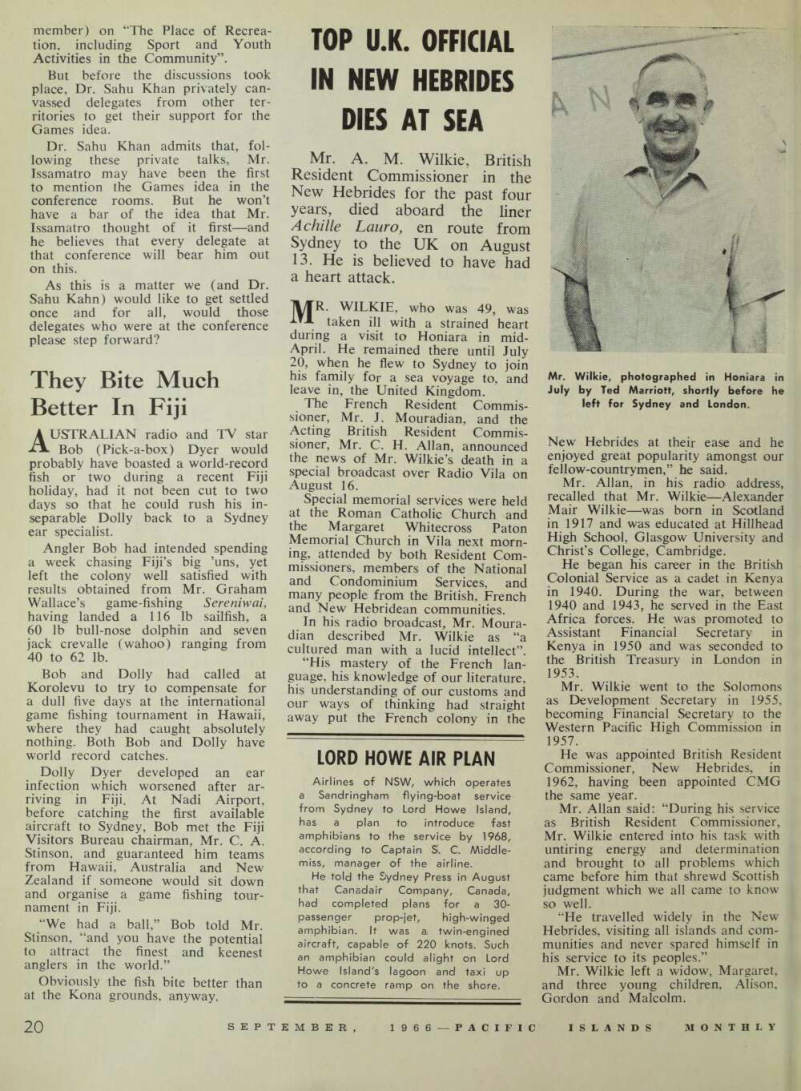
Olive Robin, sister in charge at Koinambe in the Western High lands District, on patrol with her husband, Canon Peter Robin. With them are their two young children, Alice (3) and David (18 months).
member) on “The Place of Recrea tion, including Sport and Youth Activities in the Community”.
But before the discussions took place, Dr. Sahu Khan privately can vassed delegates from other ter ritories to get their support for the Games idea.
Dr. Sahu Khan admits that, fol lowing these private talks, Mr.
Issamatro may have been the first to mention the Games idea in the conference rooms. But he won’t have a bar of the idea that Mr.
Issamatro thought of it first—and he believes that every delegate at that conference will bear him out on this.
As this is a matter we (and Dr.
Sahu Kahn) would like to get settled once and for all, would those delegates who were at the conference please step forward?
They Bite Much
Better In Fiji
AUSTRALIAN radio and TV star Bob (Pick-a-box) Dyer would probably have boasted a world-record fish or two during a recent Fiji holiday, had it not been cut to two days so that he could rush his in separable Dolly back to a Sydney ear specialist.
Angler Bob had intended spending a week chasing Fiji’s big ’uns, yet left the colony well satisfied with results obtained from Mr. Graham Wallace’s game-fishing Sereniwai, having landed a 116 lb sailfish, a 60 lb bull-nose dolphin and seven jack crevalle (wahoo) ranging from 40 to 62 lb.
Bob and Dolly had called at Korolevu to try to compensate for a dull five days at the international game fishing tournament in Hawaii, where they had caught absolutely nothing. Both Bob and Dolly have world record catches.
Dolly Dyer developed an ear infection which worsened after ar riving in Fiji. At Nadi Airport, before catching the first available aircraft to Sydney, Bob met the Fiji Visitors Bureau chairman, Mr. C. A.
Stinson, and guaranteed him teams from Hawaii, Australia and New Zealand if someone would sit down and organise a game fishing tour nament in Fiji.
“We had a ball,” Bob told Mr.
Stinson, “and you have the potential to attract the finest and keenest anglers in the world.”
Obviously the fish bite better than at the Kona grounds, anyway.