Start In The Gilberts
pp. 19-155 · Read in the full issue
The Noumea Games Build-Up
Games Fever Follows Slow Start In The Gilberts
From a Tarawa Correspondent
After a slow start, enthusiasm has now built up in the Gilbert and Ellice Islands for the Second South Pacific Games in December. The Colony’s team for Noumea will be more ex perienced and better trained than in 1963 when the GEIC won one silver medal and one bronze.
WHEN the Suva Games finished, most Pacific territories began to lay the foundations for greater sports achievements for 1966, but it didn’t happen that way here in the Gilbert and Ellice. The Games became not a thing of the future but an event of the past. Enthusiasm dropped until it was non-existent.
There were picnic athletics com petitions during the Queen’s Birthday celebrations in 1964 and 1965, but apart from those days field and track events were forgotten. Tennis and table tennis returned to their earlier place as social sports.
The new enthusiasm was rekindled less than 12 months ago, when it was suddenly realised the Noumea Games were close and the colony govern ment also began to give support.
All this enthusiasm was given a further boost when in March of this year a new recruit reached the colony, Peter Barker, a young man
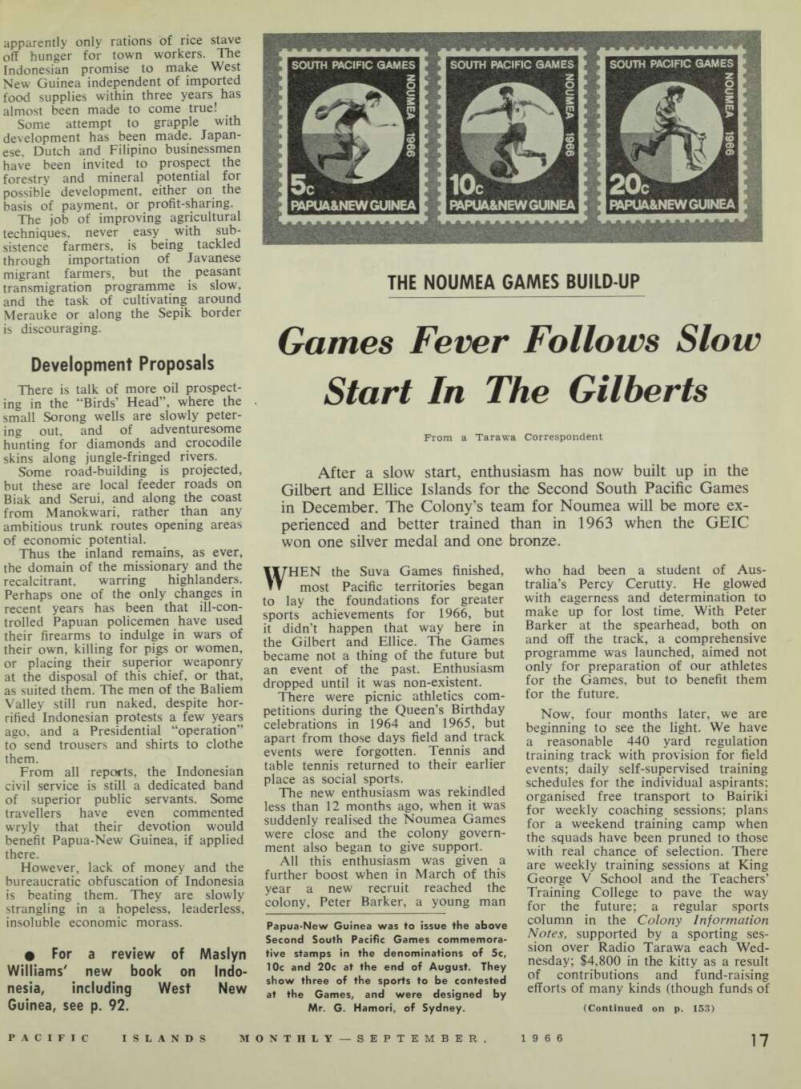
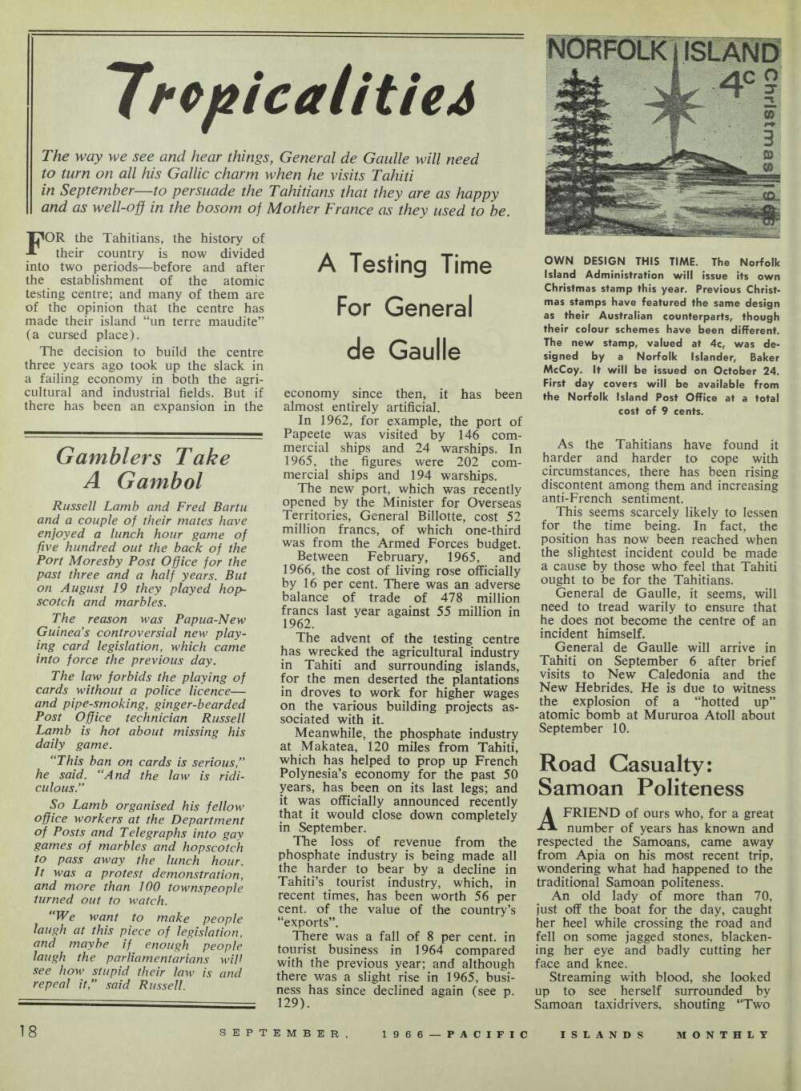
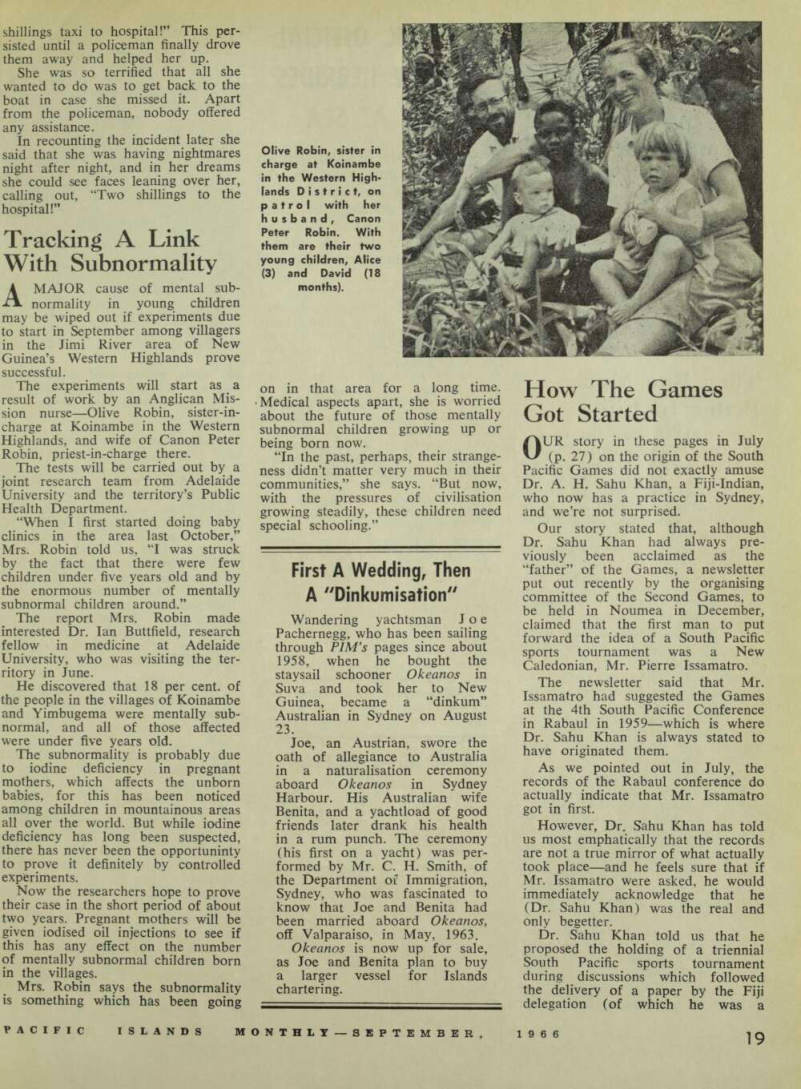
Papua-New Guinea was to issue the above Second South Pacific Games commemora tive stamps in the denominations of sc, 10c and 20c at the end of August. They show three of the sports to be contested at the Games, and were designed by Mr. G. Hamori, of Sydney.
who had been a student of Aus tralia’s Percy Cerutty. He glowed with eagerness and determination to make up for lost time. With Peter Barker at the spearhead, both on and off the track, a comprehensive programme was launched, aimed not only for preparation of our athletes for the Games, but to benefit them for the future.
Now, four months later, we are beginning to see the light. We have a reasonable 440 yard regulation training track with provision for field events; daily self-supervised training schedules for the individual aspirants; organised free transport to Bairiki for weekly coaching sessions; plans for a weekend training camp when the squads have been pruned to those with real chance of selection. There are weekly training sessions at King George V School and the Teachers’
Training College to pave the way for the future; a regular sports column in the Colony Information Notes, supported by a sporting ses sion over Radio Tarawa each Wed nesday; $4,800 in the kitty as a result of contributions and fund-raising efforts of many kinds (though funds of
(Continued on p. 153)
at least this much again have to be raised).
Small disappointments have naturally occurred —such as the limited response to the offer by the Amateur Sports Association to pay fares to Tarawa and to billet any promising athletes from the outer islands.
On the other hand there are little things which make the effort worthwhile—such as the young lad who made a three-hour journey one Sunday to seek Mr. Barker and apologise for not having attended training the previous day; the efforts of members of the Betio Youth Club who slaved to make fund-raising dances a success, later held a dance to raise something for their own depleted funds and then donated a big percentage of these profits to the Games appeal!
The 1966 colony team will probably be no larger than the one in 1963 and despite their better training they may have no greater success than in 1963. But they will be at Noumea proudly, honestly and with genuine determination, and that surely is in the spirit of the South Pacific Games.
Samoan Tennis Squad
Games fund raising activities of sporting bodies has been stepped up in Apia. Western Samoa hopes to send to Noumea about 40 repre sentatives in athletics, weightlifting, women’s basketball, table tennis, boxing and tennis.
First team member has already been selected. He is part-Samoan Curtis Wallwork, a heavyweight weightlifter living in Auckland and who appears to have every chance of winning a gold medal.
Team manager and Games Council representative will be Tufuga S. Atoa.
Tennis manager will be R. H.
Carruthers and basketball manager Mrs. To’oto’to Pulotu.
The most active of local sports associations is the Western Samoa Lawn Tennis Association, which for most of the year has been fund raising.
Early in August a training squad of 10 men and six women was announced. It is likely that the six men and two women who will represent Samoa will be picked from this group.
Those selected were (men): M.
Westerlund, L. Purcell, R. Rankin and J. Loi On, of the champion Apia team; D. Betham, H. Betham and A. Lam Sam, of Apia Protestant; Fr. Leamy and T. Faai’uaso, of Hospital, and P. Faalogo, of SCOPA (Samoa College Old Pupils Associa tion).
Ladies picked were: M. Lam and N. Rasmussen, of Hospital; B.
Palmer and A, Chan, of Apia; and S. Skipps and C. Betham, of Apia Protestant.
Criticism Of Expenses
Noumea’s newspaper, Journal Cale donian, has recently been very critical of the expenses incurred by the or ganising committee of the Noumea Games.
The newspaper specially criticises the sum of 700,000 francs ($A7,000) for an organising secretary, due from France soon. The paper claims the sum is excessive because it is to pay for the fares and costs of the secre tary’s family as well while staying in Noumea. His salary will be paid by a metropolitan organisation.
Criticism has also been levelled at orders placed in France for such ordinary articles as basketball panels, referee seats for volley ball and a host of other things which, the paper claims, could be manufactured at a lower cost in New Caledonia.
The paper also commented that there was sure to be a rush of French councillors, technical experts and a “heavy contingent of political per
sonalities”, all of whom ignored the last Suva Games, but who have “suddenly discovered the Noumea Games”.
The article concludes, “The tax payer will have to take up the bill . . . and as usual will say nothing”.
Island Night
Among the many activities de signed to attract and entertain visitors to the Noumea Games, is a collection of local artifacts to be displayed in the New Caledonian Museum.
The Games Committee also hopes to hold an exhibition of handicrafts from other territories. To date the Solomons, Gilberts and New Hebrides have asked to be repre sented in the display.
The South Pacific Commission is organising an “island night” at which traditional songs and dances will be performed by various Games teams.
These colourful nights have been a feature of the regular three-yearly South Pacific Conferences in the Pacific and there was such a night at the First Games in Suva.
A lottery which was organised in New Caledonia to raise funds for the South Pacific Games was drawn in late June.
This was the first lottery with cash prizes to be held for many years in New Caledonia. Lotteries generally have prizes of cars or other goods.