Britain's Colonial Secretary
pp. 12-13 · Read in the full issue
Looks Over His Pacific Empire
From R. W. Robson, in Suva
Many people in the South Pacific Islands in late August were trying to see Frederick Lee as a new Messiah, competent and authorised to lead them out of a wilderness of political un certainty and economic doubt.
THIS courteous, quiet-spoken British Secretary of State for the Colonies does inspire confidence by his eagerness to learn all he can about the problems of Britain’s South Pacific territories, and by his sincerity in seeking practicable answers.
Yet the day he left by air for Canberra, to discuss some of the angles of Britain’s South Pacific responsibilities with a so far un responsive Australia, a few of the more cynical commentators were ex pressing doubt about the overall value of the Ministerial tour. But the tour has by no means been a write-off.
There appears to be a clear indica tion of British policy in some of Mr. Lee’s more positive statements (see panel), and some of the hints
he gave of probable British planning are comforting.
We may assume there is a possibility of using Fiji’s surplus labour and Fiji-Indian technical skills in the establishment of new industries in the Solomons and New Hebrides.
Mr. Lee was deeply impressed, for example, with the possibilities of rice production on Guadalcanal’s vast, rich plains, and of unearthing rich mineral deposits in the hitherto neglected Solomons if money and skilled labour can be found.
Fiji and Australia
His eminently practical mind fastened on the potential of the New Hebrides, provided by co-operation already seen in British, French and Japanese enterprise and with a pos sibility of investment capital from Australia and America.
Mr. Lee has been encouraged by what he has seen and sensed in Fiji, to believe that the administrative system now slowly taking shape under the proposed constitution, will solve the more acute political and economic problems which have bedevilled a line of governors.
When he left Fiji on August 25 for talks in Canberra with Aus tralia’s Ministers, it seemed likely that he would have some interesting things to say.
It seemed that he might point out that, while Britain had borne most of the heat, burden and expense of Fiji’s administration, most of the sweets of Fiji’s trade were trickling away—rather unfairly—to Australia through the Australian trading corporations, which own 80 or 90 per cent, of Fiji’s economic organisa tion, Mr, Lee was also expected to make the point that, henceforth, control of Fiji’s trade, commerce and develop ment would be mostly the respon sibility of Fiji’s own elected govern ment, which would also be mainly
responsible for Fiji’s relations with Australia and New Zealand, So Mr. Lee’s wink in Canberra seemed likely to be as good as a nod 'to those blind horses, which, in the past, have failed to see that the profits they drew from Fiji carried some obligations.
Mr. Lee also seemed likely to talk tourism to Australia. It was pointed out to him in Suva that, if Australia could buy from Fiji only a tithe in value of the goods she sold to Fiji, tourism was one Fiji product which Australia could buy lavishly, if only Canberra would co-operate in the field with private enterprise.
Comfortless Tour
So when the Minister left for Australia and London, the tides of speculation ran freely in Fiji. This speculation was mixed with sympathy, because, on the eve of his departure, he was really ill.
Little wonder.
Someone should be pole-axed for planning a tour which was packed with far too many meaningless engagements and receptions, plus comfortless travel in small boats on a boisterous South-East Trades sea.
The cynics join all classes in sing ing his praises, as an amiable, approachable, sensible gentleman.
He was surrounded at all stages with Colonial Office Brass—the local officials of the various territories, plus the highly qualified and übiquitous Mr. Trafford Smith (a Colonial Office Under-Secretary with a wide knowledge of the now dis integrated Colonial Empire), and, as private secretary, Mr. Gumming Bruce, who filled important posts in many former colonies.
It is a part of the bureaucrats’ jobs to keep the feet of a touring
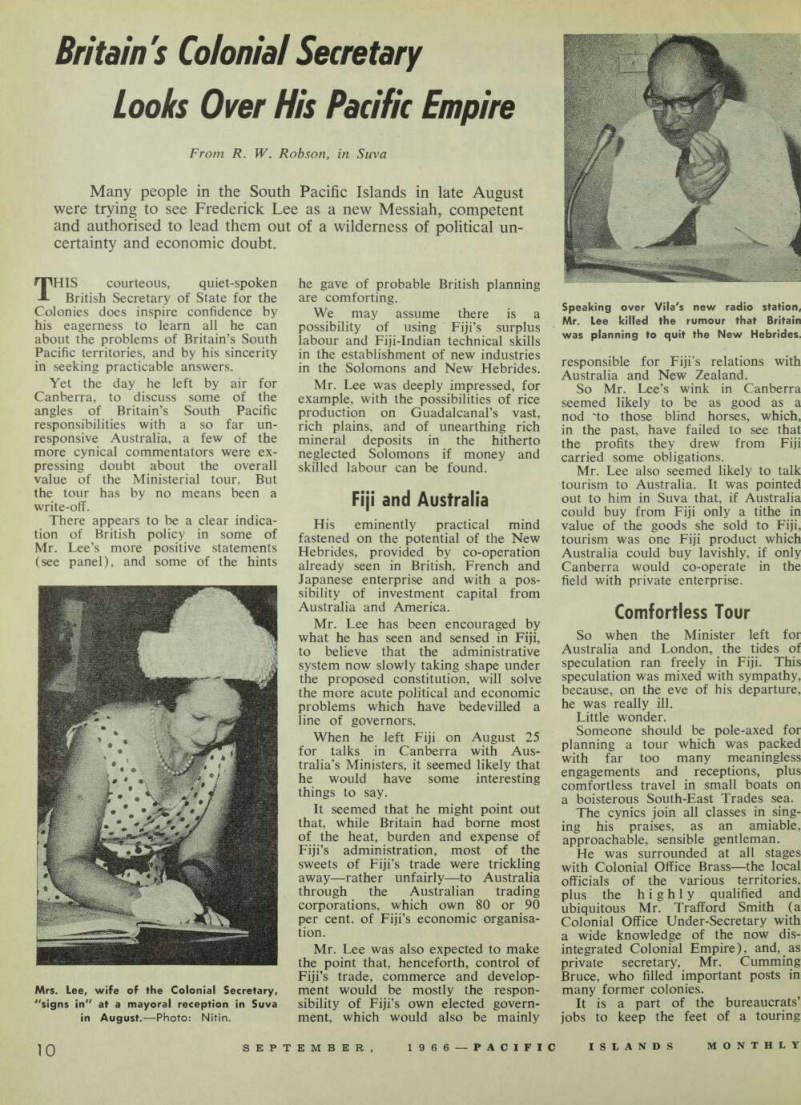
Mrs. Lee, wife of the Colonial Secretary, "signs in" at a mayoral reception in Suva in August.— Photo: Nitin.
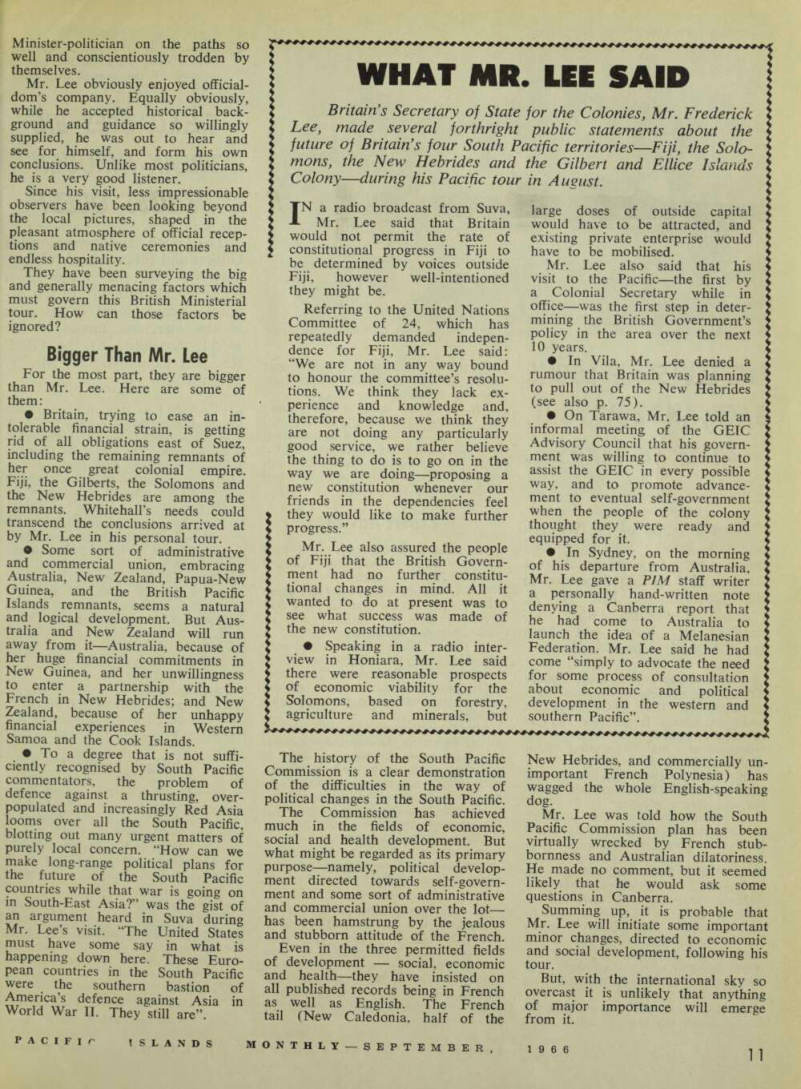
Speaking over Vila's new radio station, Mr. Lee killed the rumour that Britain was planning to quit the New Hebrides.
Minister-politician on the paths so well and conscientiously trodden by themselves.
Mr. Lee obviously enjoyed official dom’s company. Equally obviously, while he accepted historical back ground and guidance so willingly supplied, he was out to hear and see for himself, and form his own conclusions. Unlike most politicians, he is a very good listener.
Since his visit, less impressionable observers have been looking beyond the local pictures, shaped in the pleasant atmosphere of official recep tions and native ceremonies and endless hospitality.
They have been surveying the big and generally menacing factors which must govern this British Ministerial tour. How can those factors be ignored?
Bigger Than Mr. Lee
For the most part, they are bigger than Mr. Lee. Here are some of them: • Britain, trying to ease an in tolerable financial strain, is getting rid of all obligations east of Suez, including the remaining remnants of her once great colonial empire.
Fiji, the Gilberts, the Solomons and the New Hebrides are among the remnants. Whitehall’s needs could transcend the conclusions arrived at by Mr. Lee in his personal tour. • Some sort of administrative and commercial union, embracing Australia, New Zealand, Papua-New Guinea, and the British Pacific Islands remnants, seems a natural and logical development. But Aus tralia and New Zealand will run away from it—Australia, because of her huge financial commitments in New Guinea, and her unwillingness to enter a partnership with the French in New Hebrides; and New Zealand, because of her unhappy financial experiences in Western Samoa and the Cook Islands. • To a degree that is not suffi ciently recognised by South Pacific commentators, the problem of defence against a thrusting, over populated and increasingly Red Asia looms over all the South Pacific, blotting out many urgent matters of purely local concern. “How can we make long-range political plans for the future of the South Pacific countries while that war is going on in South-East Asia?” was the gist of an argument heard in Suva during Mr. Lee’s visit. “The United States must have some say in what is happening down here. These Euro pean countries in the South Pacific were the southern bastion of America’s defence against Asia in World War 11. They still are”.
The history of the South Pacific Commission is a clear demonstration of the difficulties in the way of political changes in the South Pacific.
The Commission has achieved much in the fields of economic, social and health development. But what might be regarded as its primary purpose—namely, political develop ment directed towards self-govern ment and some sort of administrative and commercial union over the lot— has been hamstrung by the jealous and stubborn attitude of the French.
Even in the three permitted fields of development social, economic and health—they have insisted on all published records being in French as well as English. The French tail (New Caledonia, half of the
New Hebrides, and commercially un important French Polynesia) has wagged the whole English-speaking dog.
Mr. Lee was told how the South Pacific Commission plan has been virtually wrecked by French stub bornness and Australian dilatoriness.
He made no comment, but it seemed likely that he would ask some questions in Canberra.
Summing up, it is probable that Mr, Lee will initiate some important minor changes, directed to economic and social development, following his tour.
But, with the international sky so overcast it is unlikely that anything of major importance will emerge from it.