P-Ng's New Budget Seeks
p. 11 · Read in the full issue
To Wean Territory From
Australia's Purse-Strings
From Stuart Inder in Port Moresby
An awareness of constitutional changes to come seeps through all pores of New Guinea’s 1966-67 Budget. Although the figures are still of the astronomical variety that have long been envied by other Pacific territories desperate to find more money to keep their sluggish economies moving, a bigger proportion of the Budget will be raised within New Guinea than at any time since the war.
FURTHERMORE, Australia’s grant will comprise the smallest pro portion of the total figure since the war.
Thus the first perceptible moves are being made to get New Guinea on to an economy of its own and wean it away from the massive Australian handouts which have increased yearly.
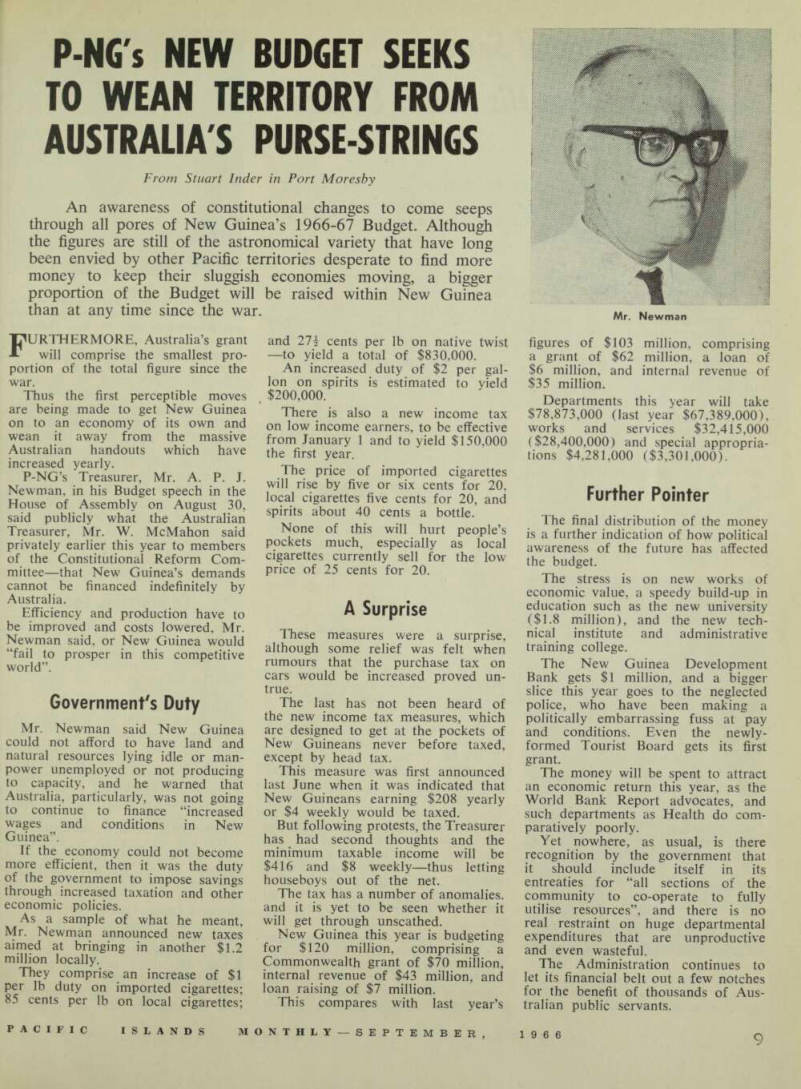
P-NG’s Treasurer, Mr. A. P. J.
Newman, in his Budget speech in the House of Assembly on August 30, said publicly what the Australian Treasurer, Mr. W. McMahon said privately earlier this year to members of the Constitutional Reform Com mittee—that New Guinea’s demands cannot be financed indefinitely by Australia, Efficiency and production have to be improved and costs lowered, Mr.
Newman said, or New Guinea would “fail to prosper in this competitive world”.
Government's Duty
Mr. Newman said New Guinea could not afford to have land and natural resources lying idle or man power unemployed or not producing to capacity, and he warned that Australia, particularly, was not going to continue to finance “increased wages and conditions in New Guinea”.
If the economy could not become more efficient, then it was the duty of the government to impose savings through increased taxation and other economic policies.
As a sample of what he meant, Mr. Newman announced new taxes aimed at bringing in another $1.2 million locally.
They comprise an increase of $1 per lb duty on imported cigarettes; 85 cents per lb on local cigarettes;
and 27i cents per lb on native twist —to yield a total of $830,000.
An increased duty of $2 per gal lon on spirits is estimated to yield $200,000.
There is also a new income tax on low income earners, to be effective from January 1 and to yield $150,000 the first year.
The price of imported cigarettes will rise by five or six cents for 20, local cigarettes five cents for 20, and spirits about 40 cents a bottle.
None of this will hurt people’s pockets much, especially as local cigarettes currently sell for the low price of 25 cents for 20.
A Surprise
These measures were a surprise, although some relief was felt when rumours that the purchase tax on cars would be increased proved un true.
The last has not been heard of the new income tax measures, which are designed to get at the pockets of New Guineans never before taxed, except by head tax.
This measure was first announced last June when it was indicated that New Guineans earning $2OB yearly or $4 weekly would be taxed.
But following protests, the Treasurer has had second thoughts and the minimum taxable income will be $416 and $8 weekly—thus letting houseboys out of the net.
The tax has a number of anomalies, and it is yet to be seen whether it will get through unscathed.
New Guinea this year is budgeting for $l2O million, comprising a Commonwealth grant of $7O million, internal revenue of $43 million, and loan raising of $7 million.
This compares with last year’s
figures of $lO3 million, comprising a grant of $62 million, a loan of $6 million, and internal revenue of $35 million.
Departments this year will take $78,873,000 (last year $67,389,000), works and services $32,415,000 ($28,400,000) and special appropria tions $4,281,000 ($3,301,000).
Further Pointer
The final distribution of the money is a further indication of how political awareness of the future has affected the budget.
The stress is on new works of economic value, a speedy build-up in education such as the new university ($l.B million), and the new tech nical institute and administrative training college.
The New Guinea Development Bank gets $1 million, and a bigger slice this year goes to the neglected police, who have been making a politically embarrassing fuss at pay and conditions. Even the newly formed Tourist Board gets its first grant.
The money will be spent to attract an economic return this year, as the World Bank Report advocates, and such departments as Health do com paratively poorly.
Yet nowhere, as usual, is there recognition by the government that it should include itself in its entreaties for “all sections of the community to co-operate to fully utilise resources”, and there is no real restraint on huge departmental expenditures that are unproductive and even wasteful.
The Administration continues to let its financial belt out a few notches for the benefit of thousands of Aus tralian public servants.
Mr. Newman