The Editors' Mailbag
pp. 57-61 · Read in the full issue
On Being Well-Informed
Sir, —A Suva correspondent (PIM, June, p. 27) laments being able to find “only one man who had been interviewed” by the Morris Mission on Higher Education in the South Pacific. Your correspondent claims that “a large proportion of the population, even the usually well informed, had no idea that the mission had ever been in Fiji”; and that the mission “did not, like the P-NG Commission on Higher Educa tion, seek the views of the general public and few residents of Fiji other than officials were asked for their views”.
Shame on your Suva correspondent and on the usually well-informed. A two-column caption in the November 8, 1965, issue of The Fiji Times said; “Education Mission Seeks Submis sions”. Those who read on received this invitation: “The Higher Educa tion Mission to the South Pacific is seeking written submissions within its terms of reference”. After listing the members of the mission and its terms of reference, the news item concluded: — “The mission would welcome written submissions on matters within its terms of reference. They should be sent, in duplicate, to the Secretary, Higher Education Mission, Laucala Bay, Suva, not later than Friday, November 26.
“The mission hopes that education and local authorities, commercial organisations and persons concerned about the provision of higher educa tion and training facilities in the South Pacific region, will take this opportunity to express their views to it.”
Similar radio publicity was given by the Fiji Broadcasting Commission.
Your correspondent will that in the Morris Report, the mission records its thanks, inter alia, to members of the Legislative Council, senior officials of no fewer than ten national, state and territorial admini strations and to “a considerable range of organisations, firms and individuals who showed no less kindness and helpfulness”.
A list, given in Appendix I of the report, of specific submissions made to the mission, shows 15 separate categories of persons or organisations.
In addition, the mission studied 60 reports and other documents made available to it in Fiji, the British Solomon Islands Protectorate, the
New Hebrides, Papua-New Guinea, Western Samoa, Tonga, the Gilbert and Ellice Islands Colony, and by the University of Hawaii; together with a large variety of technical and miscellaneous papers. One of them was the Pacific Islands Monthly!
K. R. Bain.
Secretary Social Services, Government Building, Suva,
Wrist-Whipping Ceremony
Sir, —In answer to D. J. Rumsey, who wants to know the significance of the Tolai “wrist-whipping” ceremony (PIM, May). The ceremony is called lebe (ler-ber) which means a strong fighting man. It has no significance other than it boasts the strength of the participants. There is a song ( malira ) with words to this end, but it is rarely sung during the game. However, I’m told that it is often sung while the canes are being cut.
The canes used are cut from the goragoro plant, somewhat similar to the lawyer cane in appearance. It has a glossy-dark-green skin, but it is soft and pithy in the centre. After the canes are cut the skin is scraped with a piece of glass and they are left to dry for about 30 mins. Lime is then rubbed on the canes giving them the appearance of old sticks.
The “drugged or drunk” ap pearance Mr. Rumsey described is due to betel or alcohol and has no bearing on the game of lebe, as no pain is involved. I have played lebe on a few occasions, and only once did it leave a mark. On the skin of a Tolai this would not be visible.
M. S. Russell.
Rabaul, New Guinea.
Tongan Representative
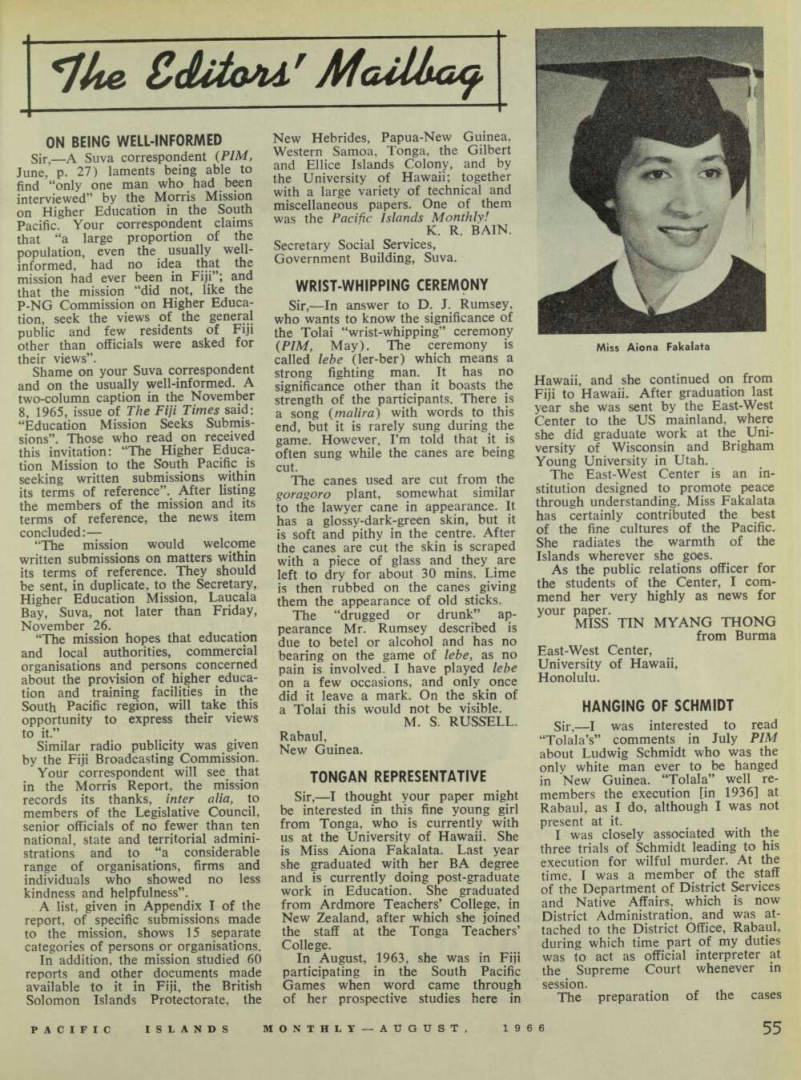
Sir, —I thought your paper might be interested in this fine young girl from Tonga, who is currently with us at the University of Hawaii. She is Miss Aiona Fakalata. Last year she graduated with her BA degree and is currently doing post-graduate work in Education. She graduated from Ardmore Teachers’ College, in New Zealand, after which she joined the staff at the Tonga Teachers’
College.
In August, 1963, she was in Fiji participating in the South Pacific Games when word came through of her prospective studies here in
Hawaii, and she continued on from Fiji to Hawaii. After graduation last year she was sent by the East-West Center to the US mainland, where she did graduate work at the Uni versity of Wisconsin and Brigham Young University in Utah.
The East-West Center is an in stitution designed to promote peace through understanding. Miss Fakalata has certainly contributed the best of the fine cultures of the Pacific.
She radiates the warmth of the Islands wherever she goes.
As the public relations officer for the students of the Center, I com mend her very highly as news for your paper.
Miss Tin Myang Thong
from Burma East-West Center, University of Hawaii, Honolulu.
Hanging Of Schmidt
Sir, —I was interested to read “Tolala’s” comments in July PIM about Ludwig Schmidt who was the only white man ever to be hanged in New Guinea. “Tolala” well re members the execution [in 1936] at Rabaul, as I do, although I was not present at it.
I was closely associated with the three trials of Schmidt leading to his execution for wilful murder. At the time, I was a member of the staff of the Department of District Services and Native Affairs, which is now District Administration, and was at tached to the District Office, Rabaul, during which time part of my duties was to act as official interpreter at the Supreme Court whenever in session.
The preparation of the cases
Miss Aiona Fakalata
against Schmidt and subsequent trials involved me for three months, firstly at the Crown Law Department (now Department of Law) and then in the Supreme Court, Thus I came to know well, details of the atrocities committed by Schmidt. In actual fact, there were many charges of wilful murder sworn against him, and eventually he was brought to trial in the Supreme Court on three of them.
He was tried and found guilty three times, and was sentenced to death on three separate occasions, probably being the only person of any race to be sentenced to death three times in succession in New Guinea.
My impression then, as it is now, was that I wholeheartedly agreed with the remarks of the presiding judge, the late Chief Justice Wanliss, when sentencing Schmidt. He said, “If ever a man deserves to be hanged,
you do”.
Hal Evans.
Turramurra, NSW.
Death Of W. G. Mackay
Sir, —I have noted in both the June and July PI M’s no mention of the death of Mr. William George Mac Kay. This, most people con sider, a very bad error on your part for he was a very well-known and loved identity of Fiji. In fact, he helped build this colony. And there are many people in Fiji whom W.
G. Mac Kay has helped in many, many ways. I hope you will rectify this mistake. Needless to say, Mr.
Mac Kay had been a subscriber to PIM since it began.
(Mrs.) E. M. Beddows
Suva, Fiji. • PIM concurs with Mrs.
Beddows’ view of the late William Mac Kay, whose death on May 23 occurred too late for inclusion in June, PIM. An obituary was set in type for July, but due to an error it failed to find its allotted space in the magazine. The mistake is rectified in this issue.
The New Hebrides Scene
Sir, —Not much has been said in PIM about the New Hebrides lately.
Readers are wondering whether we have been shelved in the forgotten file.
A prominent member of the public threatens to resign from the Port Council. Understandable, as his position on the council is purely of an advisory nature, and whose “advice” generally goes unheeded.
This applies to other advisory
councils with nominated members exceeding elected ones. The chosen few appear ornamental and a cover-up for a shoddy display of democracy.
More “advisers” are soon to be required for a Santo Town Council, to be presided over by District Agents with other officials as members.
Those who are able to think for themselves are against this move, except for some non-permanent set tlers who may aspire to a tem porary seat of prominence during such meetings.
An official once said, “We are never here long enough or have enough time to quite understand the problems of planters”. True. Those holding responsible positions, with New Hebrides’ destiny in their fumbling hands, may be likened to migratory birds, here today, gone tomorrow.
However, planters are sometimes remembered during flowery speech making events, reminding us that the New Hebrides depends mainly on agriculture. Yet, very little help is extended to make the agriculturist feel that his presence is appreciated or even required!
The planter is alarmed and con fused by the ever-increasing number of officials and departments. As a result, more taxes have been imposed to choke the planter during a time when labour is expensive and produce markets are low.
About 50 years ago it was intended that local governments be set up to protect the people against exploiters.
Today, with abundantly staffed French, English and Condominium governments, we are in dear need of a special and possibly “fourth government”, to save us from being exploited by all three!
Madame X.
Santo, New Hebrides.
The April Cover
Sir, —On PlM’s April cover ap peared one of my pictures. The picture is indeed of a Melanesian child. The photo was taken by me on Oct. 23, 1965 at Mataniko’o Village, Guadalcanal, on my first trip into the wonders of the tropical jungle.
Jorgen Lundberg.
Honiara, British Solomons. • PIM in April described Mr.
Lundberg’s striking picture as being of a “Melanesian child in the Solomons”. In June, the Solomons’ chief information officer, Mr. D. W.
Tudor-Pole, said the photo was taken in the New Hebrides. Correspondence is now closed!
"Captain Cook's" Tortoise
Sir, —Acting on a suspicion aroused by the illustrated size of “Tui Malila” in your June issue, I checked with the Auckland Museum [where “Captain Cook’s” Tongan tortoise was taken after his death recently].
They confirm that he is of a species formerly found on the Seychelles Islands, in the Indian Ocean, Galapagos tortoises grow con siderably larger than the one pic tured, often weighing between three and four hundred pounds.
B. J. Parkinson.
Auckland, NZ.
Sarka The Painter
Sir, —In recent issues of PIM I have noted articles on Gauguin and on Maugham, as they are remembered in the South Seas. These were of considerable interest, especially the latter, since I was reading Moon and Sixpence with a class at the time PIM arrived here.
It would be interesting to see if any of ydur contacts have any remembrances or information on a painter named Sarka (sometimes called Sarka of the South Seas), He arrived at Papeete at the time of Gauguin’s death and remained a number of years there.
Recently a cache of his pictures has been unleashed through a New York art dealer and has been at tracting some attention. I have had some fine contacts with the family, and I know that they will be interest ed in hearing anything that is to be said about this member of their clan.
I have certainly enjoyed PIM and have tried to get others interested in the South Seas through this magazine, which, incidentally, I purchased as an adjunct to a stamp collection devoted to some of the South Sea islands.
Edward A. Williams.
Nichols School, Amherst and Colvin Sts,, Buffalo, New York,
Usa.
Fiji Tobacco Statistics
Sir, —I refer to the article on the Fiji tobacco industry ( PIM, July, pp. 138-139). There are four small errors that I would like to bring to your attention. The statistics pro vided in the first paragraph after the heading “Imports Drop” on p. 139 could be misleading. The following figures are taken from the official trade report for Fiji for 1955 and 1965.
In 1965, in addition to both Fiji Tobacco Co. Ltd. and Carreras of Fiji Ltd., together having manufac
tured 320,689,000 cigarettes, my com pany manufactured 30,000 lb of cigarette and pipe tobacco in vacuum sealed tins, in Fiji.
You have incorrectly shown the retail price of Lion cigarettes as 9d for 10 whereas in fact this brand sells for 7d for 10.
In the second last paragraph of the article on p. 139, the rate of produc tion of cigarettes is shown as 14,000 cigarettes a minute, whereas produc tion in the range of 1,000-1,500 per minute is the normal.
F. J. Makin,
Manager.
Fiji Tobacco Co. Ltd., Suva.
1955 1965 lb lb Tobacco u n manufactured. 56,658 649,468 Cigars and cheroots 644 2,390 Cigarettes . 272,989 12,348 Tobacco manufactured . 130,963 3,893 461,254 668,099