Liquor Problem
p. 55 · Read in the full issue
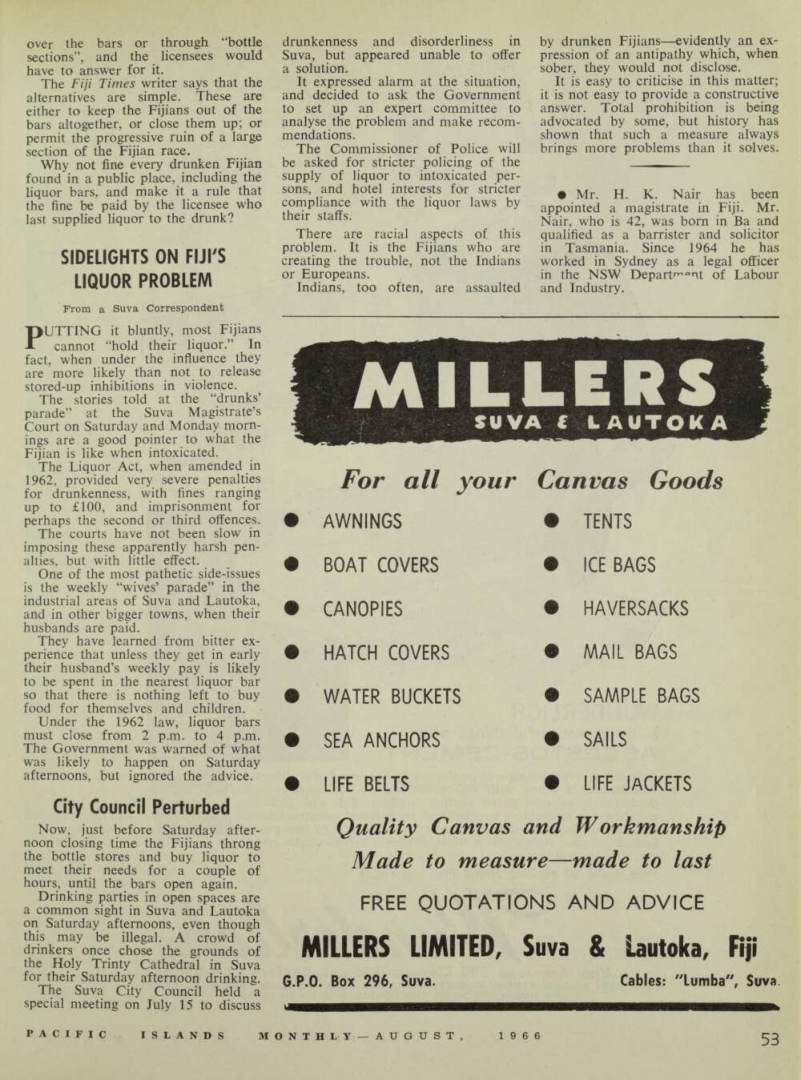
Sidelights On Fiji's
From a Suva Correspondent PUTTING it bluntly, most Fijians cannot “hold their liquor.” In fact, when under the influence they are more likely than not to release stored-up inhibitions in violence.
The stories told at the “drunks’ parade” at the Suva Magistrate’s Court on Saturday and Monday morn ings are a good pointer to what the Fijian is like when intoxicated.
The Liquor Act, when amended in 1962, provided very severe penalties for drunkenness, with fines ranging up to £lOO, and imprisonment for perhaps the second or third offences.
The courts have not been slow in imposing these apparently harsh pen alties, but with little effect.
One of the most pathetic side-issues is the weekly “wives’ parade” in the industrial areas of Suva and Lautoka, and in other bigger towns, when their husbands are paid.
They have learned from bitter ex perience that unless they get in early their husband’s weekly pay is likely to be spent in the nearest liquor bar so that there is nothing left to buy food for themselves and children.
Under the 1962 law, liquor bars must close from 2 p.m. to 4 p.m.
The Government was warned of what was likely to happen on Saturday afternoons, but ignored the advice.
City Council Perturbed
Now, just before Saturday after noon closing time the Fijians throng the bottle stores and buy liquor to meet their needs for a couple of hours, until the bars open again.
Drinking parties in open spaces are a common sight in Suva and Lautoka on Saturday afternoons, even though this may be illegal. A crowd of drinkers once chose the grounds of the Holy Trinty Cathedral in Suva for their Saturday afternoon drinking.
The Suva City Council held a special meeting on July 15 to discuss
drunkenness and disorderliness in Suva, but appeared unable to offer a solution.
It expressed alarm at the situation, and decided to ask the Government to set up an expert committee to analyse the problem and make recom mendations.
The Commissioner of Police will be asked for stricter policing of the supply of liquor to intoxicated per sons, and hotel interests for stricter compliance with the liquor laws by their staffs.
There are racial aspects of this problem. It is the Fijians who are creating the trouble, not the Indians or Europeans.
Indians, too often, are assaulted
by drunken Fijians—evidently an ex pression of an antipathy which, when sober, they would not disclose.
It is easy to criticise in this matter; it is not easy to provide a constructive answer. Total prohibition is being advocated by some, but history has shown that such a measure always brings more problems than it solves. • Mr. H. K. Nair has been appointed a magistrate in Fiji. Mr.
Nair, who is 42, was bom in Ba and qualified as a barrister and solicitor in Tasmania. Since 1964 he has worked in Sydney as a legal officer in the NSW °nt of Labour and Industry.