New Guinea
pp. 10-11 · Read in the full issue
New Man For
The Top In
By Judy Tudor
The appointment of Mr. D
O. Hay, CBE, DSO, as Ad
ministrator of Papua and New Guinea in succession to Sii Donald Cleland surprised everyone, including those whc have flown the highest kites in the last six months. Mr. Hay is a distinguished rather than a public figure and he has spent most of the last 15 years out of Australia serving his country in SE Asia and North America.
THE announcement of his ap pointment was made in Can berra on July 21, only about a week after his name was first mentioned publicly as a possibility.
Mr. Hay is a personal friend of Mr. Dudley McCarthy, present Aus tralian Minister to the United Nations, who is a New Guinea “old hand”. It was at a lunch given by Mr. McCarthy, in the members’ dining room in the United Nations building in New York, that I met Mr. Hay briefly at the end of 1963.
He appeared to me to be a man with a very pleasing personality and a
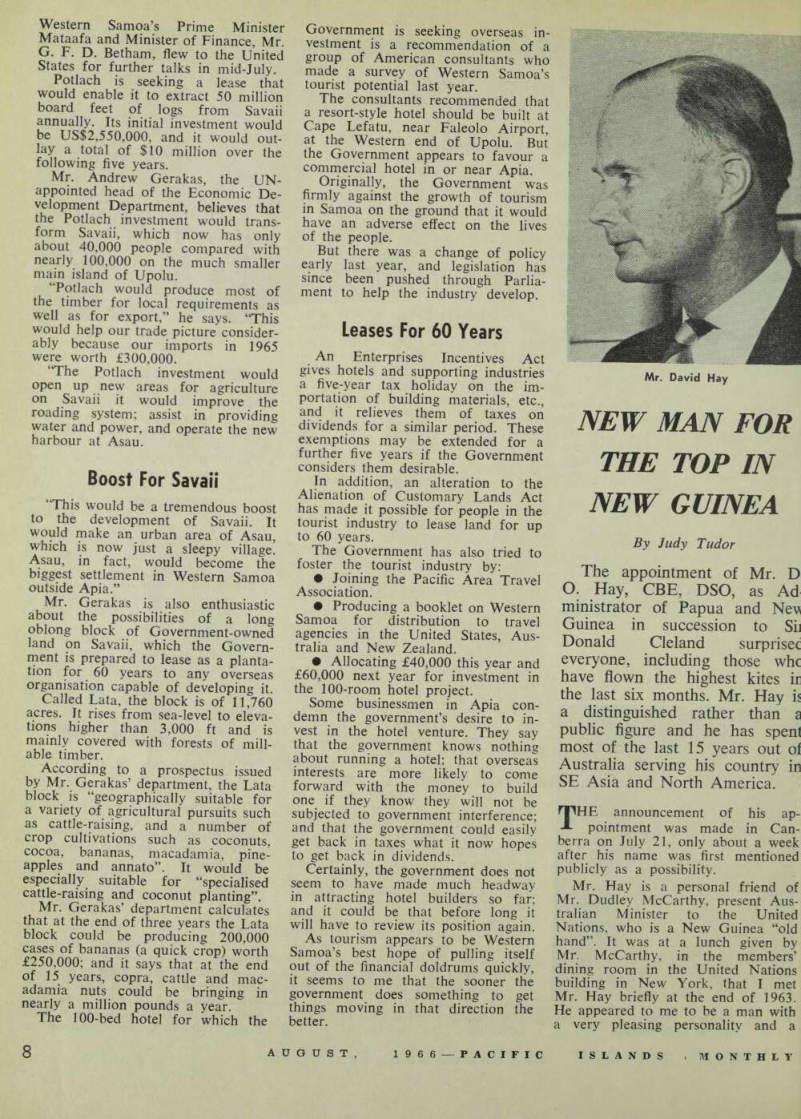
Mr. David Hay
wide interest in Pacific and international affairs.
At this time the UN Committee on Colonialism was having a lot to say about Fiji and Mr. Hay was interested in getting the background of that country.
He then combined the two posts of High Commissioner in Ottawa, which he had held since 1961, and Ambassador to the UN, but shortly afterwards the ambassadorship became a full-time appointment. He returned to Australia as First Assistant Secretary, Department of External Affairs, at the end of 1965.
Considering the difficulty the Australian Government has had in getting a successor to Sir Donald Cleland, Mr. Hay is a lucky choice.
He should do very well in the territory. Sir Donald retires on December 31.
Mr. Hay was born in Corowa, NSW in 1916 and is married with two sons, aged 21 and 16. He joined the Public Service in 1939 but wfthin a year had enlisted in the 7/A Tnfsntrv Rn ATF as a nrivate h s service fn the Western Desert* Gree« Ceylon and New Guinea he attained the rank of major. (As a memento of his NG service he has an airstrip named after him—Hayfield, just west of Maprik).
After he returned to the External Affairs Department he continued as a citizen soldier and, with the rank of lieut.-col., commanded 3 Infantry Bn. CMF in 1948-49.
Perhaps when he is installed as
Administrator he will revert to being lieut.-col. Military titles seem to be traditional in New Guinea (although Papua, before the war, had a Judge and a Mr.). If this were a UK ter ritory the solution would be simple, of course. Mr. Hay would become Sir David before the end of this year; but the Australian Government, which hands knighthoods out to retired pubkeepers and politicians with a free hand, can bring itself to create knights in Papua-New Guinea only once every 20 years or so.
This is the first time that P-NG h as a diplomat for an Admini strator but at the present stage of t h e territory’s development the skills Q f a diplomat will probably be very US eful. Particularly the skills of this diplomat, who has spent so many years in contact with the represen tatives of emerging nations. • ton . p.xrr, , ay f r p«tipr mnr J but he shortly as a refresher-course but he ?" d ,t is S mto the bl § bungalow called GOVem ™nt House until the new . y ear ' W u hen » h /V d ° o.aleXs and ? c . on ‘ rast ' he P late ' g,ass and steel of New York ' Government House, Port Moresby, is basically the same building where Sir Hubert Murray lived in austerity for so long. It has been extended and redecorated in latter years but it still is no palace. The Hays will, however, inherit a very pleasant hill top garden that has been the special care of Lady Cleland.