Outside Investment Badly
pp. 9-10 · Read in the full issue
Needed In Run-Down
Western Samoa
By Robert Langdon
After 4h years of independence, Western Samoa's economy has become so run down that unless the country can generate some new energy and drive from within and obtain some new capital from without, the situation will become progressively worse.
THIS was the conclusion I came to after a brief visit to the country in July.
You don’t have to be an economist to see that the country has more or less come to a standstill.
All the way from Faleolo Airport to Apia (20 miles), you see hundreds and hundreds of people, but few of them doing anything. The road you travel on is a pot-holed bone-shaker, badly in need of repair. The bus you travel in is ancient.
When, at last, the bus finally gets you to Apia, you are likely to be astonished —or, at least, surprised— at the town’s ramshackle appearance.
Buildings are dilapidated and in need of paint. The main road —along what used to be “The Beach” before the reclamation project—is no better than the one from the airport, and possibly worse.
Most of the offices and shops are gimcrack affairs, badly in need of paint. The shops are pitifully short of goods. Business is slack. Vegetable-
sellers sit for hours at a time with out anyone buying anything. News paper vendors personally solicit your custom. Taxi drivers converge on you three at a time in the hope of getting a fare.
If you happen to take a taxi, you find to your surprise that you can drive the whole length of Apia for only 2/-, which gives you a fair idea of the low cash income of most of the people. (The average wage, I was told, is 12/7 a day. Samoan currency is on a par with sterling).
The present state of Western Samoa’s economy stems mainly from a declining income from the country’s three chief export crops— copra, bananas and cocoa.
Exports Hit
Copra exports have either diminished or have stood still oyer the past 4i years because of the ageing of plantations, the ravages of rats and the rhinoceros beetle, the failure to replant, and the failure to check jungle growth.
The banana industry has been hit by bunchy top disease and the devastating hurricane that swept the Central Pacific in January this year.
Cocoa exports have also dropped because of hurricane damage, and they have been bringing in less be cause of a fall in world prices.
The Government plans to devote large sums of money to reviving, im proving and increasing the country’s agricultural production in a five-year development plan which is due to be published by the Economic Develop ment Department in September.
This plan will include a major coconut replanting scheme to replace the ageing trees planted by the Ger mans some 70 years ago.
However, the replanting scheme will have little effect on the economy before the mid-1970’5, and like all other schemes in the field of Samoan agriculture, the success of it will
depend on rousing the languid, work shy Samoans to carry it out. (The Germans, when they planted the existing coconut groves, had to import labour from the Solomons and China —and even then, they had to administer quite a few floggings to keep their workmen on the job).
Apart from the climate and a don’t think-about-tomorrow philosophy, the Samoans are inhibited from working any harder than they can help by the matai system of land tenure, which denies them, to a large extent, the fruits of their own labours.
The matai system could be the ulti mate stumbling block for the Govern ment in its efforts to attract capital from overseas.
The Government’s Economic De velopment Department estimates that Western Samoa will need outside in vestment of £32 million by 1985 merely to maintain the present standard of living.
36,500 Jobs Needed
It calculates that 36,500 jobs will have to be provided by 1985, and that the population by then will have doubled from its present figure to 268,000.
At present, the Government is actively seeking overseas capital for three projects; • A timber industry on Savaii, Western Samoa’s largest island. • A large plantation block on Savaii. • A 100-bed hotel to give a lift to the country’s barely-started tourist industry.
Negotiations have been going on for some months between the Govern ment and an American corporation, Potlach Forests Inc., on the exploita tion of Savaii’s timber resources; and
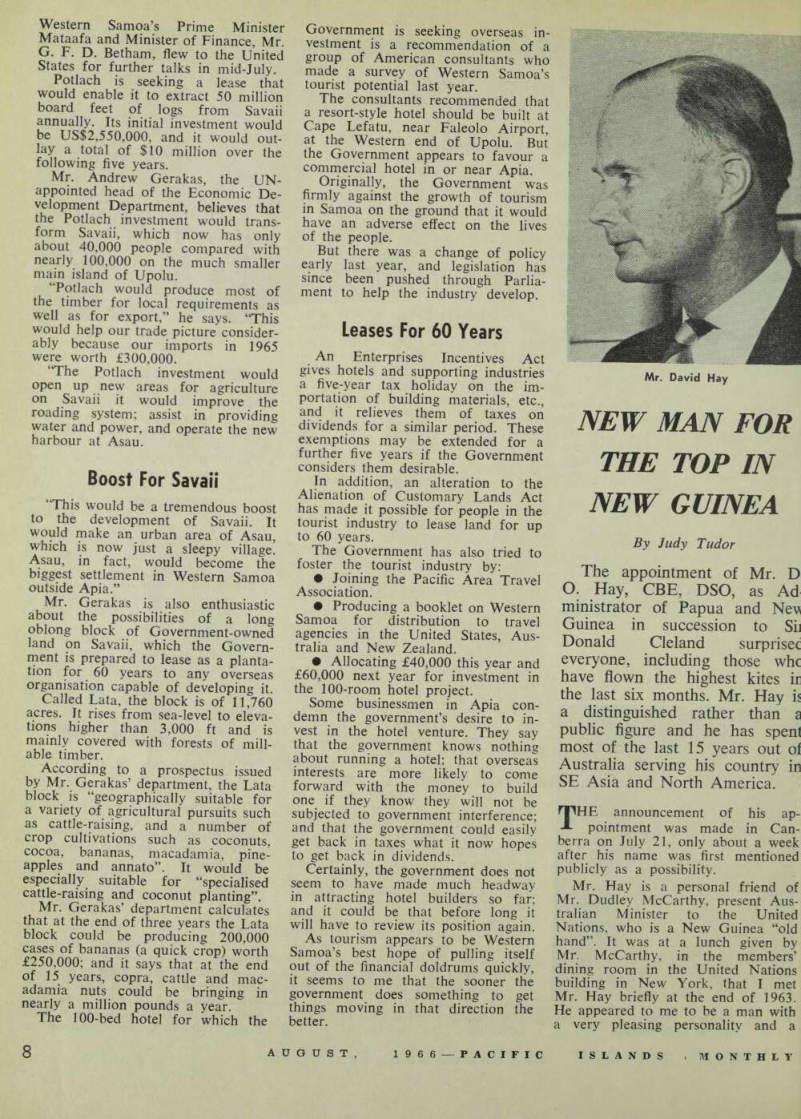
Western Samoa's Minister of Finance, Mr. G. F. D. Betham.
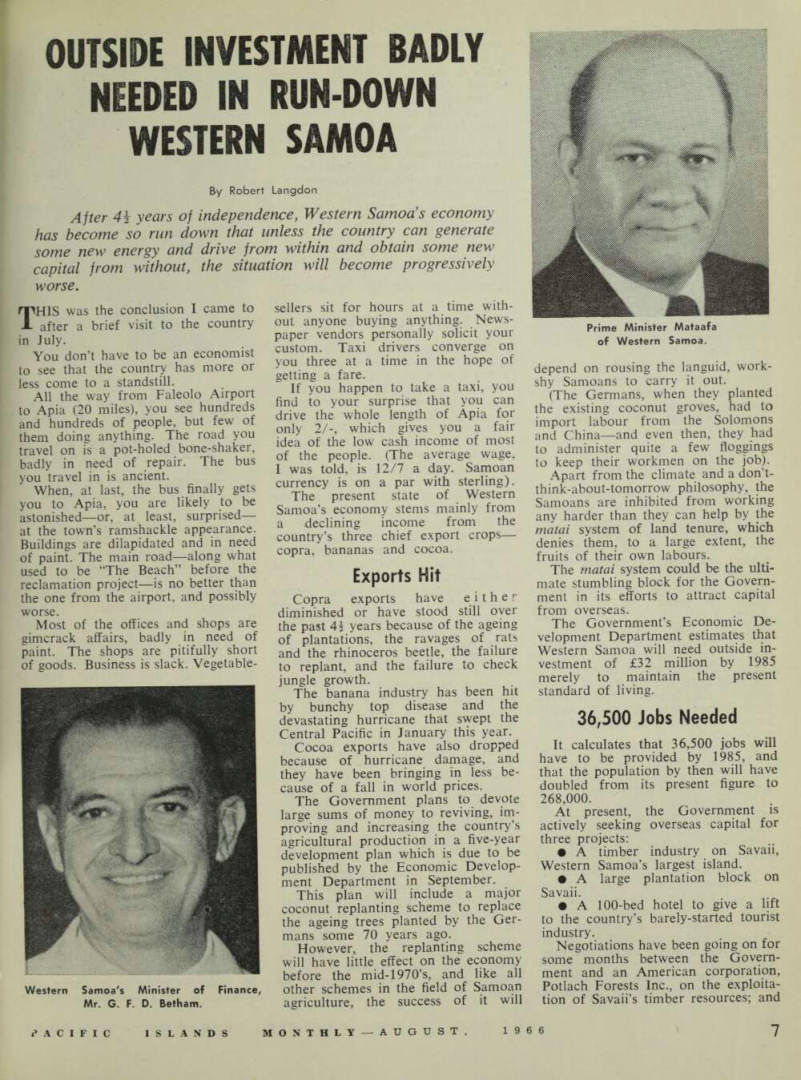
Prime Minister Mataafa of Western Samoa.
Western Samoa’s Prime Minister Mataafa and Minister of Finance, Mr.
G. F. D. Betham, flew to the United States for further talks in mid-July.
Potlach is seeking a lease that would enable it to extract 50 million board feet of logs from Savaii annually. Its initial investment would be U 552,550,000, and it would out lay a total of $lO million over the following five years.
Mr. Andrew Gerakas, the UN appointed head of the Economic De velopment Department, believes that the Potlach investment would trans form Savaii, which now has only about 40,000 people compared with nearly 100,000 on the much smaller main island of Upolu.
“Potlach would produce most of the timber for local requirements as well as for export,” he says. “This would help our trade picture consider ably because our imports in 1965 were worth £300,000. ‘The Potlach investment would open up new areas for agriculture on Savaii it would improve the reading system; assist in providing water and power, and operate the new harbour at Asau.
Boost For Savaii
‘This would be a tremendous boost to the development of Savaii. It would make an urban area of Asau, which is now just a sleepy village.
Asau, in fact, would become the biggest settlement in Western Samoa outside Apia.”
Mr. Gerakas is also enthusiastic about the possibilities of a long oblong block of Government-owned land on Savaii, which the Govern ment is prepared to lease as a planta tion for 60 years to any overseas organisation capable of developing it.
Called Lata, the block is of 11,760 acres. It rises from sea-level to eleva tions higher than 3,000 ft and is mainly covered with forests of mill able timber.
According to a prospectus issued by Mr. Gerakas’ department, the Lata block is “geographically suitable for a variety of agricultural pursuits such as cattle-raising, and a number of crop cultivations such as coconuts, cocoa, bananas, macadamia, pine apples and annato”. It would be especially suitable for “specialised cattle-raising and coconut planting”.
Mr. Gerakas’ department calculates that at the end of three years the Lata block could be producing 200,000 cases of bananas (a quick crop) worth £250,000; and it says that at the end of 15 years, copra, cattle and mac adamia nuts could be bringing in nearly a million pounds a year.
The 100-bed hotel for which the
Government is seeking overseas in vestment is a recommendation of a group of American consultants who made a survey of Western Samoa’s tourist potential last year.
The consultants recommended that a resort-style hotel should be built at Cape Lefatu, near Faleolo Airport, at the Western end of Upolu. But the Government appears to favour a commercial hotel in or near Apia.
Originally, the Government was firmly against the growth of tourism in Samoa on the ground that it would have an adverse effect on the lives of the people.
But there was a change of policy early last year, and legislation has since been pushed through Parlia ment to help the industry develop.
Leases For 60 Years
An Enterprises Incentives Act gives hotels and supporting industries a five-year tax holiday on the im portation of building materials, etc., and it relieves them of taxes on dividends for a similar period. These exemptions may be extended for a further five years if the Government considers them desirable.
In addition, an alteration to the Alienation of Customary Lands Act has made it possible for people in the tourist industry to lease land for up to 60 years.
The Government has also tried to foster the tourist industry by: • Joining the Pacific Area Travel Association. • Producing a booklet on Western Samoa for distribution to travel agencies in the United States, Aus tralia and New Zealand. • Allocating £40,000 this year and £60,000 next year for investment in the 100-room hotel project.
Some businessmen in Apia con demn the government’s desire to in vest in the hotel venture. They say that the government knows nothing about running a hotel; that overseas interests are more likely to come forward with the money to build one if they know they will not be subjected to government interference; and that the government could easily get back in taxes what it now hopes to get back in dividends.
Certainly, the government does not seem to have made much headway in attracting hotel builders so far; and it could be that before long it will have to review its position again.
As tourism appears to be Western Samoa’s best hope of pulling itself out of the financial doldrums quickly, it seems to me that the sooner the government does something to get things moving in that direction the better.