There's A Boom In Resort Building
pp. 119-124 · Read in the full issue


In Travel Conscious Fiji
From PIM Staff Correspondents in Fiji. 1 Pa r 0f i he pnce Fip . will hav . e t 0 P a y for economic stability in the future is a larger and larger dependence on tourism, which already is close to becoming the colony’s second most im portant industry. Generally, Fiji people have no qualms about this or of tourism spoiling the hke *** * entertained in Tahiti and still dominate thinking in places
is still unobtrusive in Fiji. Although it provides jobs for local people, and the money that the tourists bring filters down through all levels of the community, Fijian life, which is part of the charm of the place, appears to go on in much the same way that it always did.
At the moment there is a boom in hotel and resort building in Fiji, and the future looks bright. But there still are problems, spawned by the very rapid growth of the industry, that must shortly be solved.
That Horrible Road
Foremost among these is the abominable state of Fiji’s roads. It is difficult to see how the colony government can go on much longer encouraging tourism as an official policy without doing something about the most-used tourist highway, that from Nadi to Suva.
This 130 miles of road was com pleted in the 1930’s by hand labour and follows the coast, twisting and turning, rising and falling with the butt-ends of the mountain spurs as they come down to the sea.
Apart from the short stretches of tar-seal in front of Fijian villages, done to abate the dust nuisance, the surface is gravel, in three varieties: (a) pot-holes; (b) washing-board corrugations; or (c) loose, six-inch flints or river stones of the same dimensions.
Every wet season low-lying parts of this road are inundated and traffic ceases for periods of hours or several days. But, for the most part the road is a sea of dust that seeps into cars and smothers plantations, foliage, houses and people within 50 feet on either side of the road with a fine powdering of white grit.
After 40,000 miles a medium weight passenger vehicle using this road has all the suspension and trans mission faults a normal car develops after a hoary life of 130,000 miles.
Yet this is Fiji’s busiest highway.
Not only are taxis, private cars, lorries and buses constantly pounding along it but, in the cane crushing
season, June to December, cane trucks are thick upon the Sigatoka- Nadi section of it.
Tlie road doesn’t only require sealing. It also requires rebuilding.
Technically it is quite feasible to build a modern highway from Nadi to Suva, because this isn’t New Guinea with 5,000 or 8,000 ft moun tain passes, misty and rain-soaked.
Lack of funds prevented reconstruc tion in 1961 when it was estimated to cost £F4,000,000. Lack of money is the problem now, when it would probably cost twice as much.
The sum required is well beyond the point where it can come within the colony’s ordinary budgetary ar rangements. It calls for special help from outside the colony and, prob ably, more road and vehicle taxes for the people of Fiji. It could be financed through tourism perhaps.
The financial advisers of the Fiji Government are aware of the Nadi- Suva road problem and have already tried to enlist the aid of Australia —apparently without success.
If this door is closed then other measures will have to be taken— perhaps through special loans or by
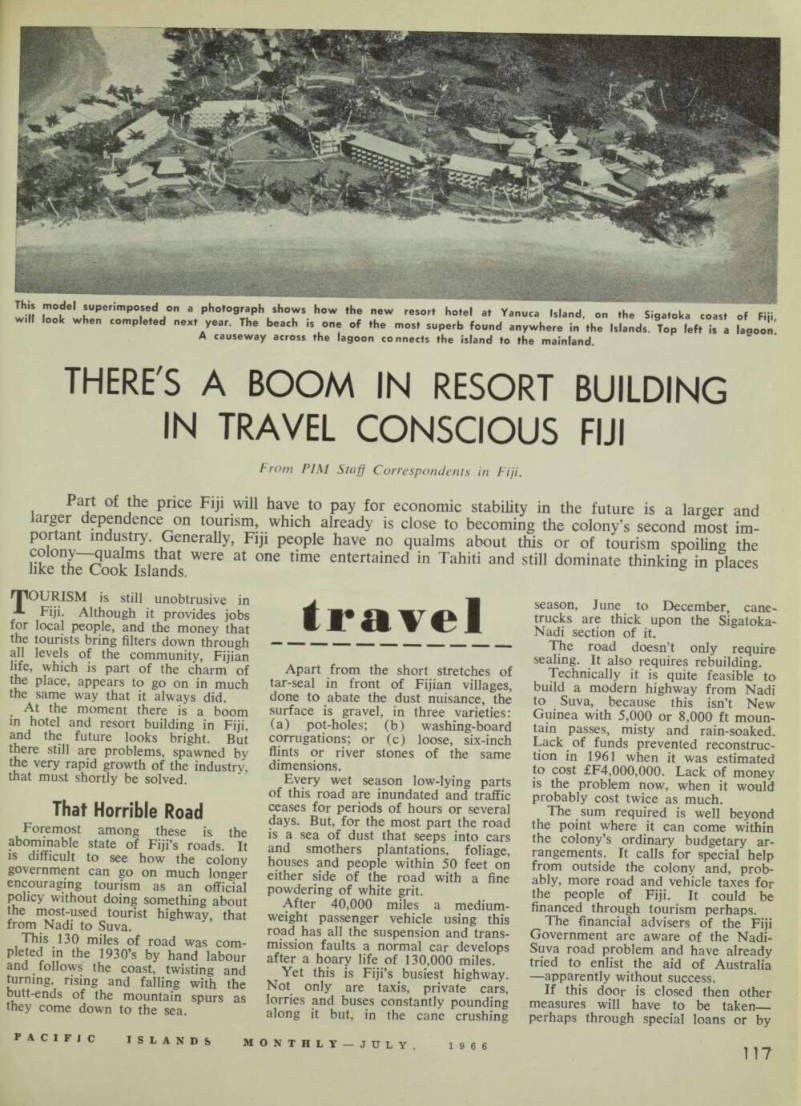
This model superimposed on a photograhp shows the new resort hotel Yanuca Island, on the Sigatoka coast of fiji, will look when completed next year. The beach is one of the most superb found anywhere in the Islands. Top left is a laooon A causeway across the lagoon connects the island to the mainland.
seeking the co-operation of some large overseas concern which would build the road in exchange for the right to collect a toll for the next 20 years.
Whatever the means, the Govern ment has got to find some way to produce better transport facilities to keep faith with the tremendous amount of private money that is now being put into hotel and resort de velopment all along the coast from.
Lautoka to Navua. Every visitor to this coast must travel the present road.
Accommodation Fine
But if Fiji road-building is 20 years behind the times, there is no doubt that on the accommodation side the colony is really swinging.
The new hotels are full; more are abuilding.
In Suva itself the new Outrigger Motel opened in April and provides some much-needed extra first-class accommodation for this overcrowded city. The motel, the first in Suva and the first real motel of the Aus tralian kind in Fiji, is on the Suva harbourside at Nasese, between the Grand Pacific Hotel and Suva Point.
It is owned by a group of local people of whom Mr. B. Derrick, of Derrick and Derrick, architects, is one. The motel is to his design and the 24 large air-conditioned suites are the most attractive in Fiji at present. There is a swimming pool for guests plus a small dining room and snack-bar of the motel type. It has a liquor licence, service is ex cellent and manager is Mrs. Nan Miller.
At the other extremity of the city, out past Lami, Mr. Colin Philp and some associates plan another hotel.
At present the site is being filled in, but when the hotel is developed it will be in very beautiful surroundings, facing the Bay of Islands.
When Fiji’s roads are reconstructed this type of accommodation and that already provided by the Outrigger Motel will be very much in demand
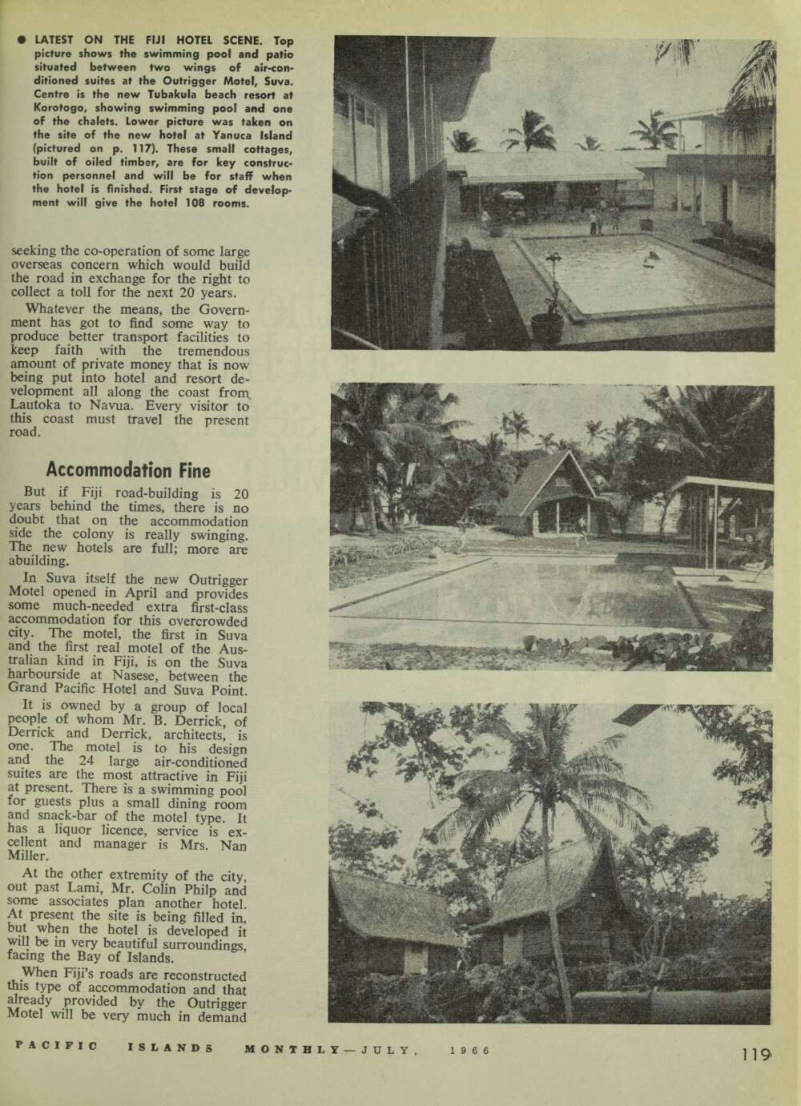
LATEST ON THE FIJI HOTEL SCENE. Top picture shows the swimming pool and patio situated between two wings of air-con ditioned suites at the Outrigger Motel, Suva.
Centre is the new Tubakula beach resort at Korotogo, showing swimming pool and one of the chalets. Lower picture was taken on the site of the new hotel at Yanuca Island (pictured on p. 117). These small cottages, built of oiled timber, are for key construc tion personnel and will be for staff when the hotel is finished. First stage of develop ment will give the hotel 108 rooms.
by tourists who prefer to drive them selves.
Down on the Korotogo coast, five miles east of Sigatoka in the real tourist belt, the Cathay Hotel com pany’s project of Tubakula Resort is now ready.
Korotogo Coast
The resort consists of about 20 individual A-type cottages scattered along the beach-front and around the new swimming pool. A central service-block consisting of shop, snack-bar and liquor bar, was nearing completion in early June.
This place was originally owned by Mr. and Mrs. Ernie Corbett, who sold it to Cathay in 1964. Mr. Corbett remained on to supervise the building of the new resort but they will soon retire to live in New Zealand.
Nearby, between highway and beach, swathed in tropical greenery, is another group of luxury cottages, with a modern swimming pool, where veteran Bill Baxter also caters for first-class tourist traffic.
The system by which overseas visitors can settle themselves into beachside cottages, with all amenities, is growing in popularity, and many here are catering for it.
The new very attractive Reef Lodge Hotel, situated on Korotogo Beach beside the highway, modernly equipped, and with swimpool, has been suffering managerial troubles— the result of long-distance control—it is owned by a New Zealand group.
Under pressure from a big com mercial corporation, the leading shareholders recently gave power of attorney to R. S. Kay and Co., of Suva, and the well known and ex perienced Mrs. Marie Hardwick, from the Mocambo, has been ap pointed manager. It is an excellent tourist-class hotel, and prospects seem good.
Northern Hotels’ famed Korolevu Beach Hotel is back in full business with the new terrace of modern bed rooms to replace the line of bures burned down last year. (Including replacement of the Korolevu bures, Northern Hotels in the past two years have spent nearly £200,000 on new and improved hotels in Fiji. The newest is at Ba.)
Yanuca Developments
The biggest development in hotel building at present is at Yanuca Island, about eight miles on the other side of Sigatoka. A causeway has been built across the tidal channel that separates the island from the mainland and by the end of June workshops and staff accommodation had been built, and work on the actual hotel was expected to begin
immediately.
Several hundred workmen will be employed on the project. The hotel —name not yet released—is owned by the same group of Americans who already own the Mocambo and Sky lodge hotels at Nadi Airport, It will be ready next year. Hotel execu tive Paddy Doyle is directing opera tions.
The hotel will be the centre of a luxury resort which will feature all sorts of marine sports as well as the opportunity to sit on the beach and do nothing. Guests will be ac commodated in three-storey air conditioned blocks that will be linked to the lounge-restaurant-reception block by covered ways; and also in separate bungalows.
Aerial pictures of Yanuca give the impression of a flat sandy cay. In fact, the seaward point of the island is up-thrust limestone which ends in a cliff about 30 feet high.
The reception-lounge section of the establishment will be built on this high ground, with superb views over the beach and lagoon, and the bed room block on the flat beachside land.
Guests will have level access from the bedroom blocks to reception from second floor level. Guests accom modated on the third or ground floors will therefore have only one flight of stairs to negotiate.
Services For All
The Yanuca hotel will be one of the very few outside of Suva that will be assisted with public utility services. It will draw its water from the South Pacific Sugar Mills supply behind Cuvu and its electricity from Sigatoka.
Because of Yanuca some of the other resorts at Korotogo may also benefit. The Sigatoka electricity supply, which is privately owned, is
Qualito Island
The locale of the Castaway Hotel, now being on Qalito Island in the Mananuca Group of Fiji. The island is seen below from a distance. There will be separate bures plus a main hotel block, where the weary executive can get away from it all. See p. 122.
to be taken over by the new Fiji Electricity Commission and expanded with equipment transferred from Lau toka. Rumour has it that by next April or May electricty will be avail able all along the Korotogo coast.
Residents of the area are throwing their hats up in the air at the pros pect, while still retaining a bit of natural scepticism, and resort mana gers are turning hand-springs.
When Mr. and Mrs. Bill Baxter established Sandy Point Cottages six years ago they had to install their own 24-hour electricity supply and pipe water from up in the hills. When Reef Lodge Hotel was built next door, three years ago, it had to put in its own electricty and water sup plies; and Tabakula now has had to do the same thing.
As a result, in the three establish ments, the owners and/or managers, act also as hydraulic and electrical engineers and diesel mechanics.
A reliable public supply of elec tricty will greatly lessen the burden of catering for tourists along this coast and may even encourage the Public Works Department, at some future date, to extend the more than adequate Sigatoka water supply four miles further to Korotogo.
Out on Qalito Island—one of the Mamanuca group of three (Qalito, Malolo and Malolo Lailai) seen out on the horizon, from Nadi—enter prising Dick Smith is building the Castaway Hotel—a highly modern ised establishment where the weary executive can get away from it all.
Three of the well-planned bures and other buildings have been erected along the lovely beach, and the main hotel block is in course of construc tion. Dick Smith, with whom Don Lane now is associated, runs the Stardust cruises out of Lautoka, through the island chain south of the Yasawas. He has just purchased Mr. J. S. K. Borron’s coconut island, Malolo Lailai, near Qalito.
The Yasawas
The famous Blue Lagoon Cruises, from Lautoka through the Yasawa chain, pioneered some years ago by Captain Trevor Withers, now are run by Captain C. I. Miller and his son lan, New Zealanders who bought Captain Withers’ interests last year, They have been running the famous Sayandra in this tourist service, and another, similar vessel, the Romanda , was due to arrive from Auckland in June, to duplicate the service.
Captain Withers spends his time now between Lautoka and Yaloli (Waya Island) where his Fijian friends built for him a luxurious bure.