South Seas
pp. 93-94 · Read in the full issue
The Month's New Reading
Of Gauguin In The
Fifteen years ago, when Swedish writer Bengt Danielsson visited Hivaoa in the Marquesas Islands, he met there a retired French schoolmaster with a large col lection of books about the artist Paul Gauguin, who spent 10 of the last 12 years of his life in the South Seas.
THE books had been carefully read and well-annotated—the notes pointing out “an astonishing number of quite elementary mistakes even of geography and ethnology”.
The schoolmaster’s explanation for the mistakes was that none of Gauguin’s biographers had ever visited the South Seas. Furthermore, as they had based their accounts on Gauguin’s own writings, they had given only a fragmentary and sub jective picture of events and affairs in the islands at the time.
Needless to say, it occurred to Danielsson that there was scope for i book on Gauguin in the South Seas, md this, in a translation from the original Swedish, has now been pub lished in English. It represents the fruits of 13 years of research, off md on.
Attractive Book
The book is most attractive in ippearance, with 66 illustrations, of vhich 16 are colour photographs of )resent-day scenes and people.
To anyone who has never been to he Eastern Pacific, the colour pictures vill convey a vivid idea of the lazzling hues that Gauguin trans ated on to canvas; and to those vho have been there, they will serve is pleasant reminders of what they lave seen.
The black and white illustrations ire mainly photographs of scenes nd people in the South Seas of Jaugum’s day, and reproductions of ns paintings.
The book itself is a most scholarly nd painstaking piece of work, and lust surely be virtually the last word n all aspects of Gauguin’s South eas career. „ Danielsson’s diligent combing of jovernment records, Tahiti news apers of Gauguin’s day, and the Things of various visitors to Tahiti
and the Marquesas in his time have enabled him to enlarge on many facets of Gauguin’s life which previ ous biographers have glossed over.
This research, together with the author’s own physical knowledge of the locale, has also enabled him to correct a date or two here, a mis apprehension there, and to nail for ever numerous furphies perpetrated by other biographers.
But one is inclined to think that Danielsson would have written a more readable book if he had ignored all the mistakes made by other writers, and had simply concentrated
on making his own as correct and interesting as he could.
One is also inclined to wonder whether the enormous amount of time and energy that he put into his research was always justified by the results.
The author reveals, for example, that after Gauguin had been in spired to go to Tahiti by reading Pierre Loti’s sentimental novel, The Marriage of he sought a more reliable book on the subject and was given an official handbook, now identified as Les Colonies Francoises, (1889), which actually contained a
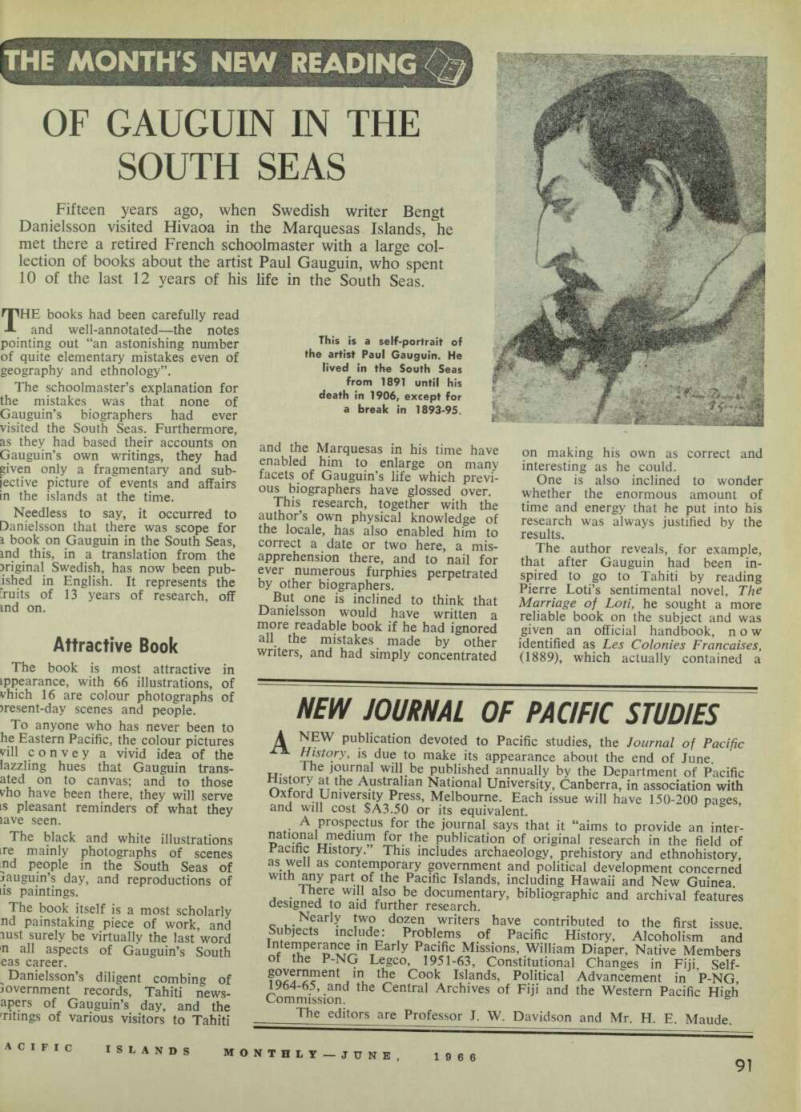
This is a self-portrait of the artist Paul Gauguin. He lived in the South Seas from 1891 until his death in 1906, except for a break in 1893-95.
good deal of material that had probably been lifted from Loti’s book.
So what?
On another occasion Danielsson records, in menu style, what was on the menu at a farewell banquet given for Gauguin on the eve of his de parture for the Islands.
In short, much of what Danielsson has unearthed and placed on record is of no great consequence. And his portrait of Gauguin, himself, leaves you with much the same impression as you had before—namely, that Gauguin was a disagreeable, arrogant, spiteful, anti-social, selfish, foul mouthed and unclean fellow, who stole his friends’ wives, but failed to look after his own: who irresponsibly put Polynesian girls in the family way while bemoaning the European contamination of Polynesia; and who seemed to have the idea that, despite everything, the world owed him a living.
This is not to say that Gauguin did not paint some outstanding pic tures.
But would they create all the fuss that they now do if Somerset Maugham had not directed attention towards Gauguin with his Gauguin based novel. The Moon and Sixpence, of nearly 50 years ago?—RL.
(Gauguin In The South Seas.
George Allen and Unwin, London. $6.60.)