Yesterday
p. 91 · Read in the full issue
Stories about the recently much-publicised phosphate islands of Ocean Island and Nauru were among the more newsworthy items in PIM for June, 1946.
THE Ocean Island story con cerned the transfer of 703 Banabans (Ocean Islanders) and 300 Gilbertese from the Caroline Islands (to which the Japanese had deported them during the war) to Rabi Island, Fiji, which the Western Pacific High Com mission had bought for them in the early 1940’5. That on Nauru stated that the first shiploads of Nauruan phosphate to reach Aus tralia since the war were due in Australian ports in July, 1946.
“With the partial restoration of phosphate workings on the island,” the item said, “about 200,000 tons of Nauru’s phosphate have been earmarked for Australia.”
OTHER items from that issue of PIM of 20 years ago were:— AN all-out drive to locate oil in Papua and New Guinea was to be held as part of a national search for oil by the Australian authorities in Australia and its territories. Geological and geophysical maps were to be pub lished to encourage private com panies to concentrate on promising localities, but the Australian Government was also to undertake drilling operations. rwas announced that New Britain and New Ireland, the only parts of New Guinea still under military rule, were to be transferred to civilian rule under the Provisional Administration before the end of June. The Pro visional Administration took con trol of Papua and the part of New Guinea south of the Markham River on October 30, 1945. Control was extended to the remainder of the New Guinea mainland on March 1, 1946.
British Government was reported to have contracted to purchase all Ceylonese copra for the following five years, at a price equal to £37 (Aust.) per ton, f.0.b., for the first year. The Ceylon price was to provide a temporary basis for New Guinea copra and offered temporary stability in the period when there
was a great deal of argument as to the price allowed to the New Guinea planter by the Australian authorities.
Mr. A. C. Rentoul, A
British District Agent in the New Hebrides for two years during the war, suggested in an article that the Condominium be divided between Britain and France to end the confusing method of joint administration.
“In all the islands north of Vila, to the upper coast of Espiritu Santo,” he wrote, “the French have beaten us hollow in popula tion and holdings. If partition were decided on, this would un doubtably be their territory; and tragic as it would be for the natives, there would seem to be no alternative. On the other hand, the southern district, from Vila to far-away Aneytium, is popu lated by a few Australians—there being only one French subject in the area. This southern district should be taken over by Britain or Australia—but, preferably, by the latter.” * A POLOSI NAWAI, a rebellious Fiji political leader, who had given the British authorities in Fiji many a headache between the wars, died on Yanuca Island.
Fin, on April 17, 1946. Apolosi organised a native co-operative society and led the first and only
movement resembling a rebellion against the British authorities from the time of Cession in 1874. He was twice banished to Rotuma, and at the time of his death, he had spent 20 years of his life in exile.
TEST plantings carried out in the Solomon Islands in 1944-45 proved that good yields of rice could be obtained from the plains of Guadalcanal, using machine methods of planting and sowing the crop in the wet season.
Six varieties were planted and some of these yielded up to 100 bushels per acre.
FIRE had destroyed the large business premises of O. F, Nelson and Co. Ltd., at Matafele, Apia, Western Samoa. The only pump available to police and voluntary helpers did not have sufficient pressure to reach the fire and the building was burnt to the ground within an hour.
THE Australian Department of External Territories and the Army Department were searching for information about 68 people, most of whom lived on New Ireland and New Britain, who were reported missing during the war. There was no evidence that they were on the Montevideo Maru when she was sunk.
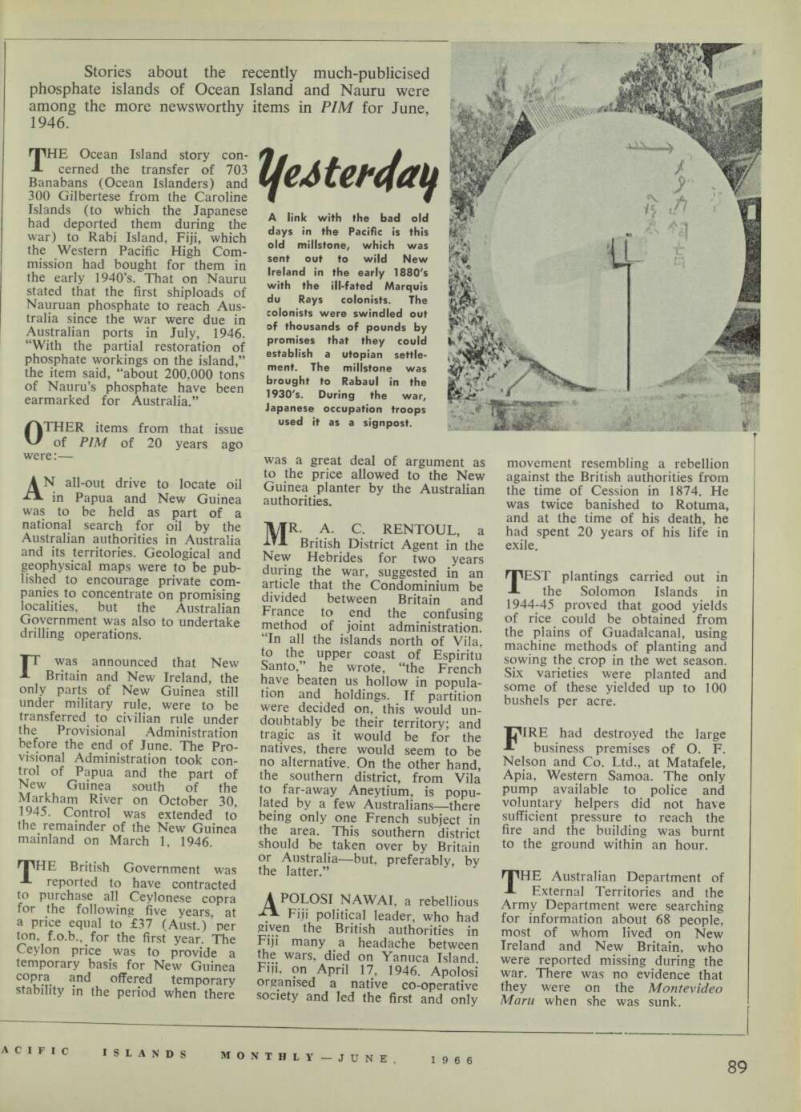
A link with the bad old days in the Pacific is this old millstone, which was sent out to wild New Ireland in the early 1880's with the ill-fated Marquis du Rays colonists. The colonists were swindled out of thousands of pounds by promises that they could establish a utopian settle ment. The millstone was brought to Rabaul in the 1930'5. During the war, Japanese occupation troops used it as a signpost.