Stories Behind
pp. 85-87 · Read in the full issue
Fiji's Place
Names
From Captain Stan Brown in Suva What's in a name? It de pends, of course, on what and where the name is.
T>LACE names on the maps and charts of Fiji have a varied background. The traditional Fijian place names are often relics of old legends, their origin lost in antiquity or myth.
The other names, mostly English, were all given since the voyage of Tasman, and therefore in the time of recorded history. They each have a story associated with them, some times unusual, often fascinating. But always, a story.
Even the name of Fiji is no more ancient than these modern names.
The early Fijians named their islands Viti. That is still the Fijian name.
But their Tongan neighbours, frequent visitors to the islands, could not pronounce this. Feejee or Feechee was the nearest the Poly nesian tongue could get to the correct pronunciation.
Queen Victoria s Whim
The first rush of ships to Fiji, the sandalwooders, all came via Tonga.
Like Cook and Bligh before them, they heard the islands they sought referred to as Feejee, and this spel ling and pronunciation became com mon. Later the spelling was altered on the whim and orders of Queen Victoria.
The Fiji Islands received other names. Captain Bentley, of the Ann and Hope, who touched there in 1799, gave them the name, Land of
Liberty, but the name was never in common use.
During and after the sandalwood days the name “Bligh’s Islands” was used frequently.
It was when the missionaries, seeking monetary assistance for their work, told of the fierce warriors and their customs that the name the “Cannibal Islands” was in popular use.
Of the individual islands and reefs, the first non-Fijian names were those given by Tasman and Cook.
Heemskerk shoals in north-eastern Fiji mark the place where Tasman’s Heemskerk was nearly stranded in 1642. Turtle Island was the name given by Cook to Vatoa, the only Fiji island he visited. This was in 1774.
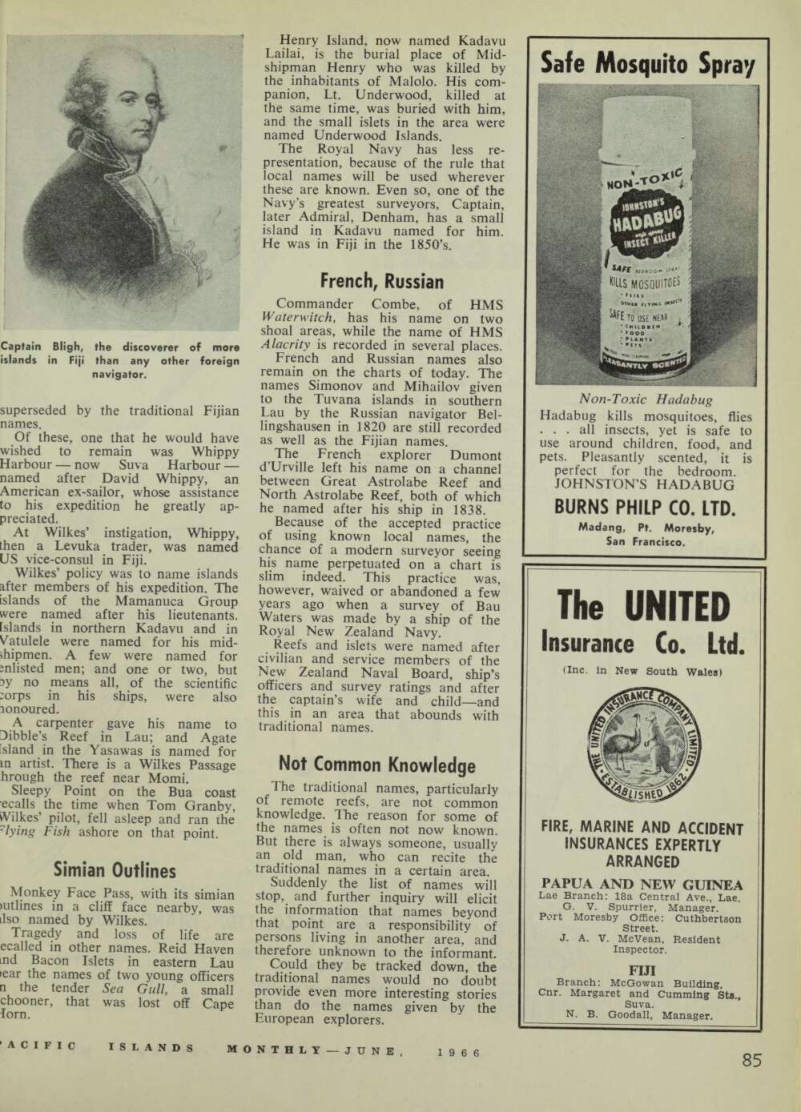
Bligh, who discovered more islands in Fiji than any other foreign navigator, did not name one. His name and fame are remembered on the chart nonetheless.
Bligh Water, through which he sailed in the Bounty’s launch in 1789, was named by the Fiji ment in 1941.
Bounty Boat Passage, through which Bligh first sailed into the Fiji Islands was named in May, 1962,. but has not yet appeared on charts, or maps.
Traditional Names
Commodore Charles Wilkes, of the United States Exploring Expedition to the Pacific of 1838-42, named more places in Fiji than any other surveyor. His surveys produced the first complete chart of the Fiji Islands.
Of the many islands and reefs he named, some still appear on today’s; charts and maps. Others have been
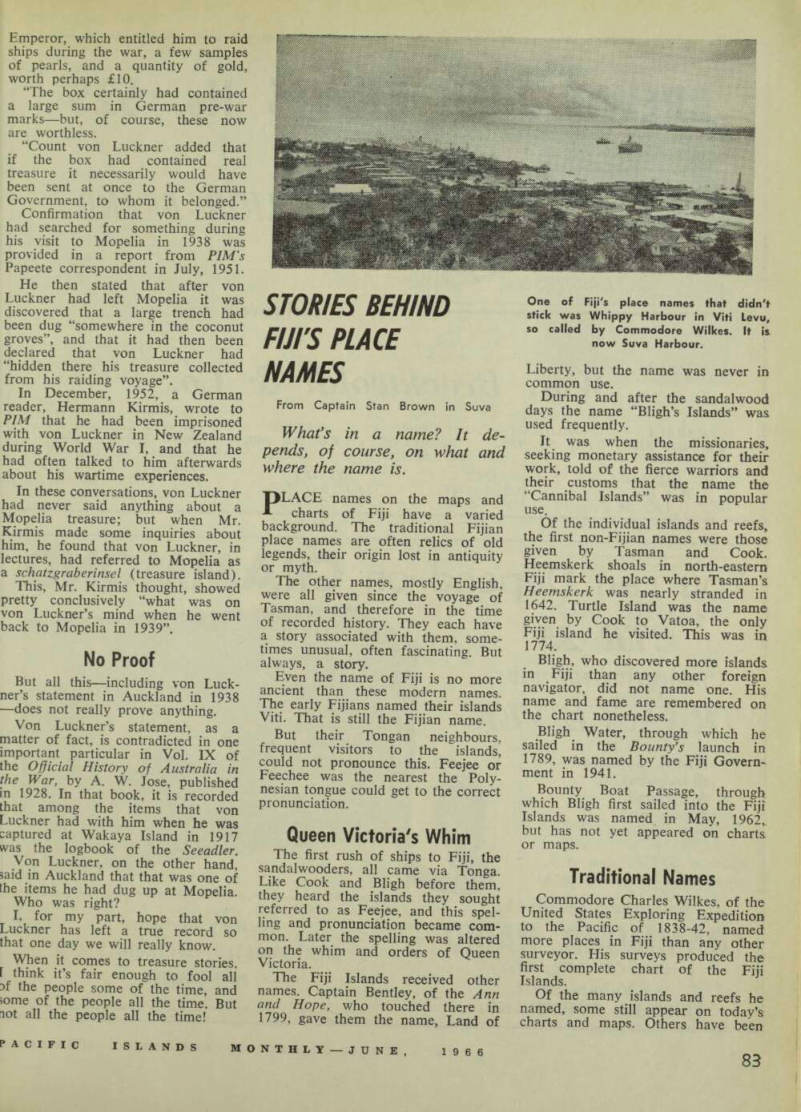
One of Fiji's place names that didn't stick was Whippy Harbour in Viti Levu, so called by Commodore Wilkes. It is now Suva Harbour.
superseded by the traditional Fijian names.
Of these, one that he would have wished to remain was Whippy Harbour now Suva Harbour named after David Whippy, an American ex-sailor, whose assistance to his expedition he greatly ap preciated.
At Wilkes’ instigation, Whippy, then a Levuka trader, was named US vice-consul in Fiji.
Wilkes’ policy was to name islands after members of his expedition. The islands of the Mamanuca Group were named after his lieutenants.
Islands in northern Kadavu and in Vatulele were named for his mid shipmen. A few were named for mlisted men; and one or two, but ay no means all, of the scientific :orps in his ships, were also aonoured.
A carpenter gave his name to Dibble’s Reef in Lau; and Agate island in the Yasawas is named for in artist. There is a Wilkes Passage hrough the reef near Momi.
Sleepy Point on the Bua coast ecalls the time when Tom Granby, Wilkes’ pilot, fell asleep and ran the 7 lying Fish ashore on that point.
Simian Outlines
Monkey Face Pass, with its simian mtlines in a cliff face nearby, was ilso named by Wilkes.
Tragedy and loss of life are ecalled in other names. Reid Haven md Bacon Islets in eastern Lau >ear the names of two young officers n the tender Sea Gull, a small chooner, that was lost off Cape lorn.
Henry Island, now named Kadavu Lailai, is the burial place of Mid shipman Henry who was killed by the inhabitants of Malolo. His com panion, Lt. Underwood, killed at the same time, was buried with him, and the small islets in the area were named Underwood Islands, The Royal Navy has less re presentation, because of the rule that local names will be used wherever these are known. Even so, one of the Navy’s greatest surveyors, Captain, later Admiral, Denham, has a small island in Kadavu named for him.
He was in Fiji in the 1850’s.
French, Russian
Commander Combe, of HMS Waterwitch, has his name on two shoal areas, while the name of HMS Alacrity is recorded in several places.
French and Russian names also remain on the charts of today. The names Simonov and Mihailov given to the Tuvana islands in southern Lau by the Russian navigator Bel lingshausen in 1820 are still recorded as well as the Fijian names.
The French explorer Dumont d’Urville left his name on a channel between Great Astrolabe Reef and North Astrolabe Reef, both of which he named after his ship in 1838.
Because of the accepted practice of using known local names, the chance of a modern surveyor seeing his name perpetuated on a chart is slim indeed. This practice was, however, waived or abandoned a few years ago when a survey of Bau Waters was made by a ship of the Royal New Zealand Navy.
Reefs and islets were named after civilian and service members of the New Zealand Naval Board, ship’s officers and survey ratings and after the captain’s wife and child—and this in an area that abounds with traditional names.
Not Common Knowledge
The traditional names, particularly of remote reefs, are not common knowledge. The reason for some of the names is often not now known.
But there is always someone, usually an old man, who can recite the traditional names in a certain area.
Suddenly the list of names will stop, and further inquiry will elicit the information that names beyond that point are a responsibility of persons living in another area, and therefore unknown to the informant.
Could they be tracked down, the traditional names would no doubt provide even more interesting stories than do the names given by the European explorers.
Captain Bligh, the discoverer of more islands in Fiji than any other foreign navigator.