Has People Guessing
pp. 83-85 · Read in the full issue
Von Luckner’s Mopelia Treasure Still
By Robert Langdon
When Count Felix von Luckner, the famous German sea raider of World War I, died in Sweden on April 14 at the age of 85, the secret of one of the South Pacific’s most intriguing treasure stories may have perished with him.
THE secret—if it was a secret—is; Did von Luckner really bury a treasure on isolated Mopelia Island in French Polynesia in 1917, and, if so, did he dig it up again when he visited that island on a world tour in the late 1930’5?
According to an American writer whom I met in Sydney about 12 months ago, there is at least one person—another American—who not only believes that there was a treasure, but thinks that it is still on Mopelia.
According to my informant, von Luckner told this American about the existence of his treasure in a letter, and he also said that he had a map showing where it was buried tattooed on his knee!
The tattoo business sounds to me like a typical piece of von Luckner hokum, for von Luckner was, one gathers, somewhat addicted to in venting fanciful stories about him self as well as embroidering on the truth.
Like A Romance
On the other hand, von Luckner’s career during World War I was so much like an Alexandre Dumas romance that one cannot lightly dismiss anything he ever said about himself.
Certainly, there is good reason to suppose that he did have a treasure when he landed on Mopelia Island; and, if he did, it would not have been surprising if he had buried it there, considering the circumstances in which he was placed at the time.
At any rate, everything concern ing Mopelia Island and the sea raider’s connection with it was made to order for a buried treasure story, and it would be a pity if there never was one.
Von Luckner’s arrival at Mopelia followed an exciting series of events
which began in Germany in 1916 when he was appointed to command the Glasgow-built clipper ship Pass of Balmaha to raid enemy shipping.
Renamed Seeadler (Sea Eagle), the ship was fitted out as if she were a Norwegian barque with a cargo of lumber for Australia, and her crew were drilled to masquerade as Norwegian seamen.
On Christmas Day, 1916, the Seeadler’s pretence enabled her to fool the British auxiliary cruiser Avenger, which stopped and searched her in the North Sea between Sweden and Iceland.
16 Ships Sunk
A week later, the Seeadler headed south towards the Azores, and before another month was out, von Luckner had already captured and sunk four of the 16 Allied ships which were to fall victims to him.
With the neutral Norwegian flag flying at the masthead, von Luckner’s general practice was to approach his victims broadside on and ask them for a time signal or the latest war gossip.
Then the Norwegian flag would come down; the German flag would be run up; and the Seeadler’s gun crew would suddenly appear on deck ready for action at point blank range.
With no chance to do anything but surrender, the Allied crews were quickly transferred to the Seeadler.
Meanwhile, some of von Luckner’s crew helped themeselves to whatever valuables they could find aboard the captured ships; planted some ex plosives, and sent the ships to the bottom.
Eleven ships—four British, four French, two Canadian and one Italian—were dealt with in this way before the French barque Cambronne
was captured on March 21, 1917, in the mid-Atlantic, east of Rio de Janeiro.
By this time there were so many “guests” aboard the Seeadler that, instead of sinking the Cambronne, von Luckner transferred his prisoners to her to free himself for further action. He then continued his voyage southwards, rounded the Horn, and made his way to the Line Islands in mid-Pacific to lie in wait for more enemy shipping.
Three more ships—all American four-masted schooners—were cap tured and sunk in this area. These victims brought the total tonnage sunk by the Seeadler to 124,000 tons gross.
30,000 Miles Logged
It was now early July, 1917. The Seeadler had been continuously at sea for seven months; she had logged some 30,000 miles; and her crew was desperately in need of fresh food and rest.
There was no friendly port any where in the Pacific to which she could go; but one of the captured Americans suggested to von Luckner that Mopelia Island might meet his requirements.
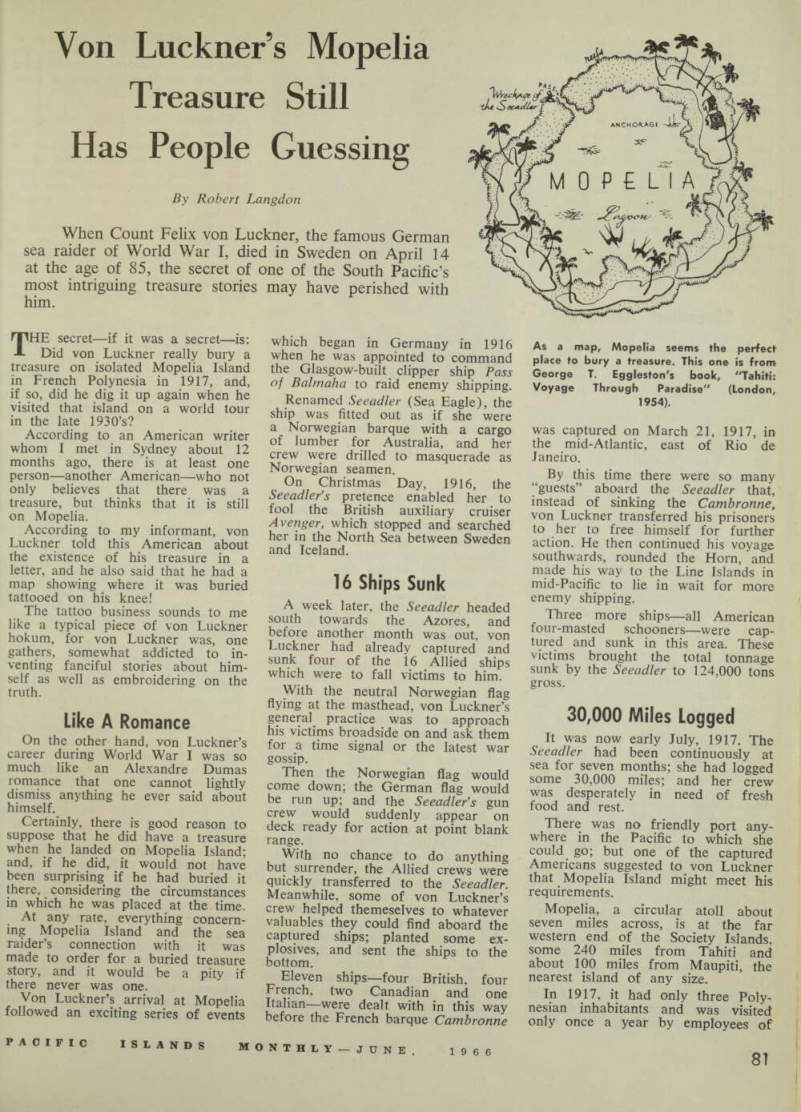
Mopelia, a circular atoll about seven miles across, is at the far western end of the Society Islands, some 240 miles from Tahiti and about 100 miles from Maupiti, the nearest island of any size.
In 1917, it had only three Poly nesian inhabitants and was visited only once a year by employees of
As a map, Mopelia seems the perfect place to bury a treasure. This one is from George T. Eggleston's book, "Tahiti: Voyage Through Paradise" (London, 1954).
a Tahiti company which leased it from the French Administration for copra planting.
Von Luckner accepted the Ame rican’s suggestion and made for Mopelia. However, he found on reaching it that his ship was too big to pass through the entrance to the lagoon. So he had to anchor out side and tether his ship to the reef.
With the ship thus moored, and with a strong current through the lagoon entrance keeping her well off the reef, most of the crew disembarked to see what they could find. Soon everyone was feasting on the numerous coconuts, lobsters, fish, turtles, pigs, birds’ eggs, etc., that the atoll afforded.
"Seeadler" Wrecked
Three days later, just as everyone was preparing to leave the ship for another day ashore, a tidal wave dragged the Seeadler from her anchorage and threw her on to the reef.
The jagged coral pierced her steel hull; the tall masts were snapped off; and it was immediately obvious that the ship was a total wreck.
The Germans and their prisoners removed everything they could from the wreck and established a settle ment under canvas on one of the motus of Mopelia’s reef. Von Luckner facetiously described this later as the last German colony.
Von Luckner remained on the island for three weeks, during which he would have had ample time and opportunity to bury a treasure un beknown to anyone else—if he had had one.
Then he and five others left the island in a well-armed lifeboat in the hope of capturing another ship with which to resume the Seeadler’s raiding career.
At Atiu in the Cook Group, the Germans managed to pass themselves off as shipwrecked Dutch seamen and so obtain water and food. But at Aitutaki, their story that they were Americans of Norwegian origin sailing from Honolulu and back for a bet did not altogether convince the locals, and they were lucky to escape from there after five or six hours ashore.
A few weeks later, von Luckner and his party arrived at Wakaya Island in the Fiji Group, and there they were captured after a part- Fijian seaman, Captain Kini McPherson, became suspicious of them. (A full account of this episode was published in PIM for March, 1964, p. 77).
From Fiji, von Luckner and his companions were transferred to a prison camp on Motu-ihi in Auck-
land Harbour. But after several weeks in captivity, some of them, including von Luckner, escaped in the prison commandant’s boat.
A day or so later, the escapees captured a scow called the Moa, and in this, they eluded their pursuers for eight days and travelled 600 miles. They were finally captured near Macauley Island in the Kerma decs and returned to New Zealand.
There they remained until the end of the war.
Meanwhile, the crewmen of the Seeadler who had stayed on Mopelia, had captured the French schooner Lutece when she arrived at that island on her annnual visit to the copra plantation.
That same day, the Germans sailed for Cape Horn, via Easter Island, leaving their American cap tives and the crew of the Lutece marooned on Mopelia.
At Easter Island, the Germans intended to overhaul their ship and take on supplies. But this plan was frustrated when their schooner struck an uncharted sunken rock while sailing into the harbour and was wrecked.
Two months later, a Chilean ship took the castaways to Chile, where they remained as guests of German colonists until the end of the war.
Thus, if von Luckner did have a hoard of money from the 14 ships he sank, there were two ways in which it could have been removed from Mopelia in 1917—in the life
boat in which he was captured at Wakaya, or in the Lutece. On the other hand, of course, it could have been left on Mopelia until a more propitious opportunity arose to remove it.
Whatever the truth was, von Luckner gave no hint of it in the book he wrote soon after the war on his career as a sea raider, and which was subsequently translated into English and considerably rewritten by the American author Lowell Thomas, In fact, there seems to have been no suggestion that there was such a thing as a treasure on Mopelia until von Luckner and his Swedish wife arrived in the Pacific in 1937 on a world cruise in their yacht Seeteufel.
Secret Purpose
The Pacific Islands Monthly's cor respondent in Papeete at that time, an American, A. C. Rowland, reported in PIM for February, 1938, that, after spending about a month in Tahiti, the Count and Countess had sailed from Papeete on December 4, 1937, with the intention of visiting Moorea, the Leeward Islands of the Society Group and Mopelia.
“A story has been passed about Papeete,” the correspondent said, “that the Count confided to some dinner companions his secret pur pose in going to Mopiha (Mopelia).
“It is said that when the Seeadler was cast upon the reef at Mopiha in 1917, her strong box, full of gold coin, was brought ashore and buried in a secret place known only to the Counnt and some trusted com panions. . .”
Two months later, PIM reported that von Luckner had arrived in Auckland in February, 1938, and that in March a New Zealand news paper had announced that the Count had found his buried box of treasure, that it was enormously valuable, that it had been sent off to Germany, and that he was rich for life.
“Immediately,” PIM went on, “the whole pack of ‘human interest purveyors’ were in full cry, and we in Sydney had von Luckner’s treasure served up to us in all sorts of fancy dress.
“Finally, Count von Luckner be came fed up with the newspaper publicity, and, on March 28, in Auckland, he made a statement to the effect that the story that he had unearthed a huge treasure was ‘all moonshine’.
“He said that he had succeeded in finding his box, which had been buried for 21 years, and that the alleged valuable treasure consisted of the logbook of the Seeadler, and a certificate signed by the German
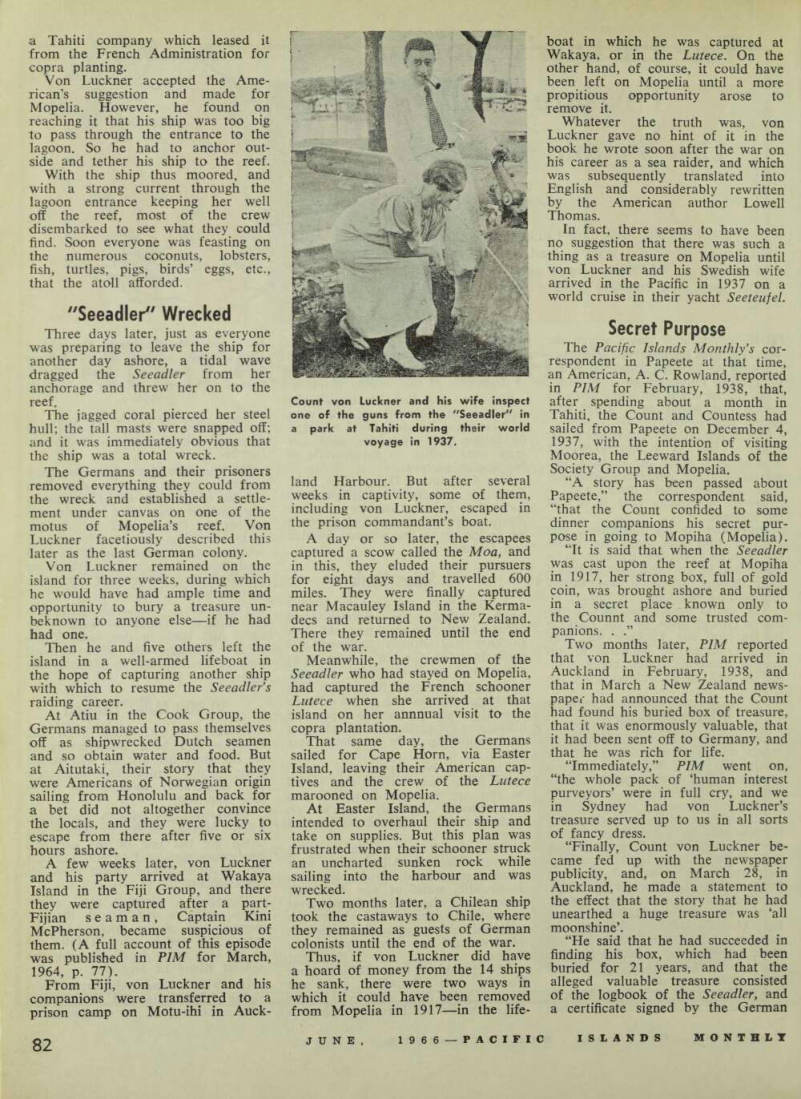
Count von Luckner and his wife inspect one of the guns from the "Seeadler" in a park at Tahiti during their world voyage in 1937.
Emperor, which entitled him to raid ships during the war, a few samples of pearls, and a quantity of gold, worth perhaps £lO.
“The box certainly had contained a large sum in German pre-war marks—but, of course, these now are worthless.
“Count von Luckner added that if the box had contained real treasure it necessarily would have been sent at once to the German Government, to whom it belonged.”
Confirmation that von Luckner had searched for something during his visit to Mopelia in 1938 was provided in a report from PI M's Papeete correspondent in July, 1951.
He then stated that after von Luckner had left Mopelia it was discovered that a large trench had been dug “somewhere in the coconut groves”, and that it had then been declared that von Luckner had “hidden there his treasure collected from his raiding voyage”.
In December, 1952, a German reader, Hermann Kirmis, wrote to PIM that he had been imprisoned with von Luckner in New Zealand during World War I, and that he had often talked to him afterwards about his wartime experiences.
In these conversations, von Luckner had never said anything about a Mopelia treasure; but when Mr.
Kirmis made some inquiries about him, he found that von Luckner, in lectures, had referred to Mopelia as a schatzgraberinsel (treasure island).
This, Mr. Kirmis thought, showed pretty conclusively “what was on von Luckner’s mind when he went back to Mopelia in 1939”.
No Proof
But all this—including von Luck ner’s statement in Auckland in 1938 —does not really prove anything.
Von Luckner’s statement, as a matter of fact, is contradicted in one important particular in Vol. IX of the Official History of Australia in the War, by A. W. Jose, published in 1928. In that book, it is recorded that among the items that von Luckner had with him when he was captured at Wakaya Island in 1917 w as the logbook of the Seeadler.
Von Luckner, on the other hand, said in Auckland that that was one of the items he had dug up at Mopelia.
Who was right?
I, for my part, hope that von Luckner has left a true record so that one day we will really know.
When it comes to treasure stories, [ think it’s fair enough to fool all 3f the people some of the time, and some of the people all the time. But lot all the people all the time!